
Unbiased headlines. Facts, not spin.
Every story is an unbiased news briefing written from 110+ sources across the spectrum — sources linked so you can verify it yourself.
 defense
Notable (6/10)
May 13, 2026 at 09:21 PM
defense
Notable (6/10)
May 13, 2026 at 09:21 PM
Trump Heads to Beijing With $11 Billion in Taiwan Arms Sales on the Table — and Xi Watching Every Move
The Numbers First
On December 17, 2025, Congress received eight separate notifications of potential arms sales to Taiwan totaling more than $11.1 billion. According to the Forum on the Arms Trade, the package includes 82 HIMARS launchers, 420 Army Tactical Missile Systems (ATACMS), 60 M109A7 self-propelled howitzers, loitering munitions including Altius-700M and Altius-600 systems, and tactical network software.
The 2026 National Defense Authorization Act also includes $1 billion in direct military aid to Taiwan and a requirement for joint U.S.-Taiwan drone and counter-drone development, according to The Diplomat.
What Taiwan Actually Is
Mark Montgomery, Senior Fellow at the Foundation for Defense of Democracies, writing in Defense One, lays it out plainly: Taiwan is a 23 million-person democracy with free elections, peaceful transfers of power, an independent judiciary, and a free press.
It also manufactures the chips that run everything. Taiwan Semiconductor Manufacturing Company alone produces roughly 90 percent of the world's most advanced logic chips. Those chips are inside every F-35, every AI system, every data center the U.S. military depends on. Last year Taiwan exported approximately $200 billion in goods to the United States — $150 billion of that was semiconductors.
This isn't just an ally. This is an irreplaceable node in the American economy and military supply chain.
The Summit Problem
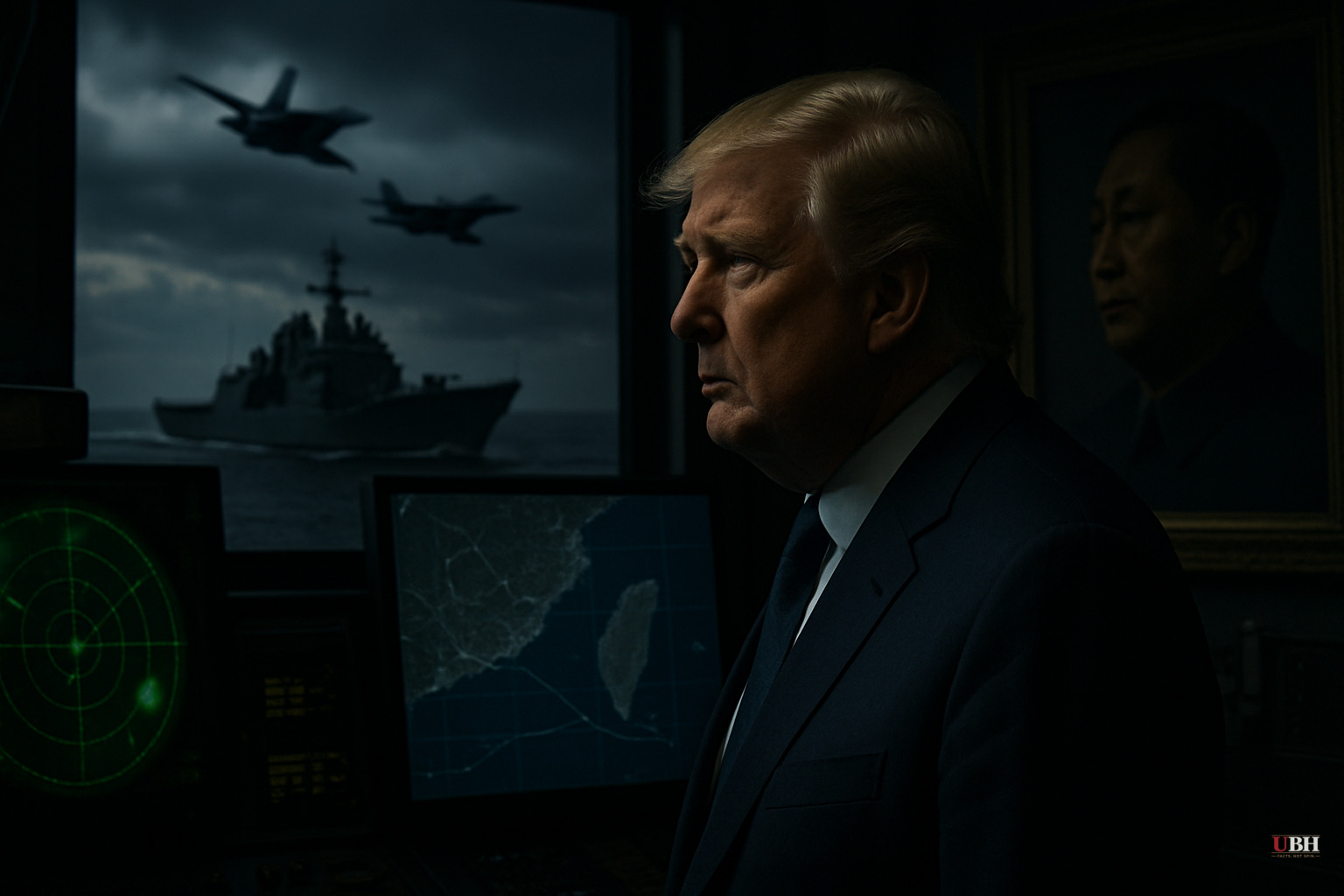
Trump is heading to Beijing this week for a face-to-face with Xi Jinping. Montgomery argues in Defense One that trading Taiwan's security for Xi's promises on trade or critical minerals would be "a strategic blunder of historic proportions."
China controls supply chains for rare earth minerals that the U.S. desperately wants access to. Xi knows this. A deal where Washington goes soft on Taiwan's defense in exchange for mineral access or soy purchases isn't a trade deal — it's tribute.
The Diplomat notes there was reportedly a pause on military aid to Taiwan earlier this year as part of trade negotiations. The administration never confirmed it publicly. That kind of quiet concession is exactly how strategic credibility erodes — not in dramatic announcements, but in small, deniable retreats.
The Arms Sales Debate in Congress
On Capitol Hill, the House Foreign Affairs Committee this week cleared three bills to streamline arms sales to allies including Taiwan, according to Breaking Defense. But one key bill failed — a measure that would have allowed Foreign Military Financing dollars to flow through faster commercial channels instead of the slower State Department-overseen Foreign Military Sales process.
It died in a 23-23 tie, with Republicans Scott Perry of Pennsylvania and Tim Burchett of Tennessee crossing the aisle to kill it. Neither explained their votes during debate, making the outcome a surprise even to the bill's supporters.
Rep. Gregory Meeks, the committee's ranking Democrat, used the failure to raise conflict-of-interest concerns about Trump's sons, who have invested in defense startup Powerus. Whether that concern is legitimate oversight or political posturing, the practical effect is the same: Taiwan gets weapons slower.
What the Anti-Sale Crowd Gets Wrong
FPIF published a piece by Jianlu Bi on December 31, 2025, arguing the $11.1 billion package is a "dangerous escalation" that could push the region "toward the brink of conflict." Bi claims ATACMS with 300-kilometer range are offensive weapons designed to strike the Chinese mainland — not defensive tools.
ATACMS function as deterrence weapons. The logic that Taiwan should only be allowed short-range systems so China remains comfortable invading is a disarmament argument dressed up as a peace argument. Bi's piece also describes the U.S.-Taiwan relationship as treating the island as a "stationary aircraft carrier" to contain China, which ignores the obvious: Taiwan didn't ask to be located 100 miles off the Chinese coast.
The FPIF framing mirrors what Beijing says. Readers should know where that argument leads: a Taiwan that cannot defend itself, relying on goodwill from a regime that crushed Hong Kong.
What Mainstream Coverage Is Missing
Most major outlets are covering this as a trade story — tariffs, rare earths, soybeans. Taiwan gets mentioned as a footnote.
The semiconductor question alone should dominate every business page in America. A Taiwan that falls under PRC control — or is simply intimidated into political submission — means China controls the chips that run the U.S. military. That changes everything about American military capability and economic security.
The Diplomat points out that despite fears of a sellout, the 2025 National Security Strategy still explicitly commits to "deny any attempt to seize Taiwan." That language matters. But strategy documents are words. The $11.1 billion in hardware is real.
What Happens in Beijing
Trump has done something right here: the arms package is serious and the NDAA commitments are real. Taiwan is spending billions on American weapons and investing in its own defense. By the administration's own standard — what it calls a "model ally" — Taiwan qualifies.
The test is what happens in Beijing. If Trump walks out of that summit having traded ambiguity about Taiwan's security for a promise about soybeans or lithium, the implications will be clear.
And the chips — literally — will be on China's side.
Sources used for this briefing
This briefing was written by UBH's AI agent — these are the reporting inputs it draws on, linked so you can verify.


