
Unbiased headlines. Facts, not spin.
Unbiased Headlines is an independently owned news organization. We bring you the facts, not opinions, written fresh from 110+ named sources. Sources linked so you can verify it yourself.
 defense
Major Story (7/10)
Event date: November 3, 2026 ·
Trump Due in Manila for ASEAN Summit as Pax Silica AI Supply-Chain Coalition Draws Philippine Protests
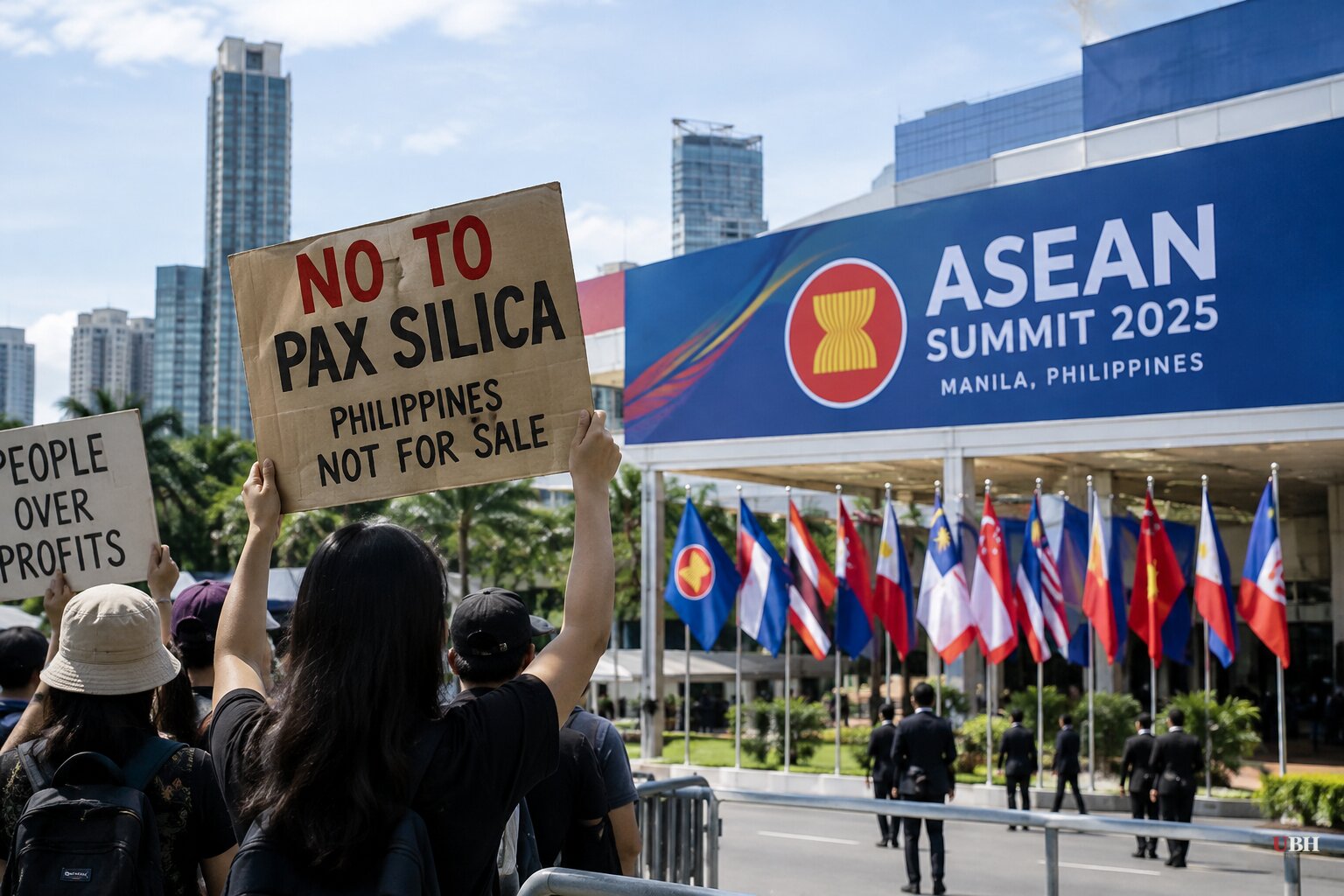
President Trump is scheduled to be in Manila for the Association of Southeast Asian Nations summit, which runs Nov. 16-18. He plans to meet Philippine President Ferdinand Marcos Jr.
The visit lands in the middle of a fight over Pax Silica, a State Department initiative launched in December 2025. The department calls it its "flagship effort on Super Intelligence (SI) and supply chain security."
What Pax Silica is
It is a political and economic security coalition, not a trade agreement. Public Citizen, which opposes it, describes it as a non-binding coalition among chosen U.S. allies, aimed at a China-free tech and AI supply chain. It is built around the physical stack of the AI economy: critical minerals, energy inputs, advanced manufacturing, semiconductors, AI infrastructure and logistics.
The partners named in National Review's account are Argentina, Australia, Chile, Costa Rica, El Salvador, the European Union, Finland, Germany, Greece, India, Israel, Italy, Japan, Kazakhstan, the Netherlands, Norway, Panama, Paraguay, the Philippines, Qatar, South Korea, Singapore, Sweden, the United Arab Emirates and the United Kingdom. Taiwan participates as a "Non-Signatory Participant." Many more countries signed on to the Pax Silica "opportunity statement." The sources do not agree on a single membership tally, so none is offered here.
The State Department says the goal is to protect sensitive technologies and critical infrastructure from "undue access, influence or control," while driving demand for energy, critical minerals, manufacturing and hardware.
Jacob Helberg, the State Department's Under Secretary for Economic Affairs, heads the initiative. Public Citizen says Helberg describes its purpose as "how we compete with China" for AI supply-chain dominance, even though the formal declaration and official statements largely avoid mentioning China.
The China dependence behind it
The dependence is real and measurable. A U.S. Geological Survey report published in June found China was the world's top producer of 39 mineral commodities in 2023, including 98 percent of refined gallium. Gallium is used in specialized semiconductors.
National Review puts China's share of germanium refining at 60 percent. Beijing has imposed export controls on gallium, germanium, graphite and rare earths. The Geological Survey warned that restrictions on minerals where China holds a majority share could cause considerable supply-chain disruption.
The U.S. mines some rare earths but has very little capacity to process them into usable form, according to National Review. A coalition on paper does not fix that.
The same concern drove the Quad meeting in Atlanta on Oct. 31, held on the sidelines of a G20 foreign ministers' meeting. The U.S., Japan, Australia and India committed $10 million in U.S. funding for critical-mineral recycling in India and Southeast Asia. They also announced an effort to spot chip supply-chain weaknesses before disruptions hit, and plan to provide more than $85 million in technical and financial assistance to expand access to trusted AI technologies across the Indo-Pacific.
Their joint statement expressed grave concern over "economic coercion" and arbitrary export restrictions without naming China. Asked about it, Secretary of State Marco Rubio said the behavior is "coming repetitively from one country; that's going to be obvious to everybody." He said the Quad is not an anti-China coalition.
Ten million dollars is small next to the scale of the problem. The sources put no price tag on Pax Silica itself.
The Philippine backlash
The Philippines is both a partner and a flashpoint. National Review says it was the 13th country to join Pax Silica and that in April its government unveiled plans to become a hub for manufacturing facilities key to AI development. It also says the government sees Pax Silica as a way to create jobs, raise wages and develop infrastructure.
Grassroots groups held protests in Philippine cities in July, August and September. Student groups demonstrated this week against U.S. investment in AI data centers.
Members of GABRIELA, a Philippine women's political organization, protested Trump's visit with signs reading "Shut the Pax Down" and "Philippines Not For Sale." The group wrote on Facebook that "under the guise of 'economic security,' the US is converting the Philippines into a militarized industrial enclave — chip plants, artificial intelligence data centers, energy facilities and critical mineral extraction."
GABRIELA also said that "the Aytas and farmers of Central Luzon are driven off their land" and that workers will be pushed into "precarious, low-wage jobs." Those are the group's allegations; the sources cited here do not identify a specific project that has displaced anyone.
The Center for Environmental Concerns – Philippines and other environmental groups are also pushing back, saying the country's lands, forests, water and minerals "must not be placed at the disposal of foreign corporations." Newsweek reports that increased mining and development threatens thousands of acres of ancestral lands and the livelihood of Indigenous Aeta communities.
National Review says Greta Thunberg has joined the opposition. Its columnist argues she is a weathervane for the international left and that progressives treat China as the hero and the U.S. as the villain.
The ideological framing matters less than the practical question GABRIELA raises: who owns the land where the plants and mines go. Washington can sign every memorandum it wants. Siting a chip plant or a mine on contested ancestral land is a local fight.
What to watch in Manila
Pax Silica has partners and a mission statement. What it needs are processing plants, recycling facilities and mines that actually produce.
Don't expect a signing in Manila. Philippine Trade Undersecretary Ceferino Rodolfo told reporters on Tuesday that the deal won't be signed at the summit, because the key players didn't want it to compete with "an already crowded diplomatic agenda." He said he believes it will be signed by the end of the year. U.S. Ambassador Lee Lipton said signing was never on the table for the summit, and that decisions will be made in full consultation with the Philippine government. He added that the U.S. expects "rigorous discussions on impacts to all stakeholders."
Protests are scheduled ahead of Trump's visit, including a Friday demonstration by university students in Manila led by the New Patriotic Alliance (BAYAN). Whether Marcos publicly commits Philippine territory to specific Pax Silica projects, or keeps his answers general, is the open question.
Sources used for this briefing
6 links from 6 independent newsrooms (syndicated copies of the same report count once)
These are the sources it draws on, linked so you can verify.


