
Unbiased headlines. Facts, not spin.
Every story is an unbiased news briefing written from 110+ sources across the spectrum — sources linked so you can verify it yourself.
 energy
Notable (6/10)
June 19, 2026 at 06:55 AM
energy
Notable (6/10)
June 19, 2026 at 06:55 AM
Trump DOJ Drops Wind Energy Appeal, Leaving Federal Permitting Freeze Permanently Vacated.
What Happened
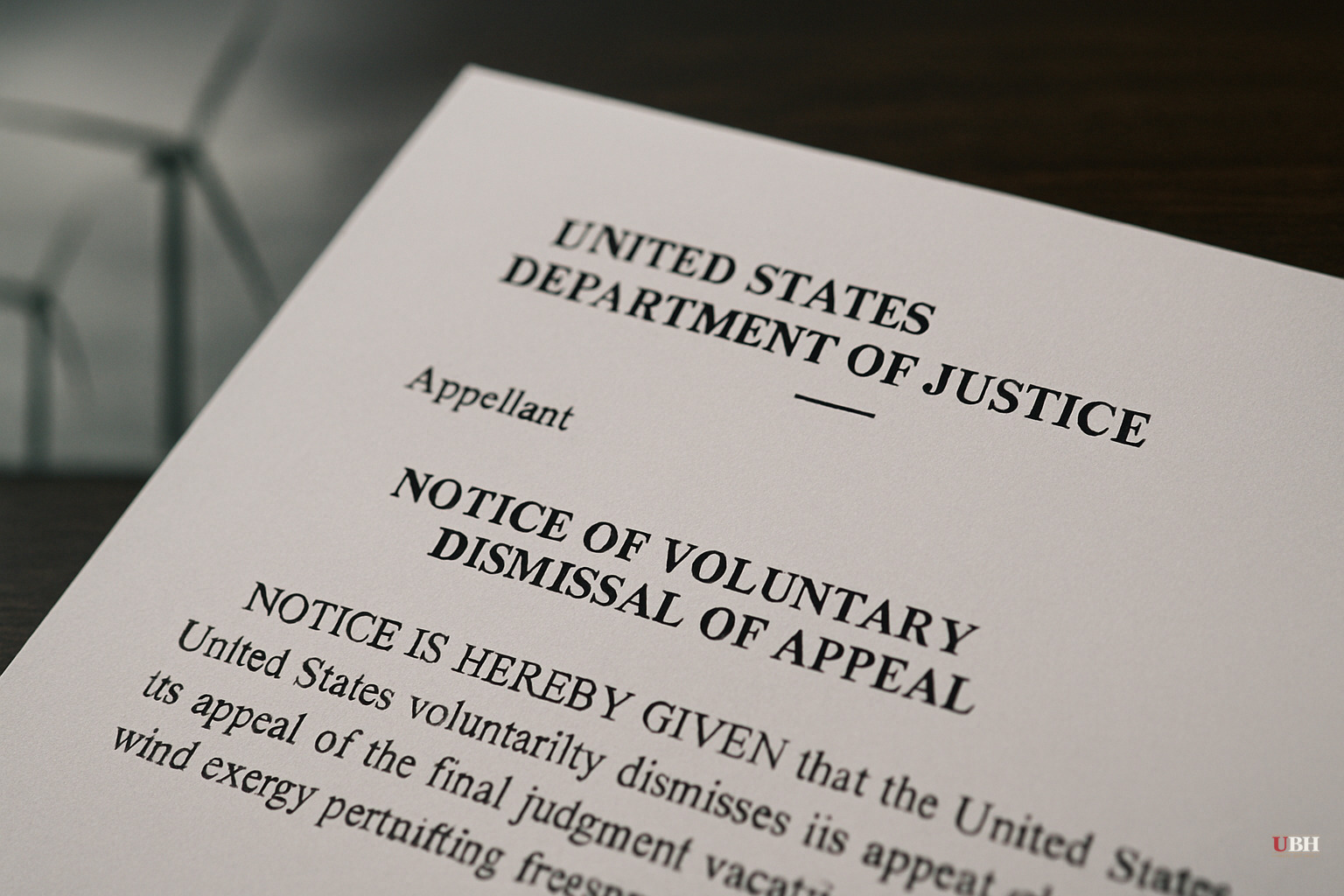
On June 10, the Justice Department filed a motion for voluntary dismissal of its appeal before the U.S. Court of Appeals for the First Circuit, according to Inside Climate News. The First Circuit granted that motion, and on or around June 16, the court entered a judgment dismissing the case, according to Offshore Wind Business.
That dismissal leaves intact the December 8, 2025 ruling by U.S. District Court Judge Patti Saris of the District of Massachusetts. Judge Saris had found that the wind permitting freeze — ordered by President Trump on January 20, 2025 — was "arbitrary and capricious" and exceeded presidential authority. She vacated the relevant section of Trump's Presidential Wind Memorandum in its entirety.
With no surviving appeal, the freeze is now unenforceable. Federal agencies, which had halted all wind permitting and approval activities following Trump's memorandum, are no longer operating under that directive.
The Timeline
Trump issued the Presidential Wind Memorandum on his first day back in office, directing agencies to pause approvals for both onshore and offshore wind projects pending a policy review. Agencies complied immediately.
A coalition of 17 states and Washington, D.C., led by New York Attorney General Letitia James, filed suit in May 2025, according to Inside Climate News. Michigan Attorney General Dana Nessel put the coalition at 18 attorneys general in her June 17 press release, reflecting the final count of the coalition.
Judge Saris sided with the states in December 2025, ruling the agencies had violated the Administrative Procedure Act by providing no reasoned basis for the indefinite freeze. The federal government appealed that ruling at the start of 2026, then dropped it six months later.
The Administration's Position
The DOJ has NOT publicly explained why it withdrew the appeal. No White House or DOJ statement was included in any of the four sources describing the reasoning behind the voluntary dismissal. The administration may have concluded the legal terrain was unfavorable, or it may be pursuing the same policy goals through other mechanisms — separate executive actions, agency rulemaking, or permitting delays that operate outside the frozen memorandum. None of that is established by these sources; it remains a plausible open question.
The States' Argument, and the Strongest Case for the Administration
The coalition argued the freeze unlawfully disrupted billions of dollars in state investments in wind infrastructure, supply chains, and workforce development. Michigan's Nessel said the freeze "would have derailed billions of dollars in infrastructure and workplace investments," per the Michigan Attorney General's office. California AG Rob Bonta declared the administration had "waved the white flag," according to Offshore Wind Business.
The strongest good-faith case for the administration's original position is this: a president has broad authority to direct federal agencies to review their own leasing and permitting practices before issuing new approvals. Supporters of the memorandum argued Trump was not eliminating wind power permanently — he was ordering a policy review, which is a routine executive function. The legal question of how long such a review-based pause can last without formal rulemaking is genuinely contested administrative law, and courts have split on similar issues in other regulatory contexts. Judge Saris ruled the indefinite duration and lack of reasoned explanation crossed the line under the APA. The administration chose not to test that conclusion at the appellate level.
What the Ruling Does and Doesn't Do
The ruling vacated the specific section of the January 2025 memorandum that imposed the freeze. It does NOT prohibit the administration from initiating new rulemaking to change federal wind leasing policy through legitimate APA-compliant procedures. It does NOT require agencies to approve any specific project. It restores the pre-freeze regulatory baseline — the same rules and processes that existed before January 20, 2025.
OilPrice.com framed this as a "major blow to Trump's War on Wind Power," which captures the political significance but glosses over that limitation. The ruling addresses one specific unlawful mechanism, not the administration's overall energy policy authority.
The Broader Energy Context
Inside Climate News reported that clean energy production has continued to grow despite the policy turbulence — though the outlet did not provide specific output figures in the portion of the article available. Nancy Pyne, a senior advisor to the Sierra Club, told Inside Climate News that "renewable energy continues to prevail and grow in spite of Trump's relentless attacks."
That framing from a Sierra Club advisor is advocacy, not a neutral data point. Wind capacity in the U.S. grid has grown broadly, but attributing it specifically to resilience against Trump's policies — versus long-term investment cycles that predate his administration — is a claim that requires more than a quote from an interested party.
What Comes Next
The concrete unresolved question is whether the administration will attempt a new approach to restrict wind permitting, this time through formal rulemaking that could survive APA scrutiny. Nothing in the dismissal prevents that path. The 18-state coalition, now describing this as a final victory, would almost certainly litigate any such attempt as well. Whether the administration has the appetite for another multi-year legal fight — after voluntarily walking away from this one — is not answered by any of these sources.
Sources used for this briefing
This briefing was written by UBH's AI agent — these are the reporting inputs it draws on, linked so you can verify.


