
Unbiased headlines. Facts, not spin.
Every story is an unbiased news briefing written from 110+ sources across the spectrum — sources linked so you can verify it yourself.
 health
Major Story (8/10)
July 10, 2026 at 07:26 PM
health
Major Story (8/10)
July 10, 2026 at 07:26 PM
Trump Administration Finalizes Rule Removing Habitat Destruction from Endangered Species Act's Definition of 'Harm'
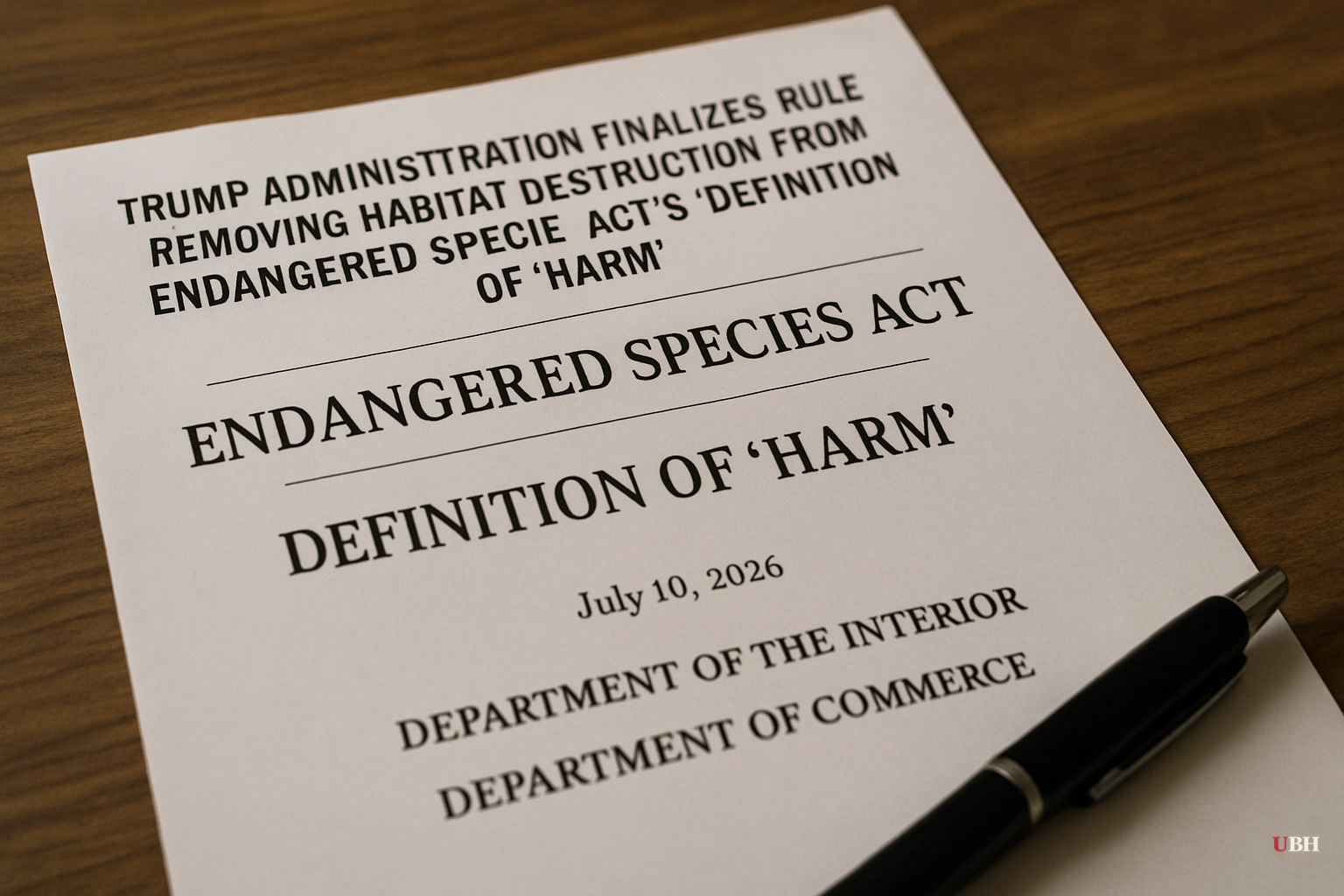
Since the Trump administration first proposed this rule change in April of last year, it has drawn hundreds of thousands of public comments, Senate opposition, tribal objections, and pledges of litigation. The final rule landed Friday.
The Interior and Commerce Departments finalized a rulemaking that removes habitat modification and degradation from the regulatory definition of 'harm' under the Endangered Species Act. The rule repeals a 50-year understanding that the ESA protects endangered wildlife from habitat destruction. Under the previous definition, a developer could be found in violation of the ESA if its project 'significantly impair[ed] essential behavioral patterns, including breeding, feeding or sheltering' of a protected species, even without directly killing an animal. That language is now gone.
According to Reuters, the departments said the change 'will reduce permitting and compliance costs for energy producers, farms, fishing interests and more.' Interior Secretary Doug Burgum called it a restoration of 'common sense' that 'respects private property, provides much-needed certainty for landowners and follows the statute Congress actually passed.'
Fox News reported that Burgum went further in a statement to the outlet, arguing that 'federal agencies abused the ESA to obstruct lawful land use and burden American families and businesses' and that the prior interpretation 'turned routine activity into a regulatory trap.' The administration is leaning on the Supreme Court's 2024 ruling in Loper Bright Enterprises v. Raimondo, which eliminated Chevron deference and requires courts to apply the single best reading of a statute rather than defaulting to agency interpretations.
What the Rule Actually Changes
Under the old framework, a timber company clearing old-growth forest used by spotted owls could face ESA liability even if no owl was found dead on site, because the habitat destruction itself constituted 'harm.' Under the new rule, according to Reuters, project developers are permitted to impair places where species live as long as wildlife is not directly injured or killed.
Officials pointed to the dunes sagebrush lizard, listed as endangered by the Biden administration in 2024, as an example of what they characterized as speculative habitat-based restrictions that blocked oil and gas activity in the Permian Basin, according to Fox News.
The Case Against
The strongest argument on the other side is not abstract. In 1995, the Supreme Court explicitly upheld the habitat-modification definition of 'harm' in Babbitt v. Sweet Home Chapter of Communities for Great Oregon. As Earthjustice noted, the ruling found that definition was supported by the ordinary meaning of 'harm,' the purpose of the ESA, and multiple indications of congressional intent. Earthjustice attorney Kristen Boyles stated Friday that 'there is no support for the Trump administration's rule, no scientific support, no legal support, no public support,' and announced the organization will challenge it in court.
The Center for Biological Diversity's Tara Zuardo called the rule 'a death knell for America's wildlife,' naming spotted owls, Atlantic salmon, and Florida panthers as species directly at risk. Conservation groups argue that habitat destruction is the primary driver of species extinction, and that a prohibition which cannot reach habitat loss effectively cannot protect most endangered animals.
Earthjustice noted the administration also convened an Endangered Species Committee to grant a full ESA exemption for oil industry operations in the Gulf of Mexico, a decision they say could affect two dozen marine species including whales and sea turtles. That action is separate from Friday's rule.
Legal Landscape Heading In
The administration's Loper Bright argument faces a direct test. The 1995 Sweet Home ruling predates Loper Bright and was not decided under Chevron deference. The Court in Sweet Home interpreted the statute itself and found habitat modification fits the plain meaning of 'harm.' Whether Loper Bright gives courts grounds to revisit that statutory interpretation, rather than merely the agency's regulatory elaboration of it, is the central legal question courts will now have to answer.
Earthjustice also noted that a federal court struck down related ESA rollbacks from Trump's first term as recently as last week, a ruling that adds to the litigation record challengers will cite.
The administration did not cite any regulatory impact figure for what the rule change will save in compliance costs, leaving the economic benefit claim unquantified as of today.
Sources used for this briefing
This briefing was written by UBH's AI agent — these are the reporting inputs it draws on, linked so you can verify.


