
Unbiased headlines. Facts, not spin.
Every story is an unbiased news briefing written from 110+ sources across the spectrum — sources linked so you can verify it yourself.
 health
Major Story (7/10)
September 19, 2026 at 09:22 AM
health
Major Story (7/10)
September 19, 2026 at 09:22 AM
Stanford Study Finds the Human Brain Develops From Two Separate Cell Lineages, Not One
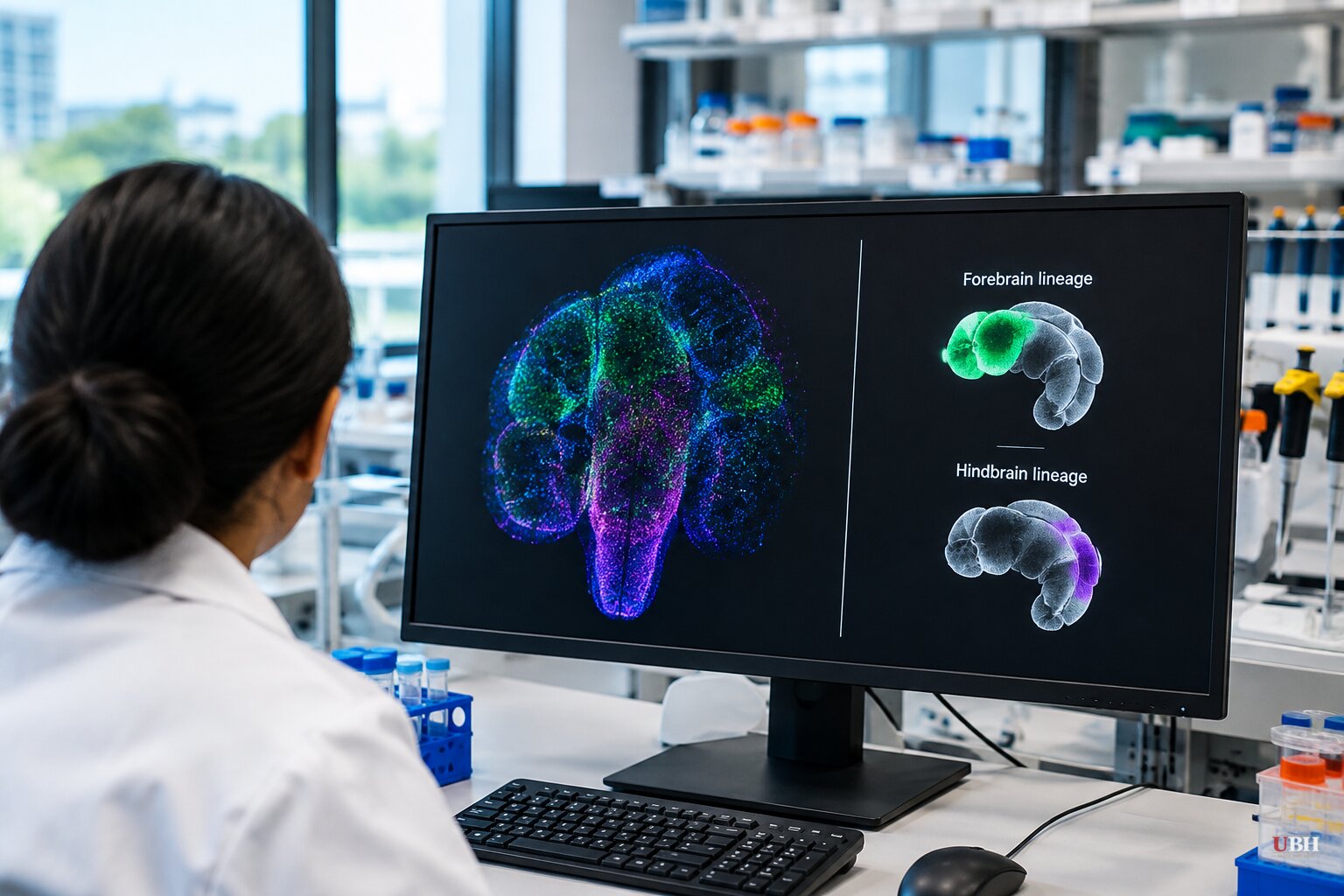
For 70 years, developmental biology textbooks taught that the entire brain grows from one starter pool of cells. That model, proposed by embryologist P.D. Nieuwkoop in 1952, is now being challenged by a study out of Stanford Medicine, published in Nature Neuroscience on September 18, 2026.
The senior author, Kyle Loh, PhD, an associate professor of developmental biology at Stanford, says the front and back of the brain don't come from a shared ancestor cell at all. They come from two entirely separate progenitor populations that lock into their fate almost immediately and never cross paths.
What the researchers actually found
Working with mouse embryos at 7.5 days old, during a developmental window called gastrulation, graduate students Rayyan Jokhai and Carolyn Dundes identified two non-overlapping groups of early neural cells.
One group switched on a gene called Otx2 and was destined to become the forebrain and midbrain, the regions responsible for language, abstract reasoning and consciousness. The other group switched on a different gene, Gbx2, and was destined to become the hindbrain, the brainstem region that runs breathing, heartbeat, sleep cycles and the muscles used for swallowing and speech.
Using a lineage-tracing technique that permanently tags cells with a glowing marker, the team followed the Gbx2 cells all the way to birth. According to Stanford Medicine's own writeup, those glowing descendants showed up almost exclusively in the hindbrain and were nearly absent from the forebrain and midbrain. A second experiment, randomly tagging cells in 16 mouse embryos across 494 cell clusters, backed up the same split, according to StudyFinds' reporting on the paper.
Epigenomic analysis found the two cell groups pack their DNA differently from the start, according to Neuroscience News, which is what locks each lineage onto its own track before the brain even takes shape.
Why it matters for ALS and SMA
The payoff isn't just theoretical. Scientists have had a decades-long problem: forebrain cells grow easily in a lab dish, but hindbrain cells almost never do.
Jokhai told Stanford Medicine that earlier attempts likely failed because researchers were trying to coax forebrain and midbrain progenitors into becoming hindbrain cells, something this study shows is biologically impossible given the separate lineages.
Armed with the new map, the Stanford team coaxed human pluripotent stem cells into functional hindbrain motor neurons for the first time, according to Stanford Medicine and Neuroscience News. Those lab-grown cells fired real electrical action potentials and produced proteins matching the hindbrain segments that control facial and swallowing muscles.
That matters because spinal muscular atrophy is a leading genetic cause of death in children under one year old, and ALS, typically diagnosed between ages 40 and 70, kills hindbrain neurons that control swallowing and breathing. Being able to grow and study these specific cells in a dish gives researchers a tool they didn't have before.
An evolutionary trail going back 550 million years
The team traced the same two-lineage pattern in chickens, zebrafish and acorn worms, marine creatures that share a distant common ancestor with humans, according to the Independent and Neuroscience News. Jellyfish, which diverged from the human lineage roughly 600 to 700 million years ago, already have two physically separate nervous systems, suggesting the human brain's split origin is a holdover from a design that predates a single fused brain entirely.
Loh put it plainly to the Independent: "Having the brain as one organ would probably be more efficient, but we rely on this primordial way to make the brain as two separate pieces."
Where the "two organs" framing gets ahead of the paper
Several outlets, including the Independent and Times of India, ran with headlines flatly declaring the brain is "two separate organs." That's a fair shorthand for two independently evolved lineages that fuse together during development, but the researchers themselves use more careful language. StudyFinds reports the paper's authors describe the brain as a "composite organ," not two fully separate organs bolted together. The two systems have different origins but integrate seamlessly into one functioning brain, a distinction the more sensational headlines gloss over.
Separately, a different Stanford team led by Sergiu Pașca, professor of psychiatry and behavioral sciences, published unrelated work in Nature on installing lab-grown human brain cells into genetically engineered mice missing most of their cerebral cortex, a technique aimed at studying neurodegenerative disease, according to NPR. That project raises its own ethical questions about human-neuron chimeras in animals, flagged by Hongkui Zeng of the Allen Institute, but it is a separate line of research from Loh's lineage study and should not be conflated with it.
The next test for Loh's team is whether the same forebrain-hindbrain split holds up in living human embryonic tissue, not just mice, chickens, fish and worms. No source indicates that work has been published yet.
Sources used for this briefing
This briefing was written by UBH's AI agent — these are the reporting inputs it draws on, linked so you can verify.


