
Unbiased headlines. Facts, not spin.
Every story is an unbiased news briefing written from 110+ sources across the spectrum — sources linked so you can verify it yourself.
 energy
Low Interest (4/10)
August 12, 2026 at 06:22 PM
energy
Low Interest (4/10)
August 12, 2026 at 06:22 PM
Total Solar Eclipse Crosses Europe: 6 Million Tourists, $1,000 Hotel Rooms and a Colander Shortage
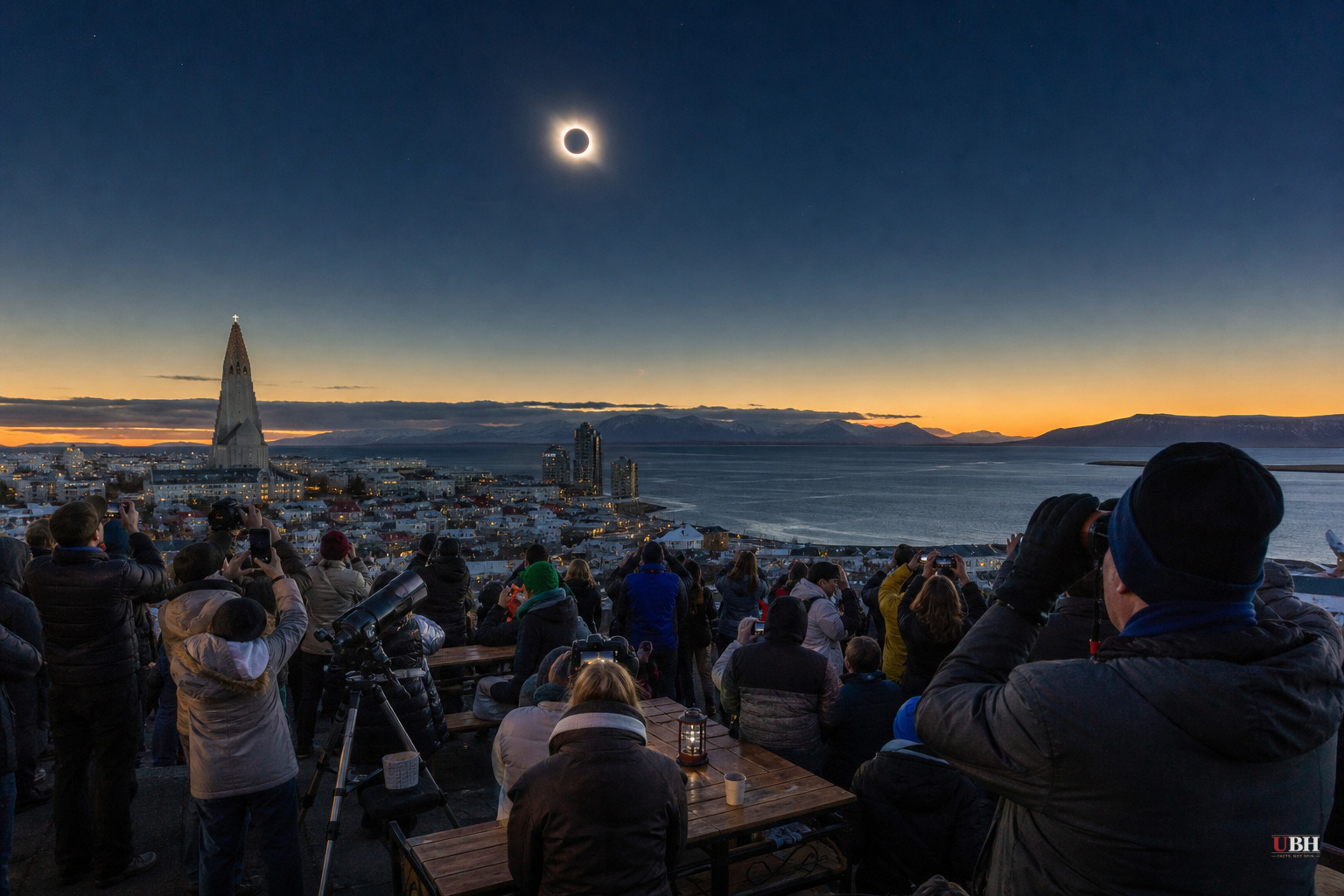
Since totality first swept ashore in Iceland at 5:48 p.m. local time on Wednesday, the eclipse has moved east across northern Spain and Portugal before ending at sunset, giving Europe its first total solar eclipse in 27 years.
Spain's secretary of state for science, Juan Cruz, told Reuters the country expected up to 6 million tourists to watch the event. Spain's interior ministry deployed an additional 25,000 police officers and more than 100 aircraft for security, according to Forbes.
The path of totality ran through cities including La Coruña, Bilbao, Oviedo and Santander, according to Euronews, with totality windows as brief as 27 seconds in Bilbao and as long as nearly two minutes in Oviedo. Totality across the Spanish mainland clustered around 8:27 to 8:30 p.m. local time, per Euronews, with the shadow reaching the Balearic Islands afterward.
Reykjavik saw totality begin at 5:48 p.m. local time and last about one minute, according to Forbes, with the partial phase wrapping up around 6:47 p.m. Cities outside the path of totality still got a serious show. Forbes reported Paris saw 92% coverage, London 91% and Berlin 85%.
Hotel prices spiked, then crashed back down
Hospitality operators in the path of totality treated the eclipse like a once-in-a-lifetime demand event, and CNBC's numbers back that up. Using data from Lighthouse Intelligence gathered in mid-July, CNBC reported Reykjavik hotel rooms averaged $1,012 a night during eclipse week, double the same week in 2025. Short-term rentals in the Icelandic capital averaged $1,172 a night, up 178% year over year.
Bilbao short-term rentals hit $1,088 a night, a 206% jump from last year, while hotel rooms there ran $315 a night, up 35%.
But Lighthouse's Jonathan Gough told CNBC that Icelandic hoteliers had priced "speculatively," listing rooms at three to four times normal rates more than a year out, then spent the following months walking prices back down. By Aug. 10, the lowest available Reykjavik hotel rates had fallen 46% from mid-May levels, to $805 a night, according to CNBC's follow-up check. Spanish hotels took the opposite approach, pricing normally through spring and raising rates only as bookings filled in.
Data firm AirDNA found nearly 64% of Iceland's roughly 9,000 short-term rental listings sat within the path of totality, along with about 21% of Spain's 365,400 listings, meaning a huge share of each country's rental inventory got swept into eclipse pricing.
Britain's best sky show since 1999, minus the glasses
The UK didn't get totality, but it got close. The Independent reported more than 90% of the sun was obscured across Britain between 6:17 p.m. and 8:06 p.m. Wednesday, the deepest coverage since the total eclipse of 1999 and the best Britain will see for the next 54 years, per the Royal Greenwich Observatory.
Devon, Cornwall and westernmost Pembrokeshire saw the highest coverage, 94% to 96%, with Plymouth forecast at 94.66% around 7:16 p.m., according to the Met Office as cited by The Independent. Cardiff was projected at 93.24% and Belfast at 93.09%.
Demand for eclipse glasses ran ahead of supply. The Royal Greenwich Observatory sold out its stock of roughly 15,000 pairs in the month leading up to the event, The Independent reported, and convenience stores and national parks ran dry too. Retailer John Lewis said colander sales rose nearly 40% year over year, since NASA recommends the kitchen item as a pinhole-projector substitute for safely viewing the eclipse's shadow rather than looking directly at the sun.
The Royal College of Ophthalmologists reported around 70 cases of vision problems following the 1999 eclipse, The Independent noted, with about 40% of those affected having looked at the sun for less than a minute without proper protection. Only ISO 12312-2 certified eclipse glasses are considered safe. Ordinary sunglasses are not, according to experts cited by the paper.
Complications on the ground
The Guardian's live coverage flagged a wildfire near Cape Cornwall in the UK that crews worried could obstruct viewing, and reported lava eruptions from Mount Etna in Italy disrupting flights during the same window. This was an unrelated but simultaneous complication for European air travel.
North America mostly missed out. Forbes reported a partial eclipse reached just 18% coverage in Montreal, 16% in Boston and 10% in New York City, with slightly higher numbers in far northern spots like Fairbanks, Alaska (37%) and St. John's, Newfoundland (53%).
Grid operators in the UK had flagged tighter power margins tied to the eclipse's effect on solar generation, according to OilPrice.com. Even a few hours of blocked sunlight can strain a power system leaning on solar capacity. Whether British grid operators needed to lean on backup generation to cover the shortfall during the event itself remains to be reported.
Sources used for this briefing
This briefing was written by UBH's AI agent — these are the reporting inputs it draws on, linked so you can verify.


