
Unbiased headlines. Facts, not spin.
Unbiased Headlines is an independently owned news organization. We bring you the facts, not opinions, written fresh from 110+ named sources. Sources linked so you can verify it yourself.
 finance
Breaking / Critical (9/10)
Tokyo and Seoul Fall 6%, Europe Drops 2% as AI Selloff Spreads; Trump Says He Is '100%' for Superintelligence
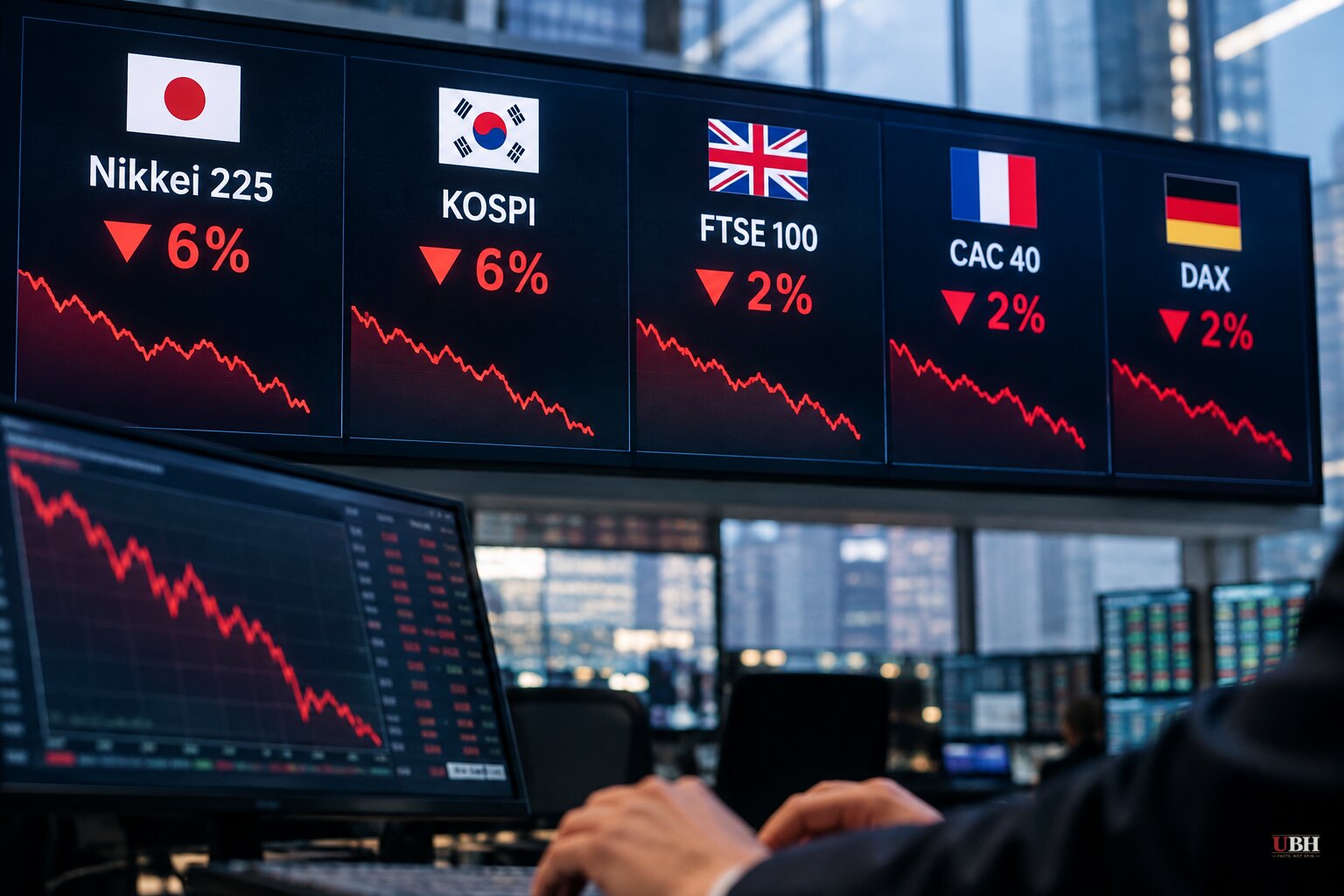
Since the Nasdaq's 5.5% drop on Thursday, Nov. 5, the AI selloff has spread across Asia and Europe, and the White House has started answering the political fear behind it.
Asia and Europe take the hit
South Korea's Kospi plunged nearly 9% at the open Friday, triggering a 20-minute trading halt, according to CNN. It closed the week about 6% lower. Tokyo also finished down about 6%.
SK hynix fell 10% and Samsung lost 6.4% in Seoul. In Tokyo, SoftBank gave back more than 10%, chipmaker Kioxia dropped 8.7% and Advantest lost 5%. TSMC's 4.7% decline dragged down Taiwan's Taiex.
Europe, which has few major tech names, still sold off. Around midday the FTSE 100 was down 2.2% at 10,542.88, the DAX down 2.3% at 25,709.82 and the CAC 40 down 1.8% at 8,057.43.
Bloomberg's tally has the Philadelphia Semiconductor Index down about 16% this week, putting it on course for its worst stretch since April 2025.
The Kospi more than doubled from the end of December to its record in mid-June. It is now down almost 50% over the past four and a half months, according to AFP.
Why investors say they are selling
The stated trigger is Tuesday's midterm result. Michael O'Rourke, chief market strategist at JonesTrading, said the slowdown of the data center buildout is "the real key theme that's going to stick," given how many governorships Democrats won.
Texas is the focal point. Governor-elect Gina Hinojosa campaigned on a temporary data center moratorium and on eliminating certain tax incentives for data center builders. Texas holds roughly a quarter of the nation's planned data center capacity, according to the Daily Wire's tally. UBS estimates about 30% of planned capacity could be affected, and tech analyst Dan Ives warned the buildout will slow sharply through 2028.
On the national stage, Sen. Bernie Sanders is calling for a "national data center moratorium now." Rep. Ted Lieu has promised public hearings and new AI "guardrails," and Democratic leaders want tech CEOs to testify under oath. Analysts said Sanders's call helped spook investors.
The Democratic caucus is not united on how far to go. Any federal restriction would also need President Trump's signature.
Other pressures were already building
The election is not the only explanation on offer. Reuters reported the AI trade has been under scrutiny for weeks, with five Nasdaq Composite drops of more than 500 points since mid-October. Neocloud firms such as Nebius and CoreWeave have faced financing worries since U.S. rates climbed late in the summer.
Big Tech's own spending is part of it. Microsoft reported capital expenditures of $39.4 billion for its latest quarter, nearly double the $19.4 billion a year earlier, and announced a $25 billion debt offering on Oct. 29. Shares of Microsoft, Alphabet and Amazon all closed lower after their October earnings.
Qualcomm missed estimates on Wednesday and said higher memory chip costs are hurting sales.
Neil Wilson, an analyst at Saxo Markets, wrote that "the blood is in the streets, folks," but added that the selloff looked overdone. He described the fear as "a total momentum unwind" if Democrats curb the buildout.
Trump's response
Thursday evening, Trump called the slide "a sad thing to watch" and blamed Democrats for the drop in Americans' 401(k) accounts.
Friday morning he shifted to reassurance. He said he is "100% in favor of Super Intelligence (SI)" and called the technology "GOLD." He also called it "foolish" for leaders to reject it. He said he will work with states that "want to become rich" by building out AI infrastructure.
The statement points to a looming clash. Trump has long backed data center expansion, while many Democrats have been more skeptical.
Pre-market indications
U.S. regular trading has not opened as of 9:18 a.m. ET. Pre-market indications showed some of Thursday's biggest losers edging up. AMD, which fell more than 17% Thursday, was up roughly 7.5% before the bell, according to Fox News Digital. Nasdaq futures pointed higher, while Dow futures were reported lower and S&P 500 indications were mixed. These are indications, not the open.
Oversight on the way
The Washington Post reports Democrats are preparing to scrutinize Silicon Valley when they take the House majority in January. The paper says one line of inquiry would examine Trump's use of Elon Musk's Grok chatbot in the Venezuelan operation that captured Nicolás Maduro. It lists Apple and Meta as other possible targets. The Post also reports private law firms are already pitching Musk on serving as his lead counsel. Musk spent $474 million on the midterms, largely backing Republican candidates. No investigation has been announced.
Next up is the U.S. jobs report, due today, Nov. 6, and the opening bell at 9:30 a.m. ET. Analysts have also wondered whether the rout will affect the timing of Anthropic's IPO. The company has not said it is changing its schedule.
Sources used for this briefing
6 links from 6 independent newsrooms (syndicated copies of the same report count once)
These are the sources it draws on, linked so you can verify.


