
Unbiased headlines. Facts, not spin.
Unbiased Headlines is an independently owned news organization. We bring you the facts, not opinions, written fresh from 110+ named sources. Sources linked so you can verify it yourself.
 finance
Breaking / Critical (9/10)
Nasdaq Falls 5.4% Into Correction and S&P 500 Drops 4.3% as the AI Selloff Hits Wall Street
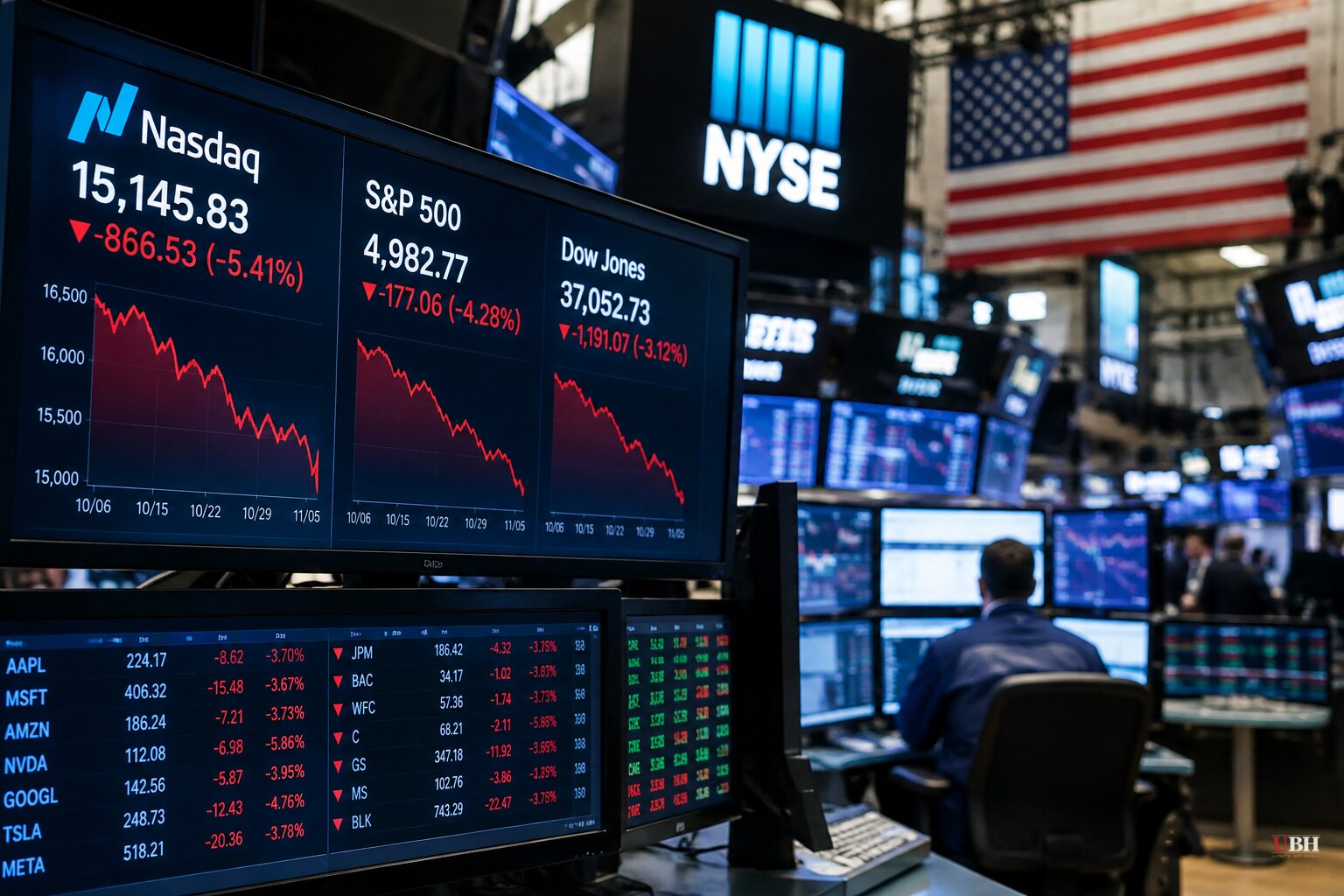
The AI selloff that rattled Asia earlier today, Thursday, Nov. 5, hit U.S. stocks at full force. The Nasdaq Composite closed down 5.4%, which puts it 10% below its Oct. 6 record close and into correction territory by the standard definition.
The S&P 500 dropped 4.3%. The Dow Jones Industrial Average lost more than 1,833 points, or 3.44%, wiping out the previous session's midterm-election gains. It was the worst day for all three indexes since April 2025.
Who got hit
Broadcom fell more than 10%. Nvidia also dropped sharply. Qualcomm closed 9.49% lower after issuing weak fourth-quarter guidance in its latest earnings report, a company-specific reason that has nothing to do with Congress.
The so-called neocloud firms took the worst of it. Nebius fell 14.94%, CoreWeave 9.83%, and Iren nearly 17%. Oracle declined 6.96%.
The big spenders slid too: Meta lost 3.96%, Microsoft 3.58%, Amazon 2.19% and Apple 1.53%. Tesla fell 10.77%.
The data center argument
Investors are pointing to Democratic control of both chambers of Congress. The worry is greater oversight and regulation of data center construction, which would delay a multitrillion-dollar build-out already facing backlash over financing and energy demand.
"The theme we are watching most closely is AI scrutiny," Vijay Valecha, chief investment officer at Century Financial, wrote in a note. "We anticipate more congressional hearings on who pays for the power-hungry buildout."
The voter signal is clear. According to Redbud Consulting, voters opted to restrict data centers in 39 of 40 ballot measures with complete counts as of Thursday.
Texas adds to the exposure. Goldman Sachs analysts estimate the state accounts for 25% of planned data center capacity, and an upset in the governor's race could have major ramifications there, according to The National.
No bill restricting data centers has been cited in this week's market commentary. The link between the election and the selloff is an investor expectation, not an enacted policy.
The slide predates the vote
The AI rout did not start on Election Day. The S&P 500 and Nasdaq both closed at record highs on Oct. 6. During the week of Oct. 12 to 16, the Nasdaq lost 4.5% and the S&P 500 fell 1.9%, each their worst week since June, as renewed inflation worries, lofty AI valuations and pressure on semiconductor stocks combined. The Nasdaq fell 2.1% on Oct. 16 alone, to 26,140.03.
Borrowing costs were already part of the story. In the run-up to big-tech earnings, Stephen Innes of SPI Asset Management said the week was "less about broad conviction and more about proof," adding that investors want to know whether compute spending is building "a durable earnings machine or just a shinier version of the same old capex furnace." Many AI-linked companies have borrowed to fund their investments, and high interest rates make those loans more expensive.
Oil added pressure. Brent crude had surged from under $97 in early October to a settlement of $116.72, its highest since June 2022.
So the election may be the trigger for Thursday's drop, but it is not the only factor, and no source in this story quantifies how much each contributed.
Money leaving emerging markets
The damage extends beyond U.S. tech. The Institute of International Finance reported that foreign investors pulled a net $33.8 billion out of emerging markets in October, the biggest monthly outflow since March. That breaks down to $31.7 billion from equities and $2.1 billion from debt.
The figure compares with a revised $19.3 billion in September and an inflow of $27.4 billion in October 2025. The IIF cited technology-stock concerns and country-specific risks.
China is a cautionary example. Key Chinese indexes have fallen more than 20% from their June peak, and the STAR50 index of homegrown AI and chip leaders is down more than 40%. Beijing put $19 billion into exchange-traded funds, according to Bloomberg data, and Natixis economist Gary Ng said the selloff reflects "a repricing of crowded AI trades, weak domestic demand, and the lack of stimulus."
What comes next
The IIF noted one possible cushion: easing U.S. bond yields and a weaker dollar after the midterms could ease pressure on emerging economies.
The open question is whether Thursday's 10% Nasdaq drawdown reflects a real change in spending or a repricing of expectations. Congressional hearings on who pays for data center power are the first concrete step analysts like Valecha are watching for. Until a hearing, a bill or a change in corporate capital spending plans shows up, the market is pricing a fear rather than a policy.
Sources used for this briefing
7 links from 6 independent newsrooms (syndicated copies of the same report count once)
These are the sources it draws on, linked so you can verify.


