
Unbiased headlines. Facts, not spin.
Unbiased Headlines is an independently owned news organization. We bring you the facts, not opinions, written fresh from 110+ named sources. Sources linked so you can verify it yourself.
 finance
Breaking / Critical (9/10)
Dow Gives Back Nearly All of Wednesday's 1,569-Point Rally by Midday as S&P 500 Falls Almost 4%
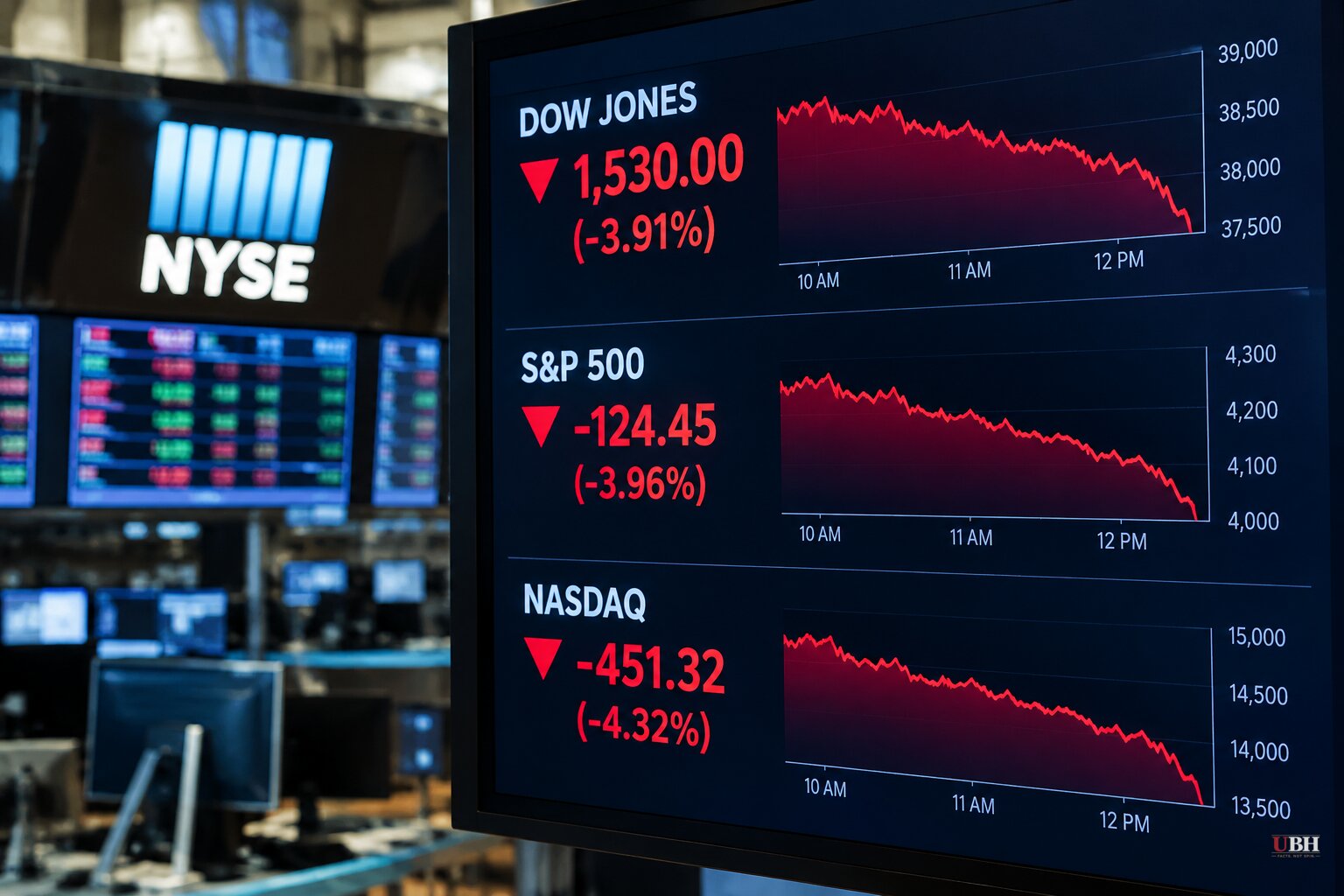
Since Wednesday's post-midterm rally gave way to a tech-led selloff, the damage has spread well beyond chips. By about 12:55 p.m. ET today, Nov. 5, the Dow Jones Industrial Average stood at 51,826.73, down 1,529 points, or 2.87%. At its worst point, CNBC's tally had the Dow off 1,566 points. Wednesday's close was 53,356, after a 1,569-point jump.
The Dow has handed back essentially all of that gain in one session.
The damage by index
The S&P 500 was down about 3.8%, on pace for its worst day since the April 2025 tariff selloff. Wednesday's close was 7,689.
The Nasdaq Composite fell about 5%, and trades more than 10% below its Oct. 6 record close. The PHLX Semiconductor index was down roughly 10.5% to 11%. CNBC reported the iShares Semiconductor ETF (SOXX) was down as much as 11%, which would be its worst day since March 2020.
Breadth is the notable change from earlier in the session. Only two of the S&P 500's 11 sectors were higher, according to Breitbart's sector tally. Technology fell about 5.1%, consumer discretionary about 4%, industrials about 2.2% and financials about 1.8%. Energy and consumer staples held up.
Caterpillar fell 4%. JPMorgan and Boeing each dropped 3%. Nike slipped 2%.
Chips, neoclouds and Musk's companies
Nvidia and Broadcom each fell roughly 6% in late-morning trading, and Oracle fell with them. AMD dropped 13.1%.
Qualcomm beat earnings estimates but fell more than 11% on a weaker-than-expected outlook. Breitbart put the stock's drop at about 13% and reported that smartphone-chip revenue fell 26% to $5.14 billion, missing expectations.
The companies that rent out AI computing capacity were hit harder. CoreWeave lost 9% to 10%, Nebius fell 13% and Iren shed 14%, extending Wednesday's losses.
SpaceX and Tesla each dropped more than 9%. Yahoo Finance tied the move to the Democratic win in Texas, where both companies are headquartered, and to doubts about regulatory hurdles for data centers and about a possible merger between the two. Democrat James Talarico won the Texas Senate seat. Elon Musk had clashed with him on social media before the election.
What investors say is driving it
The stated worry is political. Democrats won the House and Senate and several key governorships, and investors fear that will slow the AI infrastructure buildout.
Sen. Bernie Sanders, who caucuses with Democrats, has called for a national data center moratorium. He wrote on X Wednesday evening: "Americans don't want Big Tech oligarchs wrecking the environment, gutting jobs and threatening humanity's future."
Texas is the sharpest concern. The state accounts for about a quarter of planned U.S. data center capacity in coming years, according to The Epoch Times. Democrat Gina Hinojosa, who defeated Republican Gov. Greg Abbott, campaigned for a moratorium on data center development.
Tim Holland, chief investment officer at Orion, said investors are "stepping away until they get a better sense of the implications of the midterms around the AI capex cycle in particular." He called AI spending "the biggest economic tailwind we've had going for us for the last, call it, three years."
Keith Lerner, chief investment officer at Truist Wealth, described the spread: "the sell-off in tech, the size of it, is now feeding itself into the broader market."
The opposing read on divided government
Not everyone ties the midterms to a lasting hit for stocks. Tom Essaye, president of Sevens Report, argued Wednesday that a split Washington means gridlock, which he called positive given strong consumer spending, low unemployment and AI data center spending.
"Since Democrats did not secure a veto-proof majority in either the House or Senate, we now have legislative gridlock, which, historically speaking, is positive for stocks," Essaye said. He noted the S&P 500 has risen 12 months after all 19 midterms since 1950.
John Boyd of The Boyd Company offered a narrower warning. He expects "greater scrutiny of tech and AI" with possible effects on compliance costs, investigations and project timelines "even without new legislation."
The industry is also responding on costs. Meta communications official Andy Stone said Thursday on X that he welcomed OpenAI's pledge to cover the energy costs of its data centers. He noted Meta made a similar commitment earlier this year to pay its own energy and water costs so they are not passed on to consumers.
Outside the AI trade
Oil rose on uncertainty over whether President Trump will pursue a deal with Iran to end the war in the Middle East. Brent traded around $97 a barrel and WTI around $90. Vice President JD Vance wrote on X, "The reason we lost [the midterm elections] is the war."
A Challenger, Gray & Christmas report showed October layoff plans fell to their lowest level since 2023.
That sets up Friday's employment report. Duke Energy, Airbnb and Lumentum report earnings today. No national data center moratorium has been enacted yet. The market is trading on what the new Congress and governors might do, and Sanders and Hinojosa have already said what they want.
Sources used for this briefing
8 links from 8 independent newsrooms (syndicated copies of the same report count once)
These are the sources it draws on, linked so you can verify.


