
Unbiased headlines. Facts, not spin.
Unbiased Headlines is an independently owned news organization. We bring you the facts, not opinions, written fresh from 110+ named sources. Sources linked so you can verify it yourself.
 finance
Breaking / Critical (9/10)
VIX Jumps 50% to Seven-Month High as UBS Says 30% of 2028 Data Center Additions Could Face Disruption
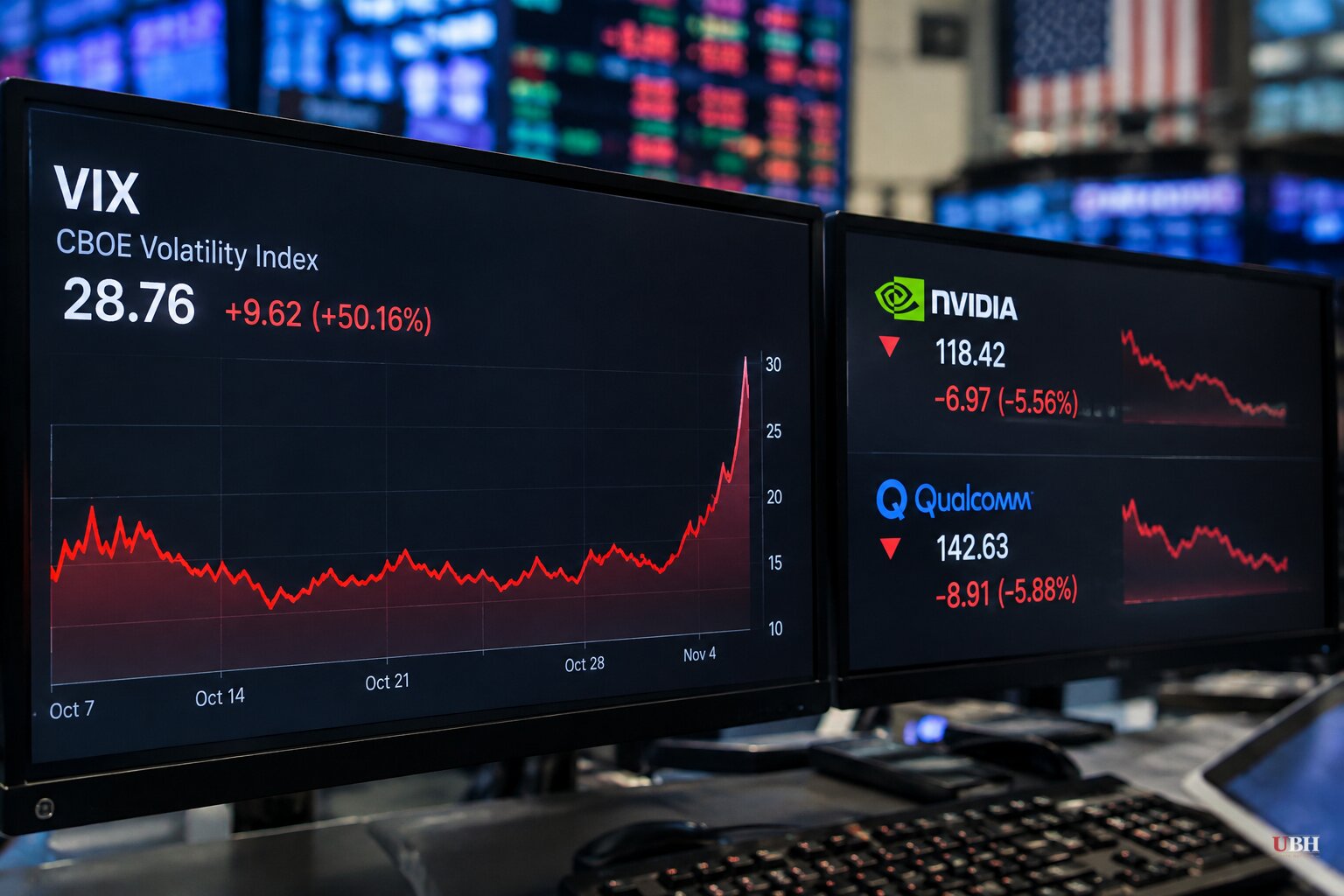
Since Wednesday's rally in the major indexes masked falling chip and AI-infrastructure shares underneath, Thursday's selloff has widened from a tech story into a fear story. Wall Street's VIX volatility gauge surged 50% to its highest level in seven months, CNN reported, as the S&P 500 fell about 3% and the Nasdaq traded more than 10% below its Oct. 6 record.
Nvidia gives back its year
Nvidia shares were down about 7% in CNN's tally and about 9% in Breitbart's, erasing the stock's gains for 2026. A closely watched index of chipmakers fell 10%. The iShares Semiconductor ETF was down more than 11% in Breitbart's account.
Qualcomm fell between 11.5% and 14% in the sources' tallies, putting it on track for its worst day since March 2020. The company beat earnings estimates, but its outlook disappointed. Smartphone-chip revenue fell 26% to $5.14 billion, below Wall Street expectations. Qualcomm said higher memory chip costs are hurting sales, which echoes Intel's guidance last week.
That means not every dollar lost today traces to Washington or Austin.
What UBS put a number on
The cleanest figure on the political risk comes from UBS strategists, who estimate that around 30% of expected 2028 data center additions could face disruption from potential construction pauses. That is an estimate of exposure, not a count of projects that have been halted.
The trigger is Texas. Governor-elect Gina Hinojosa, a Democrat who defeated Republican Gov. Greg Abbott, campaigned on a temporary data center moratorium and on eliminating certain tax incentives for data center builders. Google, Meta, Oracle and OpenAI have all made large data center investments in the state.
Breitbart reported that developers in Texas were already dealing with a suspension of approvals under Abbott. Breitbart also reported that data center measures appeared on ballots in at least 41 jurisdictions across 10 states. Incoming Democratic senators have called for brakes on data center development, according to CNBC.
Other pressures on the sector
The neocloud companies that rent out AI computing power took the hardest hits. CoreWeave fell 11% to 14%, Nebius 15% to 17%, and IREN about 19%. The Epoch Times reported those firms had already been beaten down in recent weeks over worries they will not be able to borrow enough to fund their buildouts.
Supply limits are a separate problem. Lam Research said on its earnings call that shortages of critical upstream parts and certified cleanroom space will keep restricting chip equipment makers through 2027. Reuters, citing Bloomberg, reported that Micron paused work on a planned $4.5 billion memory-chip plant in Taiwan during a prolonged labor dispute. That report ties the pause to labor talks, not to U.S. politics.
The damage was concentrated. In the S&P 500, technology fell about 5.1% and consumer discretionary about 4%, per Breitbart's sector figures. Only two of the index's 11 sectors were higher: energy, up about 0.6%, and consumer staples, up about 0.3%.
Not everyone reads it as a political verdict
Keith Lerner, chief investment officer at Truist Advisory Services, called this week's moves more of a knee-jerk reaction than a true indication of how stocks, tech in particular, would fare under Democratic control of Congress.
Chris Zaccarelli, chief investment officer at Northlight Asset Management, described the narrative as having flipped from "AI changes everything" to "Blue wave means data centers will never be built again in this country." Peter Schiff of Euro Pacific Asset Management took the opposite view of Wednesday's rally. "Yesterday's stock market rally in the face of the Democratic landslide made no sense. In contrast, today's sell-off makes perfect sense," he wrote on X. "Expect more days like today."
The backdrop is not weak. A majority of S&P 500 companies that have reported third-quarter results have beaten expectations, per the Epoch Times. The Nasdaq is still up roughly 5% for the year, and the S&P 500 and Dow are up 9% and 8%.
What comes next
No moratorium is in force yet. Hinojosa is governor-elect and has not taken office, and the sources cite no enacted federal restriction on data centers. Investors next face Friday's monthly employment report. The Nasdaq has traded in correction territory, and whether it finishes the session there and whether the VIX holds its spike remain to be seen. The next test is whether any Democratic proposal turns UBS's 30% disruption scenario into actual policy.
Sources used for this briefing
6 links from 6 independent newsrooms (syndicated copies of the same report count once)
These are the sources it draws on, linked so you can verify.


