
Unbiased headlines. Facts, not spin.
Unbiased Headlines is an independently owned news organization. We bring you the facts, not opinions, written fresh from 110+ named sources. Sources linked so you can verify it yourself.
 finance
Breaking / Critical (9/10)
Nasdaq Falls Into Correction and Dow Drops More Than 1,000 Points as AI Selloff Spreads to the Broad Market
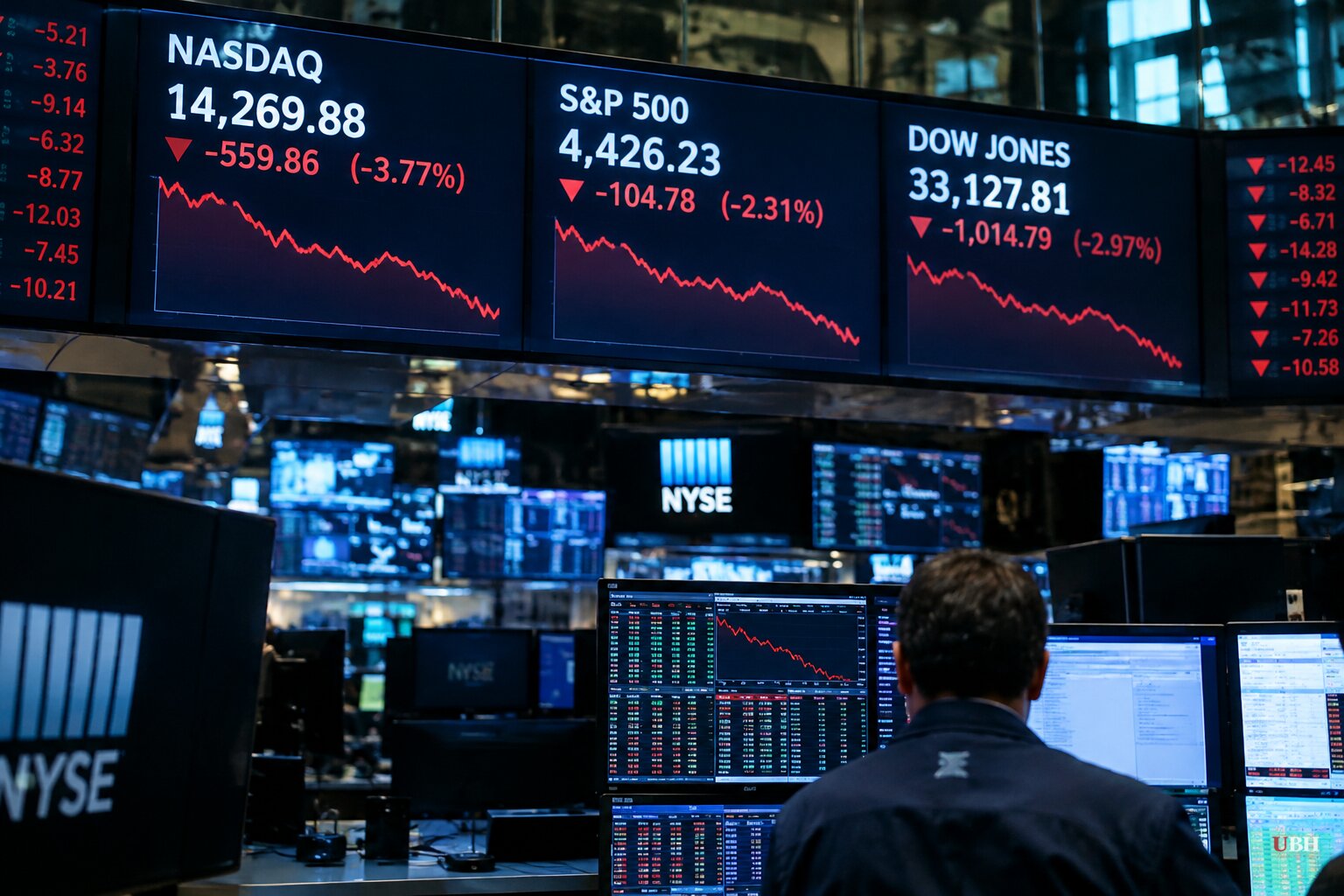
Since Tuesday's midterms gave Democrats control of both chambers of Congress, and Wednesday's Dow rally of more than 1,500 points, the AI selloff has stopped being a sector story. On Thursday, Nov. 5, it dragged the whole market down with it.
The Nasdaq Composite fell into correction territory on Thursday. CNBC reported it down 4.9%, trading more than 10% below a record set last month, while CNN reported an intraday plunge of as much as 5.5% and put the index more than 10% below its Oct. 6 record high, on pace for its worst day in five months. A trading-day snapshot from Trending Topics had the Nasdaq down 5% in the US morning session. The S&P 500 was down 3.2%, according to CNBC. The Dow Jones Industrial Average shed 1,136 points, or 2.1%, erasing more than half of its advance from Wednesday's rally.
Business Insider reported the Nasdaq 100 plunged 5% and is down 13% from its latest high. Intraday numbers moved around through the day, and every figure here is a snapshot of live trading.
Where the damage landed
Chips and data center names took the worst of it. CNBC reported Broadcom and Nvidia each fell 9% on Thursday, as did Oracle. Micron and AMD were down 16%, and the iShares Semiconductor ETF (SOXX) was down 11% in CNBC's report.
Qualcomm reported earnings that beat estimates, but the stock dropped 13% on a weaker-than-expected earnings outlook, according to CNBC. Economic Times reported the company's smartphone chip sales missed estimates.
The neocloud companies, which rent out AI computing capacity, fell hard. CNBC reported CoreWeave losing 14%, Nebius sliding 17% and Iren shedding 19%.
Tesla and SpaceX each dropped 10%, per CNBC. Trending Topics reported Palantir down more than 9%.
Money moved to defensive corners. Consumer staples rose more than 1%, and energy and utilities were also higher. Chevron and Johnson & Johnson posted gains within the Dow. Trending Topics, citing Yahoo Finance, reported gold rose to a record high above 4,120 dollars.
Oil reversed Wednesday's drop. U.S. crude had tumbled below $90 a barrel on Wednesday as investors anticipated that Democrats might use their newfound leverage to pressure President Donald Trump into ending the Iran war. On Thursday, West Texas Intermediate futures rose more than 2% to just above $90 a barrel, and Brent gained more than 2% to around $97, according to CNBC.
Why traders say it happened
The explanation on offer from strategists is policy. CNN reported that investors are weighing the implications of Democrats winning races in states like Texas that are hubs for planned data centers, and CNBC reported investors fear that a Democratic sweep of both chambers of Congress, along with victories in key gubernatorial races, could mean more regulation of the AI buildout.
"A shakeout among the most speculative parts of the theme is underway," MRB Partners said in a Thursday note. "The U.S. mid-term election results will add to headwinds for big tech and the data center buildout."
Jefferies called a Democratic sweep a "Worst-Case Near-Term Scenario" for the AI trade, according to Business Insider. The firm also revised its outlook for data center capacity through the end of the decade downward.
There is a competing read of the same tape. Business Insider reported that the logic on Thursday seems driven by a broader risk-off move, with investors looking to reduce exposure to the AI sector. It noted that traders have also been eager to take profits lately, punishing various hyperscalers after quarterly earnings even when firms beat on the bottom line and signaled greater spending discipline heading into 2027.
The weakness predates the election. The Epoch Times reported the Nasdaq fell 2% last week, the weakest of the major U.S. indexes, as Alphabet closed down 12.29% on Thursday, Oct. 29, after disappointing advertising revenue added to worries about the cost of its AI investments. On Friday, Oct. 30, Amazon missed revenue and earnings estimates and slid into negative free cash flow because of AI spending. Intel plunged more than 28%, its worst single-day decline in decades, on disappointing fourth-quarter guidance. The Nasdaq ended that Friday down 2.86%.
Richard Saperstein, chief investment officer of Treasury Partners, told The Epoch Times the focus is on whether AI spending "can continue to be financed by cash flows, or if equity and debt issuance will be necessary, too."
The Associated Press, as carried by Breitbart, put the election in perspective: U.S. stocks usually gain following midterms regardless of who wins, and over the long run prices depend more on where company profits and interest rates are heading than on who controls what in Washington.
Jordan Watson, portfolio manager at Tandem Investment Advisors, warned against reading Wednesday as an all-clear signal. Markets still have to digest the policy implications of the election, he said, and more volatility is likely.
Asia and the volatility gauge
In Asia, the AI exposure showed up before the U.S. open. South Korea's Kospi briefly sank more than 4% and by late morning was trading 3.5% lower at 5,484.38. Samsung Electronics sank 5.7% and SK Hynix lost 7.4%. In Tokyo, Advantest tumbled 9.4%, Tokyo Electron skidded 7.7% and SoftBank Group shed 5.3%.
Markets less heavily exposed to the AI industry mostly climbed. Hong Kong's Hang Seng jumped 2.8% and Australia's S&P/ASX 200 rose 1.9%.
The VIX, Wall Street's volatility gauge, rose on Thursday as the selloff picked up steam. CNBC reported it last up at 22.59, while Trending Topics reported a jump of more than 20% to above 20.
The next scheduled data point is Friday's October jobs report, which Business Insider said is expected to shape the Fed's path for future rate hikes heading into 2027, after a week that started with a relief rally and has turned into a correction for the Nasdaq.
Sources used for this briefing
7 links from 7 independent newsrooms (syndicated copies of the same report count once)
These are the sources it draws on, linked so you can verify.


