
Unbiased headlines. Facts, not spin.
Unbiased Headlines is an independently owned news organization. We bring you the facts, not opinions, written fresh from 110+ named sources. Sources linked so you can verify it yourself.
 finance
Major Story (8/10)
Event date: November 4, 2026 ·
Kospi Falls 3.5% and Advantest 9.4% as AI Chip Selloff Extends, While Hang Seng and ASX Rise After Midterms
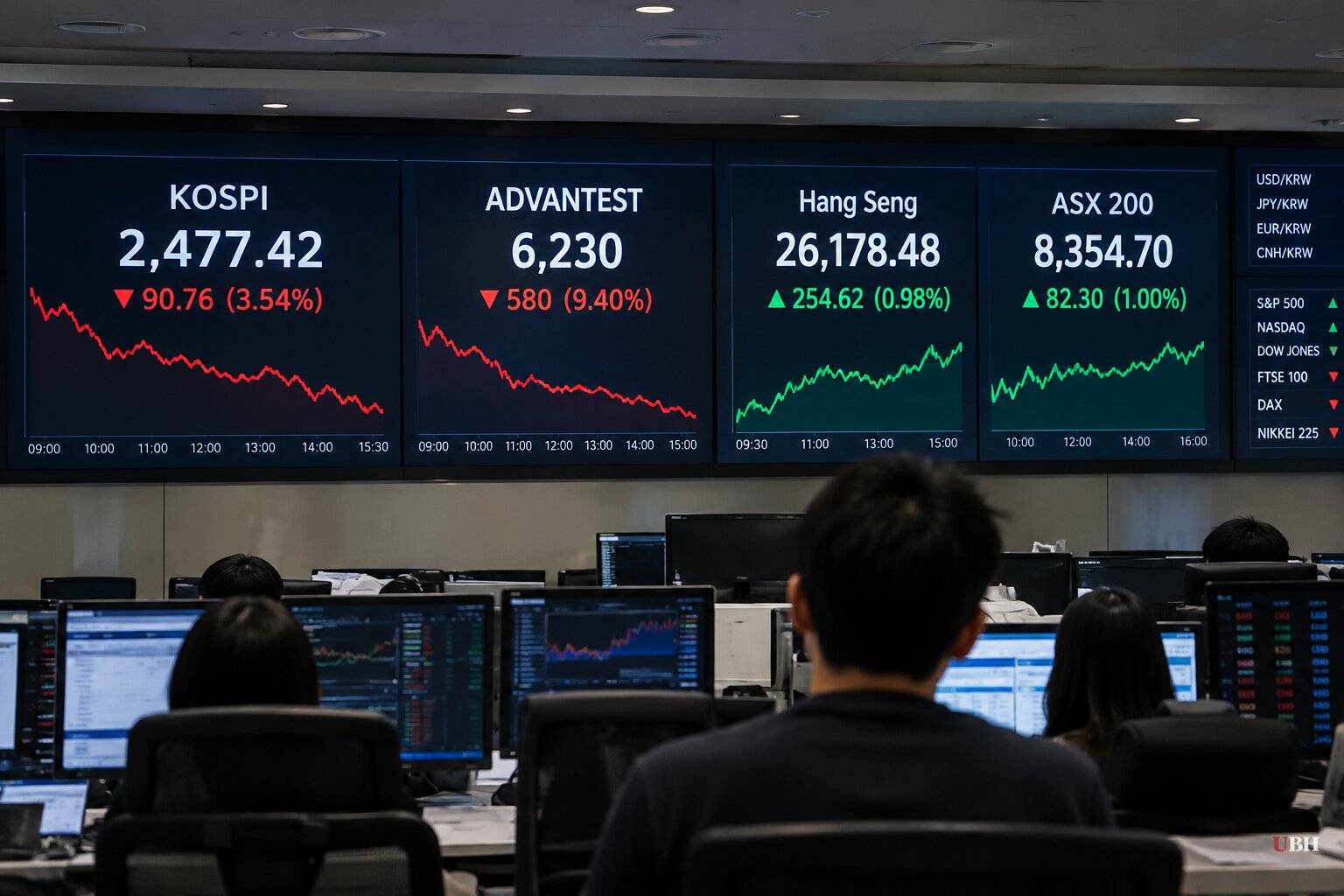
Since U.S. futures slid Tuesday evening as Democrats took Congress, the AI-linked part of the market has kept falling while the rest has rallied. On Thursday, Nov. 5, Asia split along exactly that line.
South Korea's Kospi briefly sank more than 4% on heavy selling of chipmakers. By late morning it was down 3.5% at 5,484.38. Samsung Electronics lost 5.7% and memory maker SK Hynix lost 7.4%.
In Tokyo, the Nikkei 225 slipped 0.5% to 61,914.53, but the chip names took the damage. Advantest fell 9.4%, Tokyo Electron dropped 7.7%, and OpenAI investor SoftBank Group shed 5.3%. Taiwan's Taiex lost 1.6%.
Markets with less AI exposure went the other way. Hong Kong's Hang Seng jumped 2.8% to 24,597.59. The Shanghai Composite edged up 0.1%. Australia's S&P/ASX 200 rose 1.9% to 9,003.40.
The Wednesday setup
The Asian moves follow a big U.S. day. The Dow surged 1,569 points, or 3%, on Wednesday, its best day since April 2025 and its biggest post-midterm one-day gain since 1982, according to CFRA Research. The S&P 500 rose 1.58% and the Nasdaq Composite rose 1.44%. The VIX fell almost 20%.
Hospital owners and dollar stores serving low-income Americans led the rally. Trump Media & Technology Group fell 24.5% to $4.49. Tesla dropped 3.3% and SpaceX fell 3.8%, with Elon Musk named as a possible target of investigations by a Democratic-controlled Congress.
Early Thursday, a market-data feed showed Nasdaq 100 futures down about 1%, a move it labeled a post-midterm rotation out of chip stocks.
Why chips, and what the strategists say
Democrats won majorities in the House and the Senate. Democratic Gov.-elect Gina Hinojosa, who defeated Republican Gov. Greg Abbott in Texas, has called for a temporary moratorium on data center development. Texas accounts for roughly a quarter of planned U.S. data center capacity in the coming years, according to The Epoch Times.
John Boyd, principal at The Boyd Company, expects "greater scrutiny of tech and AI, financial services, healthcare, and parts of the energy sector," with possible effects on compliance costs, investigations and project timelines, "even without new legislation."
Tom Essaye, president of Sevens Report, argues the opposite for the broader market. Because Democrats did not win a veto-proof majority in either chamber, he wrote, gridlock is "positive given the current macroeconomic setup of strong consumer spending, low unemployment, and AI data center spending." He also warned that volatility could return with next year's debt-ceiling fight, Senate investigations and impeachment threats, though he expects no lasting market impact.
So the selloff rests on a forecast: that political pressure slows the build-out. No data center project has been cancelled in these developments, and no legislation has been proposed.
Productivity data and the Fed
U.S. nonfarm business productivity rose 3.6% annualized in the third quarter, against expectations for a 0.7% contraction, with labor costs falling. That is the kind of number AI bulls would normally claim.
Richmond Fed President Tom Barkin did not. "I do not think AI is what is currently driving productivity as much as adaptation to the labor shortages that began during the pandemic," he said Thursday. On policy, he said "the path on policy is straightforward; the issue now is pace and gradual 'makes sense.'"
Oil and the Iran war
Brent crude settled Wednesday at $94.62, down almost 8.7% and the lowest settle since Aug. 31. It traded near $94 in Asia on Thursday. Vice President JD Vance wrote on X: "The reason we lost is the war. The president himself said so last night." Oil extended its drop after the comment.
Not everyone buys the de-escalation trade. "Traders are betting that the administration is going to quit this war because the (midterms) shellacking was bigger than anyone expected," said Bob McNally, president of Rapidan Energy Group. "We're not buying it. We think escalation is more likely."
Iran's state broadcaster IRIB reported an increase in the number of oil tankers on fire east of the Strait of Hormuz. That claim is unconfirmed.
What comes next
The test is whether the chip selloff is a repricing of political risk or a response to a real slowdown in spending. The Democratic Congress has not yet been seated, Hinojosa has not taken office, and the White House has not said whether the Iran war posture will change. Until one of those moves, the market is trading on forecasts about all three.
Sources used for this briefing
6 links from 6 independent newsrooms (syndicated copies of the same report count once)
These are the sources it draws on, linked so you can verify.


