
Unbiased headlines. Facts, not spin.
Unbiased Headlines is an independently owned news organization. We bring you the facts, not opinions, written fresh from 110+ named sources. Sources linked so you can verify it yourself.
 finance
Major Story (7/10)
Event date: October 22, 2026 ·
Hedge Funds Lost More Than 3% in October as AI Selloff Hit Chips, Nasdaq, Korea and China
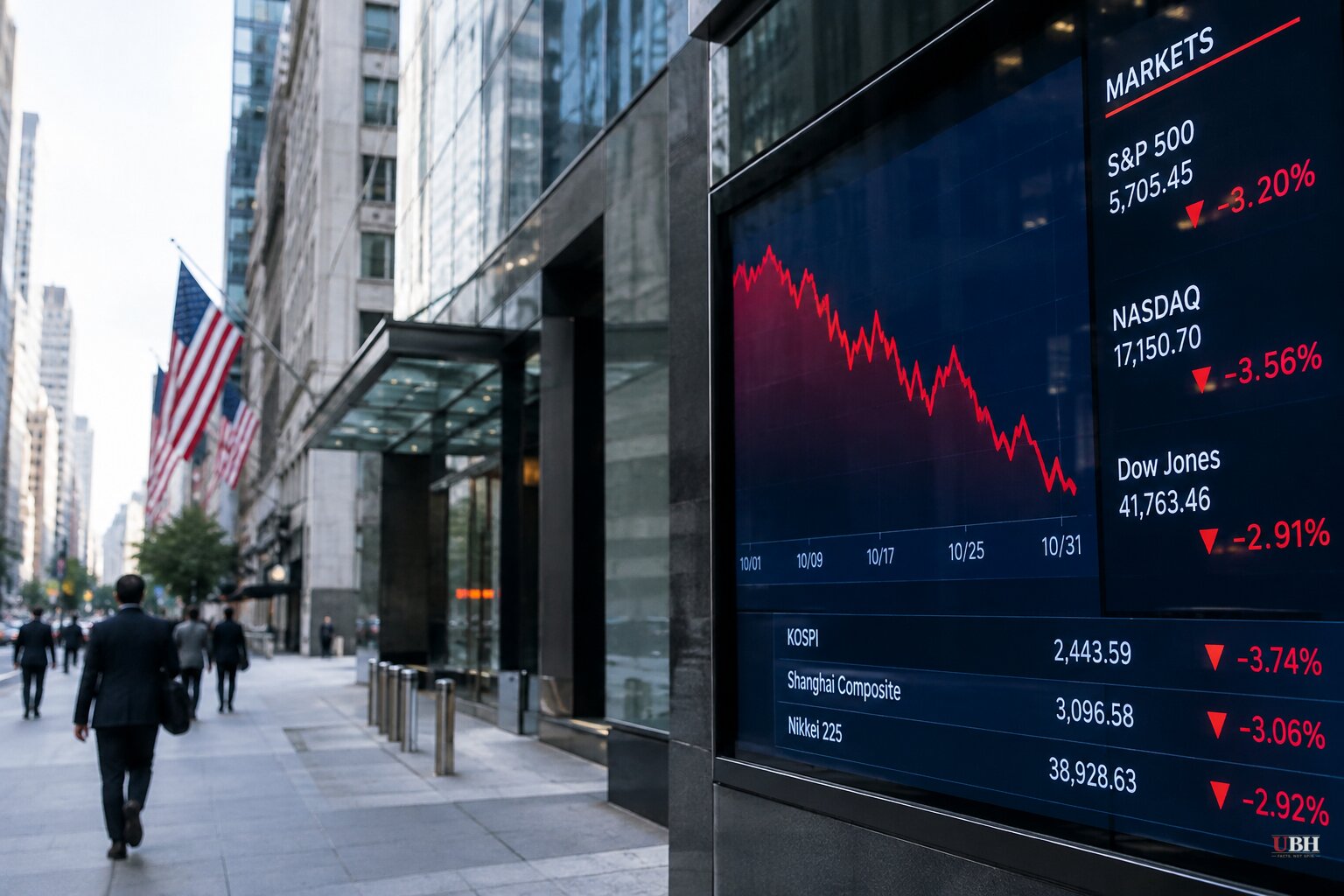
Since the Philadelphia Semiconductor Index posted its record close on June 22, the AI trade has gone from unstoppable to bruised. The October damage is now measurable on the hedge fund side.
Goldman Sachs prime brokerage data show fundamental long-short equity funds fell 3.5% in October. Systematic strategies lost 3.6%. It is the first month since Goldman began tracking performance in 2016 that both groups lost more than 3%.
Net leverage across Goldman's book dropped 4.2 percentage points to 73.4%, the steepest monthly decline in seven months. Funds were net sellers of global equities by the largest dollar amount in seven months. Long sales outnumbered short sales four to one.
Where the selling landed
Technology took the brunt. Roughly $20 billion in tech stocks was sold over two weeks, approaching the $23 billion unwind in July.
Five straight sessions of selling in AI-related equities, Oct. 8 through Oct. 14, wiped out all cumulative net purchases of the sector since the start of 2025, according to Goldman's figures. Asia-focused funds averaged losses of 9.4% for the month.
The public-market tape tells the same story. On Oct. 15 the semiconductor index sank about 2%, leaving it down almost 10% in a week. South Korea's KOSPI, heavily weighted toward memory chips, dropped almost 8% that day and 18% over five sessions.
Then came Thursday, Oct. 22. The Nasdaq Composite fell 2.6% to 26,008.86, its worst day since June. The S&P 500 lost 1.21% to 7,663.43. The Dow finished up 0.02%.
The semiconductor index plunged 6.7% that day, its biggest drop since June 23. Intel, AMD, Sandisk and Marvell each fell more than 8%. The index sits more than 26% below its June record, though it is still up about 51.5% for the year.
Spending, not earnings
The trigger was the price of the buildout. Meta beat analyst expectations but its shares fell 7% after it disclosed its first cash outflow in more than a decade, with AI infrastructure absorbing cash. Tesla fell 3.1% despite positive free cash flow and lower 2026 capital spending plans.
Paul Nolte, strategist at Murphy & Sylvest, said investors are spotting cracks in the AI narrative, magnified by the heavy tech weighting in the major indexes.
Broad earnings were not the problem. Of 111 S&P 500 companies that had reported by Oct. 22, 83% beat expectations, per LSEG. Procter & Gamble rose 5.6%, Lockheed Martin 7.0% and Spotify 11.1% that day.
The case that the buildout continues
Not everyone reads the selloff as a break in the fundamentals. Hendi Susanto, portfolio manager at Gabelli Funds, said the issue is not fundamentals but fragile expectations. He argued the AI infrastructure buildout will continue into the new year, with demand still high for accelerators, chipmaking equipment, memory and networking.
"Companies don't commit billions to new fabs unless they see the orders coming," Susanto said. Investors, he said, want proof the spending persists through 2027 and beyond.
Adam Turnquist, chief cross-asset strategist at LPL Financial, said enthusiasm for the broader AI cycle remains intact. He said Korea's concentrated memory exposure leaves it more vulnerable to competitive threats, positioning unwinds and shifts in the memory cycle.
China and Europe
China's AI and tech boom has not shielded its stocks. Key Chinese indexes have fallen more than 20% since peaking in June, crossing into bear-market territory. Shanghai's STAR50, which holds the country's AI and chip leaders, is down more than 40% from its June peak.
Unitree, the humanoid robot maker that surged 600% in its August Shanghai debut, has halved. Memory chipmaker CXMT is down nearly 30% from its August high.
Bloomberg data show Beijing put $19 billion into exchange-traded funds in its largest intervention since early 2025. Lorraine Tan, director of equity research in Asia at Morningstar, said such measures tend to be short-lived without policies addressing excess capacity and weak consumption. Gary Ng, senior economist at Natixis, called the selloff a repricing of crowded AI trades, weak domestic demand and lack of stimulus.
Europe has been the beneficiary. The Stoxx 600 rose 0.5% in Thursday trading, Nov. 5, to break above its August highs, led by mining and consumer stocks. TechFlow reported the move reflects rotation from AI into defensives such as healthcare and consumer staples, plus a strong earnings season and oil falling below $100 a barrel. Hedge fund overweights to European equities hit a one-year high of 3.5% in October, per Goldman.
What to watch
The Federal Reserve held rates at 3.75% to 4.00% at its Oct. 27-28 meeting. Attention now turns to how the U.S. midterm results affect the Iran war and tariff policy, and whether any policy shift helps renewable energy while weighing on AI trading. The next test for the AI trade is whether the hyperscalers confirm that capital spending will hold through 2027.
Sources used for this briefing
6 links from 6 independent newsrooms (syndicated copies of the same report count once)
These are the sources it draws on, linked so you can verify.


