
Unbiased headlines. Facts, not spin.
Unbiased Headlines is an independently owned news organization. We bring you the facts, not opinions, written fresh from 110+ named sources. Sources linked so you can verify it yourself.
 finance
Major Story (8/10)
AI Chip Stocks Fall for a Second Day as Strategists Tie Selloff to Democratic Midterm Wins
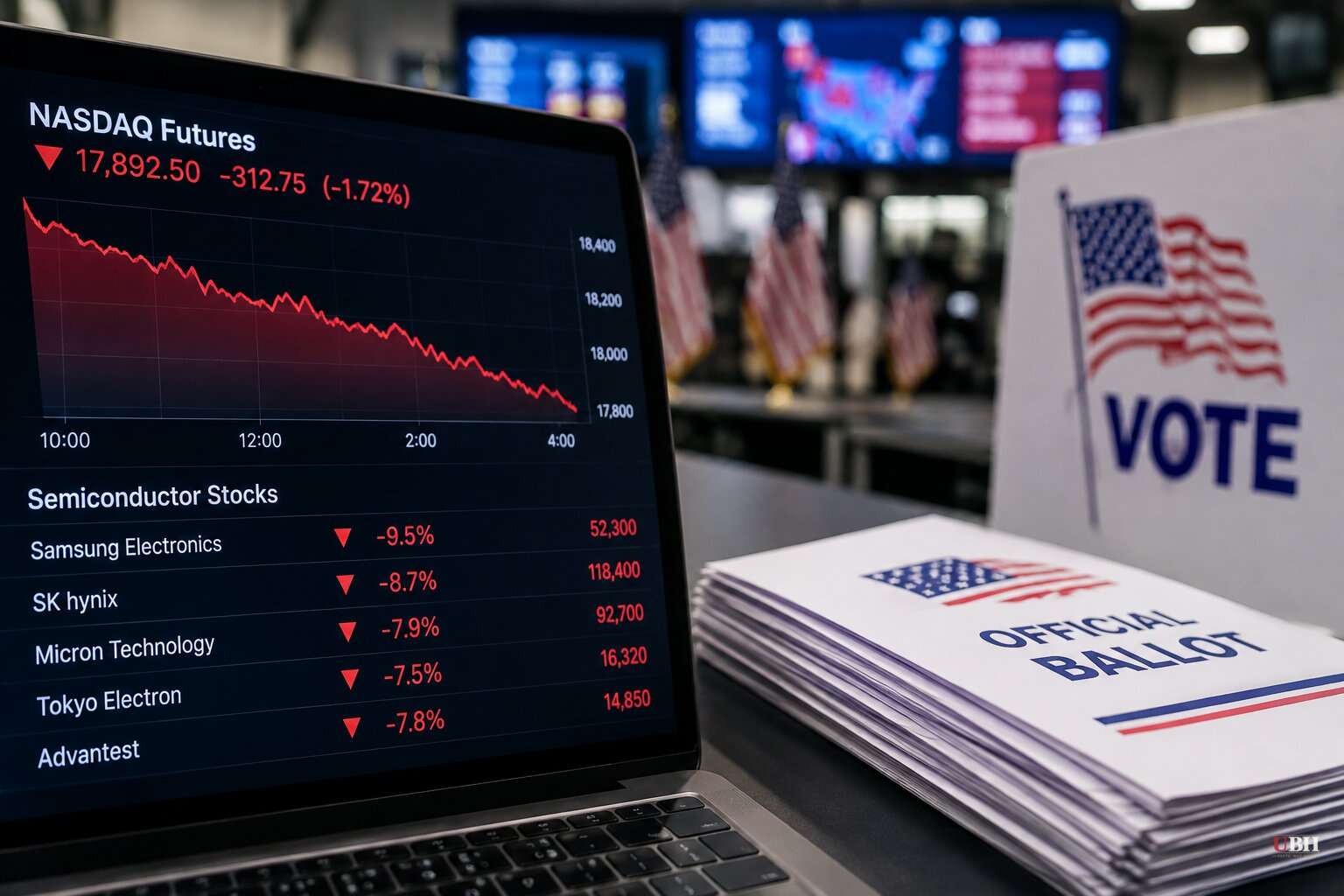
AI stocks are sliding for a second straight session, and the market's explanation is political. Democrats won both chambers of Congress and key governorships in Tuesday's midterms, and investors are repricing the companies that depend on a fast data center build-out.
The moves are sharpest in chips. Samsung Electronics fell 7.5% and SK Hynix 9.5% in South Korea on Thursday. The Kospi dropped almost 6%, and Japan's Nikkei also sold off. U.S. chip stocks were lower before the open, with Qualcomm sliding about 10% in premarket trading after a weak forecast.
Nasdaq futures were down between 0.5% and 0.7% as of this morning. S&P 500 futures were roughly flat, and Dow futures were up 0.4%. Regular trading on Wall Street begins at 9:30 a.m. ET.
What strategists say is driving it
UBS strategists wrote in a research note that a data center slowdown "should impact estimates for AI infrastructure stocks as well as cloud companies."
Texas is the focal point. Democrat Gina Hinojosa defeated Republican Gov. Greg Abbott and has called for ending data center development in the state. Wells Fargo estimates Texas holds 27% of planned U.S. data center gigawatts.
Her power has limits. Republicans still hold the majority in the Texas Legislature, which constrains how much she can change state policy.
Goldman Sachs sees moratoria potentially affecting about 45% of planned U.S. data center capacity expansion, according to a market note circulated this morning.
Local ballots pointed the same way. A tracker cited by Gotrade News counted 38 outcomes limiting development among 39 called local data center measures on election day.
Nvidia as the test case
Nvidia closed at $200.13 on Wednesday, down $6.56, or 3.17%. It was quoted at $196.50 in premarket trading at 8:02 a.m. ET, down a further 1.81%. That leaves the stock about 18% below its Oct. 6 record.
The Nasdaq Composite rose 1.44% on Wednesday, so the drop was concentrated in chips rather than spread across the market. CoreWeave fell about 10% on Wednesday.
Nvidia announced no company news Wednesday. The price move alone does not show any customer canceling an order, and no Nvidia-specific cause has been reported.
The company reports fiscal third-quarter results on Nov. 17. Consensus for the year ending January 2027 is $411.65 billion in revenue, up 90.6%, and adjusted EPS of $9.31, according to StockAnalysis. Those are analyst estimates, not reported results.
The tech trade was already shaky
The political repricing landed on a sector that was already under pressure. The Nasdaq Composite fell almost 3% on Oct. 30 and lost 5.3% in October, its worst month in more than a year.
Amazon reported third-quarter capital spending above $77 billion against expectations of $58.7 billion. Negative free cash flow marked a second straight quarter. CEO Andy Jassy told investors Amazon will "spend meaningfully more in 2027."
Intel's fourth-quarter guidance of $15 billion to $16 billion in revenue and 25 cents per share fell short of the roughly $17.1 billion and 43 cents analysts had projected. CFO Dave Zinsner said the PC slowdown should continue through at least the first half of next year. Intel shares fell sharply in premarket trading the next day.
Ipek Ozkardeskaya, senior analyst at Swissquote Bank, said Alphabet, Amazon, Meta and Microsoft spent more than $200 billion on capital investment in the third quarter. Their year-to-date total is above $500 billion. "The AI race is getting very, very expensive," she said.
Not everything is selling off
The rest of the market is cheering the result. The S&P 500 gained 1.6% Wednesday for its best day since August, and the Dow jumped about 3%. Dow Jones Newswires reported it was the Dow's best day since April 2025 and its strongest post-midterm performance since 1982.
Deutsche Bank strategists argue that two years of divided government and a gridlocked Congress would bring stability and limit U.S. fiscal excess. Treasury yields fell to eight-week lows, with the 10-year around 4.87%.
Oil also dropped. Brent crude fell almost 9% Wednesday and was near $95 to $96 a barrel this morning, versus about $118 at the end of last week. Traders are betting the election results will change U.S. policy in the Middle East. Iran said tankers hit mines near Hormuz.
Gold is back above $4,100 an ounce and Bitcoin topped $80,000.
The Bank of England raised its benchmark rate a quarter point to 4% in an 8-1 vote, with Catherine Mann seeking a half-point move, according to a market wrap. Governor Andrew Bailey warned it was unlikely to be the last hike unless the Iran war is resolved.
What to watch
Hyperscalers like Amazon and Meta were higher in premarket trading while chipmakers fell. That split shows investors are separating the companies that own compute from those that supply or build it.
No moratorium has been enacted. Whether new Democratic governors and local boards can actually delay projects at the scale traders are pricing in remains unresolved. Nvidia's Nov. 17 report will give the first hard read on whether demand is slowing, or only the timing of delivery.
Sources used for this briefing
6 links from 6 independent newsrooms (syndicated copies of the same report count once)
These are the sources it draws on, linked so you can verify.


