
Unbiased headlines. Facts, not spin.
Unbiased Headlines is an independently owned news organization. We bring you the facts, not opinions, written fresh from 110+ named sources. Sources linked so you can verify it yourself.
 finance
Major Story (8/10)
Event date: November 4, 2026 ·
S&P 500 Rose 1.6% Wednesday After Overnight Futures Slide, as AI-Linked Stocks Fell and Oil and Defense Names Weakened
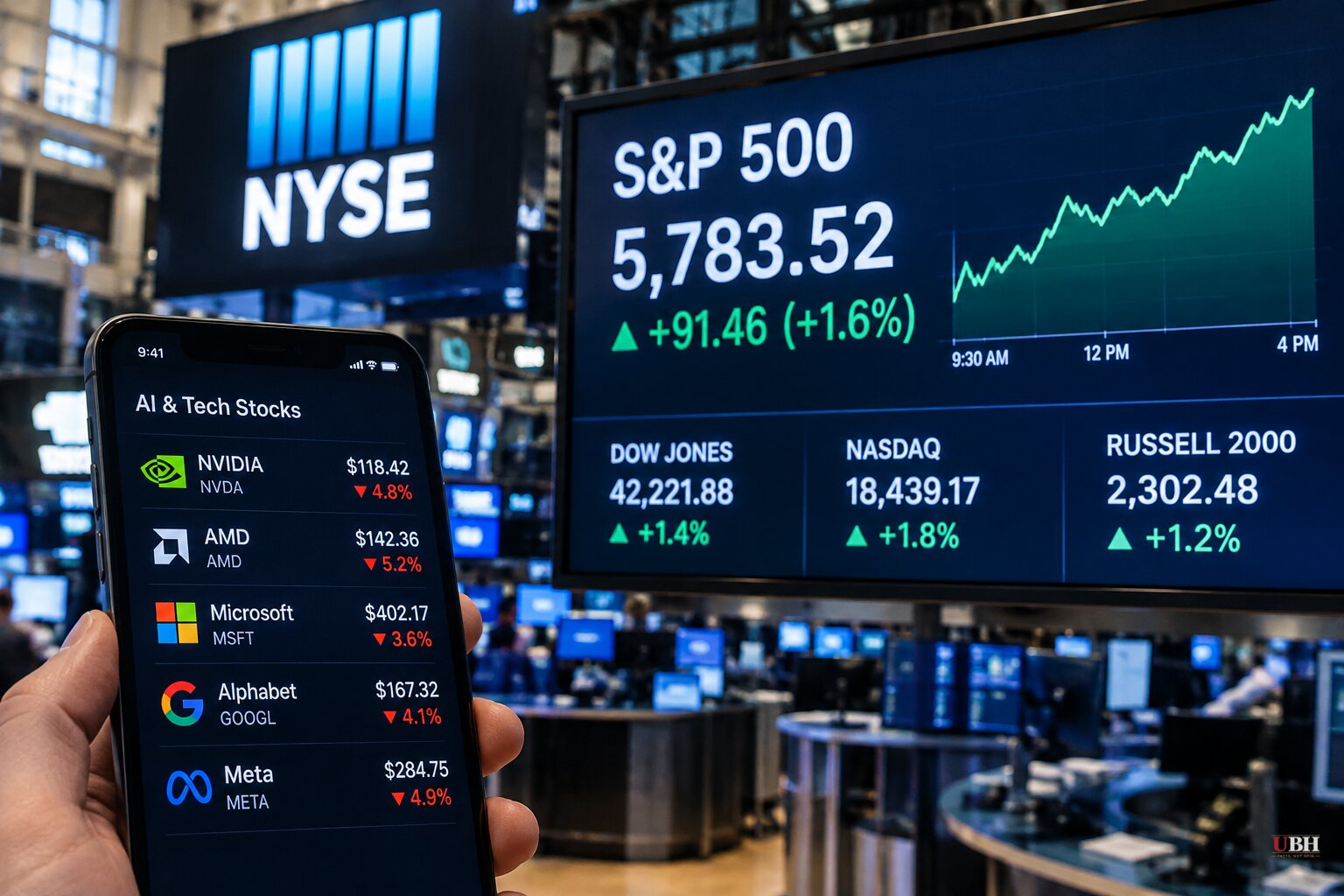
Since Democrats were projected to win both chambers of Congress on Tuesday night, Nov. 3, markets have run a full reversal. Futures sank overnight, then US stocks closed sharply higher on Wednesday, Nov. 4. Regular trading has not yet opened today, Thursday, Nov. 5.
From a Tuesday-night slide to a Wednesday rally
At 10 p.m. Tuesday, Nasdaq futures were down nearly 2%, S&P 500 futures were off 1.15% and Dow futures had dropped about 0.8%. Overseas, Japan's Nikkei fell 3.5% and South Korea's Kospi dropped 3%.
Then it turned. By Wednesday's US close, the S&P 500 had gained 1.6% and the Nasdaq 1.4%. The Morningstar US Market Index finished 1.5% higher. Earlier on Wednesday, before the cash market opened, Dow futures were pointing to a gain of roughly 700 points.
Bonds moved the other way from the Tuesday-night fear trade. The 10-year Treasury yield fell as much as six basis points overnight, briefly dipping below 4.90%, and settled near 4.92%. The two-year yield fell to 4.55%. The dollar weakened and gold climbed.
Winners and losers under the index
The index gain hides a split. Microsoft and Amazon rose, along with healthcare and renewable energy stocks.
AI infrastructure names took the hit. CoreWeave and Iren each closed more than 9% lower. Nebius fell 6.7%. Nvidia and Intel each lost more than 3%. Tesla closed down 3.3% and SpaceX fell 3.0%.
Oil and defense stocks also weakened on expectations of tougher congressional scrutiny of the Iran war. The conflict is now in its ninth month. Brent crude was trading around $103 to $104 a barrel in Wednesday reports. That is below the four-year high above $116 it reached on Oct. 23.
Data centers are the pressure point
Goldman Sachs analysts said the political shift will likely have "significant implications" for the AI buildout, because several winning Democrats campaigned explicitly on stricter data center rules. Goldman expects Democratic governors in Texas, Georgia and Michigan to impose conditional moratoria pending new legislation. That legislation could end certain tax breaks, tighten environmental, water and electricity rules, and make it easier for localities to impose their own moratoria.
Goldman estimates that states where Democrats are likely to introduce restrictions account for 45% of planned US data center capacity.
Kit Rees, investment strategist at Quilter, said the sector could "feel the heat" from regulatory scrutiny. "AI has been an enormous engine powering the US economy," Rees said, "so any curbs on its future development could threaten to put the brakes on growth."
UBS analysts see it differently. They argue greater congressional oversight will "not necessarily derail the AI investment cycle," because broad federal restrictions still face legislative and federal constraints. They point to state governments, including Texas, which now has a Democratic governor and senator, as potentially more consequential.
The AI trade was already shaky before the vote. In the week ended Oct. 23, the Nasdaq Composite lost 0.71% and the S&P 500 fell 0.47% to 7,623. Meta disclosed $825 billion in future commitments and obligations in an SEC filing, including $355.73 billion in lease obligations for facilities not yet in operation. Those numbers renewed questions about AI spending.
Why bond investors cheered gridlock
The bond rally has a plain fiscal explanation. UBS's Paul Donovan told clients: "Fiscal gridlock seems the likely default." Deutsche Bank's Jim Reid said the Treasury rally reflects that divided government "has generally made it harder for fiscal stimulus to be passed," which eased concerns about the fiscal trajectory.
The numbers behind that concern are large. Federal deficits run between 6% and 7% of GDP, and interest on the national debt now costs more than $1 trillion a year. A Congress that cannot pass another big spending or tax package is, for debt hawks, a feature.
The 30-year yield dropped below 5.3% and the 10-year moved toward 4.9%. Both had risen above 5% earlier this year.
A Business Recorder commentary tied the bond move to the Iran war, saying Trump acknowledged it was a factor in the Republican defeat while insisting he would do it again. The same piece argued that a Democratic Congress could act as a brake on the administration's fiscal and geopolitical choices. The war has kept oil prices swinging on every signal about escalation, negotiations and the security of the Strait of Hormuz.
What comes next
UBS's Mark Haefele warned clients to expect near-term equity volatility, "particularly in tech and other areas sensitive to greater regulatory scrutiny."
It remains to be seen whether the Democratic governors Goldman names actually move on conditional moratoria, and how fast. Those decisions, not Wednesday's one-day rally, will show whether the selloff in AI infrastructure shares was a one-day reaction or the start of a repricing.
Sources used for this briefing
6 links from 6 independent newsrooms (syndicated copies of the same report count once)
These are the sources it draws on, linked so you can verify.


