
Unbiased headlines. Facts, not spin.
Unbiased Headlines is an independently owned news organization. We bring you the facts, not opinions, written fresh from 110+ named sources. Sources linked so you can verify it yourself.
 finance
Major Story (7/10)
Goldman Sachs Puts Big Tech's Off-Balance-Sheet AI Commitments at $4.1 Trillion, Over Four Times Reported Debt
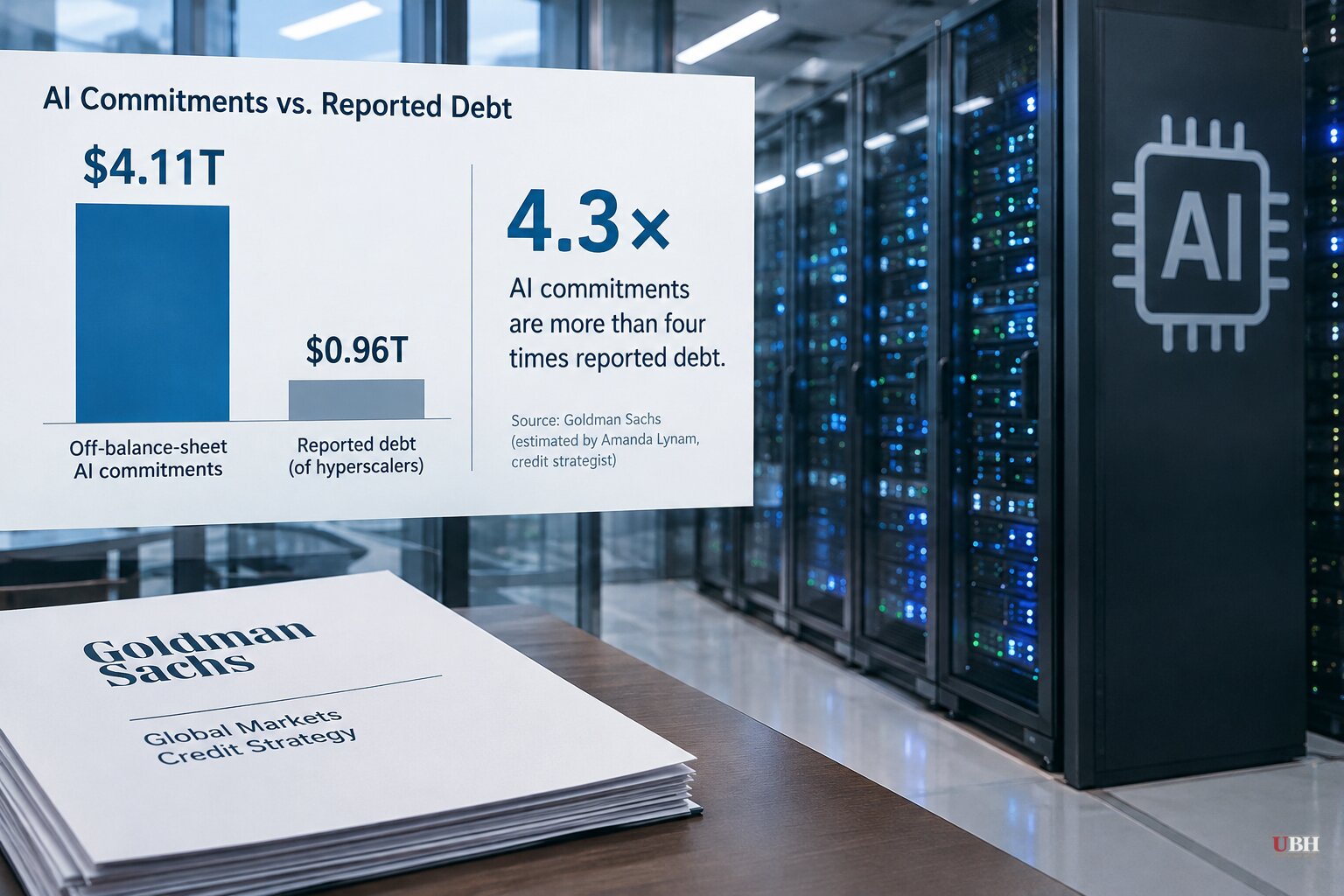
Big Tech's AI building spree now carries a price tag that mostly sits outside the balance sheet.
Goldman Sachs credit strategist Amanda Lynam estimates that five hyperscalers (Alphabet, Amazon, Meta, Microsoft and Oracle) hold about $3.6 trillion in lease and purchase commitments. Add Nvidia, Broadcom and SpaceX, and the total reaches roughly $4.11 trillion.
On-balance-sheet debt and lease liabilities for these companies come to about $1 trillion. That is more than $4 of unrecorded commitments for every $1 of reported liabilities.
What the commitments are
Goldman splits the hyperscaler figure into two buckets. About $1.7 trillion is lease obligations, mostly data centers, infrastructure and equipment. About $1.9 trillion is other purchase commitments, including hundreds of billions due by the end of 2027.
More than 75% of the hyperscalers' lease obligations have not yet begun, according to Goldman. Lease obligations for the five have grown eightfold since 2023.
Standard accounting keeps commitments off the books until they start. Nothing here means the companies are concealing anything. The numbers come from quarterly disclosures.
The pace of growth
Morgan Stanley put the comparable figure at about $3.12 trillion at the end of August 2026. Goldman's $4.11 trillion implies an increase of roughly $992 billion in about 90 days.
That comparison mixes methods. Morgan Stanley's earlier tally included commitments drawn from news reports rather than formal filings. Counting those, the new total would be $4.29 trillion, according to a Wall Street Insights analysis of the filings.
That same analysis looks only at the five companies that have filed third-quarter reports. Their combined off-balance-sheet commitments rose from $2.48 trillion to $3.05 trillion, a gain of $577 billion, or 23%, in one quarter.
Meta added $195 billion, up 29%. Its irrevocable purchase commitments climbed from $349 billion to $455 billion, mostly for third-party cloud capacity for 2027 and beyond. Unused signed leases rose from $279 billion to $356 billion, including a $68 billion lease signed in July. Amazon added $131 billion, up 41%.
Meta raises equity
Meta announced on Oct. 26 that it will raise $95 billion in stock: $35 billion through public offerings and $60 billion through ongoing share sales. The company said proceeds will support "emerging AI opportunities," including applications, data centers and its AI agent Muse. Shares were little changed after the announcement.
Meta has told investors its full-year capital spending will run between $135 billion and $145 billion. After its third-quarter report, the stock fell despite better-than-expected revenue and earnings per share. Jay Woods, chief market strategist at Freedom Capital Markets, said fears of continued capex and negative free cash flow "outweighed any positive feelings."
The Wall Street Insights analysis says credit default swaps on Meta hit a record high after the earnings report.
The other side of the ledger
The companies have real money behind the promises. The same analysis credits Meta with $97 billion in operating cash flow and an Aa3/AA- credit rating. Goldman's Lynam did not call the commitments reckless. She flagged where they could matter: future cash flows, leverage metrics and how rating firms evaluate these companies.
Nvidia CEO Jensen Huang argues the strain is a funding gap, not a demand problem. Demand for neocloud services is "off the charts," he told CNBC recently, but "there's a scarcity of capital." His view: "The demand of the capital is much greater than the availability of the capital. That's going to get solved."
Elon Musk is less sanguine about the smaller players. In an Oct. 25 post on X, he said debt markets have closed to companies without "substantial revenue independent of AI data centers." He predicted the 200-plus neoclouds will see "guppy-level death and consolidation."
Rating agencies split
There is no common yardstick for these obligations. Lynam noted that S&P adjusts for off-balance-sheet leases in its leverage calculations. Moody's and Fitch do not make comparable adjustments. She said potential changes in rating methodology deserve continued monitoring.
The financing mix is also shifting. Goldman's research says AI-related debt issuance in 2026 has already topped earlier full-year forecasts. Private markets and special purpose vehicles are funding a larger share of data center and chip projects.
Goldman separately estimates global companies will spend $7.6 trillion on computers, data centers and power between 2026 and 2031.
What comes next
The $4.11 trillion figure is a floor. Nvidia is scheduled to report quarterly results in late November. Oracle and Broadcom are due in December. None of the three has yet updated its commitments for the latest quarter.
Their filings will show whether the climb continues. The open question is whether Moody's and Fitch follow S&P in counting leases that have not yet started.
Sources used for this briefing
7 links from 7 independent newsrooms (syndicated copies of the same report count once)
These are the sources it draws on, linked so you can verify.


