
Unbiased headlines. Facts, not spin.
Unbiased Headlines is an independently owned news organization. We bring you the facts, not opinions, written fresh from 110+ named sources. Sources linked so you can verify it yourself.
 finance
Breaking / Critical (9/10)
Dow Closes Up 1,569 Points, 3%, for Best Day Since April 2025 After Democratic Sweep
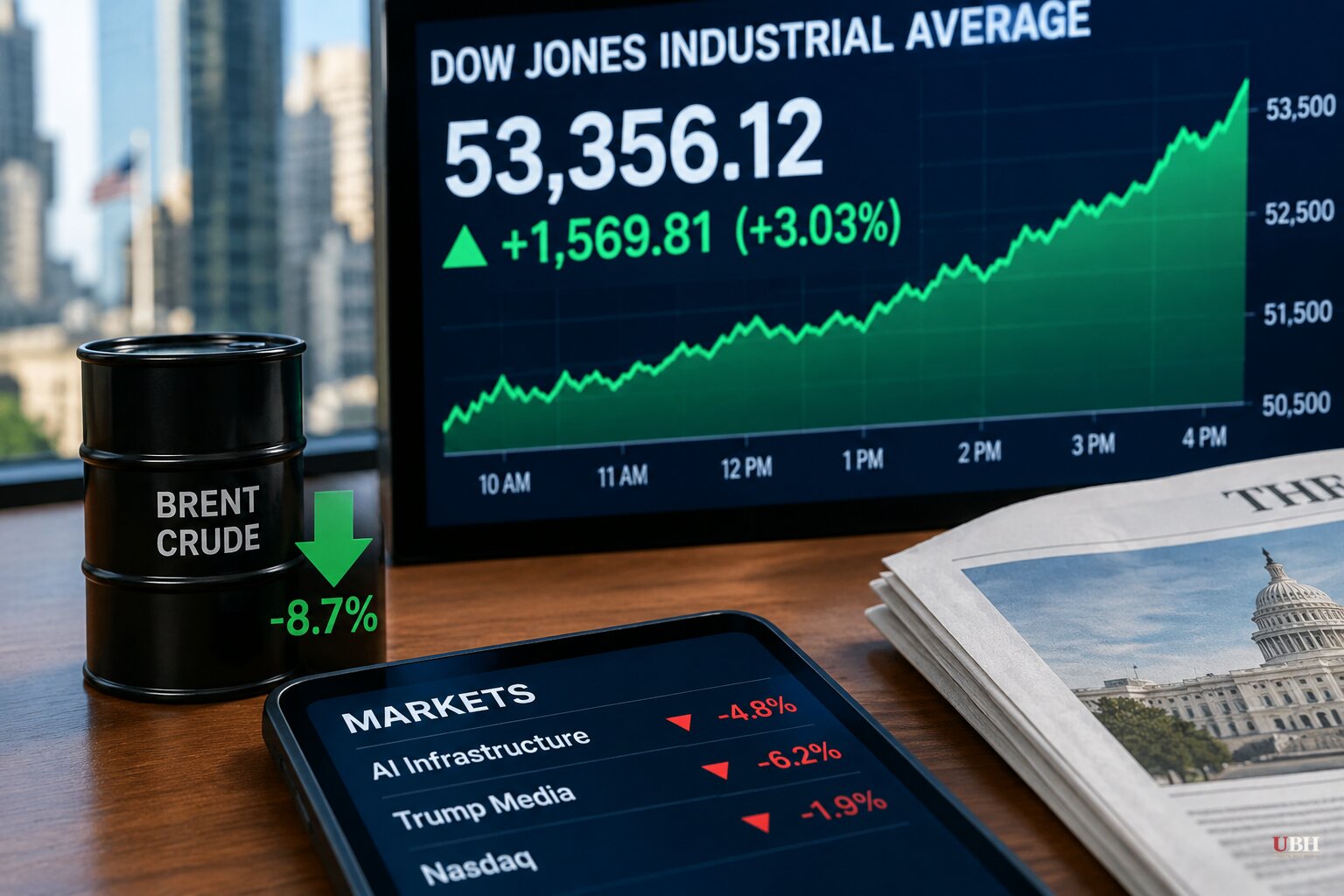
Since Democrats won both chambers of Congress on Nov. 3, Wall Street has gone from a roughly 1,000-point Dow gain before the opening bell to the index's best session since April 2025. The Dow Jones Industrial Average closed up 1,569.40 points, or 3.03%, at 53,356.12.
The S&P 500 gained 1.58% to 7,688.62. The Nasdaq Composite rose 1.44% to 25,736.51. It was the Dow's first close above 53,000 since Sept. 8.
CFRA Research data showed it was the Dow's biggest post-midterm single-day gain since 1982. The S&P 500's gain was its second-biggest post-midterm day over that span, behind 2018. The VIX, the market's volatility gauge, sank almost 20%.
Oil drops after Vance's comment
Crude was the day's other big mover. U.S. crude fell more than 8%. Brent settled at $94.62 a barrel, down almost 8.7% and the lowest settle since Aug. 31.
Oil's declines accelerated after Vance posted on X: "The reason we lost is the war. The president himself said so last night." Bond yields fell and the dollar weakened.
Peter Boockvar, chief investment officer at One Point BFG Wealth Partners, said there will be "even more pressure to end the war." He pointed to voter anger over inflation and gasoline prices.
Bob McNally, president of Rapidan Energy Group, disagreed. "Traders are betting that the administration is going to quit this war because the (midterms) shellacking was bigger than anyone expected," he said. "We're not buying it. We think escalation is more likely."
Trump's concession helped the tape
Trump told The New York Times he was "absolutely willing" to accept the results. He told The Wall Street Journal that he and Republicans would work with Democrats.
Jay Woods, chief market strategist at Freedom Capital Markets, said the rebound was "in part due to the president's initial tone and reaction to the results." Patrick O'Hare of Briefing.com wrote that the market took comfort in the understanding that the result would not be contested.
Trump also posted an image of a red "VETO" hat on Truth Social as results came in. Democrats did not win a veto-proof majority in either chamber.
Stephen Brown of Capital Economics said the size of the Democratic gains "does not change too much for the near-term policy outlook." He cited the party's lack of a filibuster-proof Senate majority and Trump's veto power.
Winners and losers
Economy-linked shares led the gains. Walmart rose about 3% and Bank of America about 4%. Solar companies, dollar stores and hospital owners also led, according to CBS News.
The damage landed in AI infrastructure and Trump-adjacent companies. Trump Media & Technology fell nearly 25%. SpaceX fell 3.8% and Tesla 3.3%. Nvidia dropped about 3%.
Gina Hinojosa's win over Gov. Greg Abbott in Texas drove much of the AI selling. She has called for a temporary moratorium on data center development in the state. Estimates put Texas at roughly a quarter to 30% of planned U.S. data center capacity.
In Business Insider's tally, CoreWeave fell 9%, IREN 11% and Nebius 7%. The Roundhill Neocloud ETF slid 8%.
Without a veto-proof majority, debates over data centers are likely to play out at the state and local level, Business Insider's analysis said. John Boyd of The Boyd Company expects more scrutiny of tech and AI, financial services, healthcare and parts of energy, "even without new legislation."
What history says, and what comes next
Analysts leaned on gridlock and past performance. Edward Jones figures show the S&P 500 rose an average of 15.5% in the six months after the last 14 midterms dating to 1970. BlackRock puts the average at 14% over the same window.
Tom Essaye of Sevens Report noted the S&P 500 has been higher 12 months after all 19 midterms since 1950. He also flagged possible volatility from next year's debt-ceiling fight, Senate investigations and impeachment threats.
Wells Fargo Investment Institute analysts said growth, inflation, rates and earnings have historically mattered more to markets than the party makeup of Congress.
In Washington, House Majority Whip Tom Emmer launched a bid to stay on as Republican whip. He wrote that "there is no sugarcoating the failure we just experienced." Minority Leader Hakeem Jeffries is running for Speaker.
The next test is the Iran war. If the administration scales back, the oil drop has room to hold. If McNally is right about escalation, Wednesday's crude slide could reverse.
Sources used for this briefing
7 links from 7 independent newsrooms (syndicated copies of the same report count once)
These are the sources it draws on, linked so you can verify.


