
Unbiased headlines. Facts, not spin.
Unbiased Headlines is an independently owned news organization. We bring you the facts, not opinions, written fresh from 110+ named sources. Sources linked so you can verify it yourself.
 finance
Breaking / Critical (9/10)
Dow Climbs About 1,300 Points Midday as Wall Street Prices In Divided Government
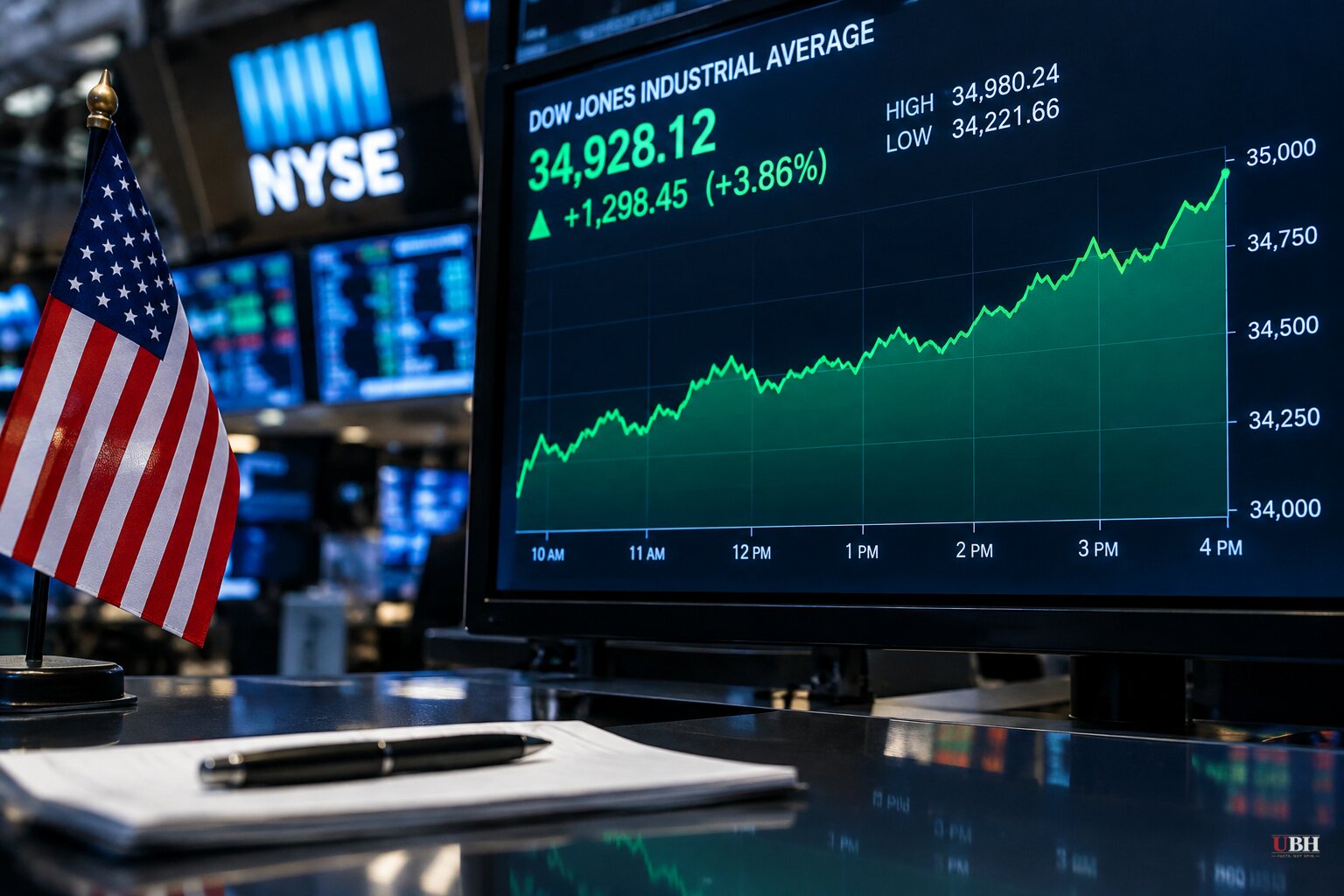
Since Democrats took the House and Senate on Nov. 3 and futures pointed higher before the open, the rally has widened into one of the biggest single-day gains in months. By late morning Wednesday, Nov. 4, the Dow Jones Industrial Average was up roughly 1,240 to 1,377 points, or between 2.4% and 2.7%, depending on the moment of measurement. CNN said it was on track for its best day since April.
The S&P 500 was up between 1.4% and 1.6%. The Nasdaq Composite gained between 1.4% and 1.8%. The VIX, the market's volatility gauge, dropped 16%.
Why traders say stocks are up
The explanations come from market strategists. Jay Woods, chief market strategist at Freedom Capital Markets, said the rebound was "in part due to the president's initial tone and reaction to the results." Trump has told The New York Times he is "absolutely willing" to accept the outcome and told The Wall Street Journal that he and Republicans would work with Democrats.
The other driver cited is gridlock. "Markets like gridlock — they don't like a party with too much power," said Andrew Slimmon of Morgan Stanley Investment Management. Tom Essaye, founder of Sevens Report, noted that Democrats did not win a veto-proof majority in either chamber. He pointed out that the S&P 500 has risen 12 months after all 19 midterm elections since 1950.
George Saravelos, global head of FX research at Deutsche Bank, wrote that a large Democratic majority plus Trump's stated willingness to work with the opposition should "bring down risk premia." Bond yields fell and the dollar weakened against a basket of major currencies. Deutsche Bank analysts said divided government makes fiscal stimulus harder to pass, which eased concerns about the deficit.
Capital Economics' Stephen Brown cautioned that the near-term policy outlook changes little. Democrats still lack a filibuster-proof Senate majority, and Trump holds the veto.
Who is up and who is down
Consumer and financial names led. Walmart gained 3% and Bank of America rose 2.5%. Health insurers and hospital operators jumped: Molina Healthcare rose 5%, while Centene and HCA Healthcare each gained 7%. The Invesco Solar ETF climbed 8%.
Oil moved lower. West Texas Intermediate crude futures fell about 2% to around $94 a barrel. Slimmon said any push toward ending the Middle East conflict could pull prices down further, which would ease a problem for the Federal Reserve and inflation.
Apple and Microsoft both touched record highs. Nvidia and Micron fell more than 1%, and CoreWeave and SpaceX also traded lower.
The data center problem
The weak spot is the AI build-out. Hinojosa, who defeated Republican Gov. Greg Abbott, has pledged an immediate moratorium on data center construction in Texas. The Epoch Times reported that Texas accounts for roughly a quarter of planned U.S. data center capacity in the coming years.
The result also surprised some traders. According to CNN, odds on Kalshi for a Hinojosa win were below 20% for most of the year.
John Boyd, principal at The Boyd Company, an economic development consulting firm, said he expects "greater scrutiny of tech and AI, financial services, healthcare, and parts of the energy sector," with possible effects on compliance costs, investigations and project timelines, even without new legislation. Essaye said Senate investigations, impeachment threats and next year's debt-ceiling fight could bring volatility back, though he does not expect lasting damage to markets.
Separately, the Treasury Borrowing Advisory Committee, a panel of bank and investor executives, released a presentation Wednesday titled "Circular Financing is a feature," defending the loop of chipmakers, cloud companies and customers funding one another. Yahoo Finance reported that the cost of insuring AI borrowers' debt has jumped as much as 80% since August.
Overseas and the Iran war
Overseas, Japan's Nikkei 225 dipped 1.4% and SoftBank dropped 3.2%. The Shanghai Composite gained 2.2%, rebounding from a year low on Tuesday. The Hang Seng rose 1.5%.
Schumer said at a Wednesday news conference that the war in Iran "must end" and that Democrats could use Congress's spending power to pressure the administration. Vance wrote that the war cost Republicans votes. Neither has laid out a timeline.
The next scheduled data points are the eurozone's flash October inflation reading, due Wednesday, and the Bank of England rate decision on Thursday. Whether Hinojosa can deliver a data center moratorium once she takes office, and how far other states follow, is the open question for AI-linked shares.
Sources used for this briefing
7 links from 7 independent newsrooms (syndicated copies of the same report count once)
These are the sources it draws on, linked so you can verify.


