
Unbiased headlines. Facts, not spin.
Unbiased Headlines is an independently owned news organization. We bring you the facts, not opinions, written fresh from 110+ named sources. Sources linked so you can verify it yourself.
 finance
Major Story (8/10)
Treasury Yields Slip After Midterms: 10-Year at 4.917%, 30-Year at 5.289%
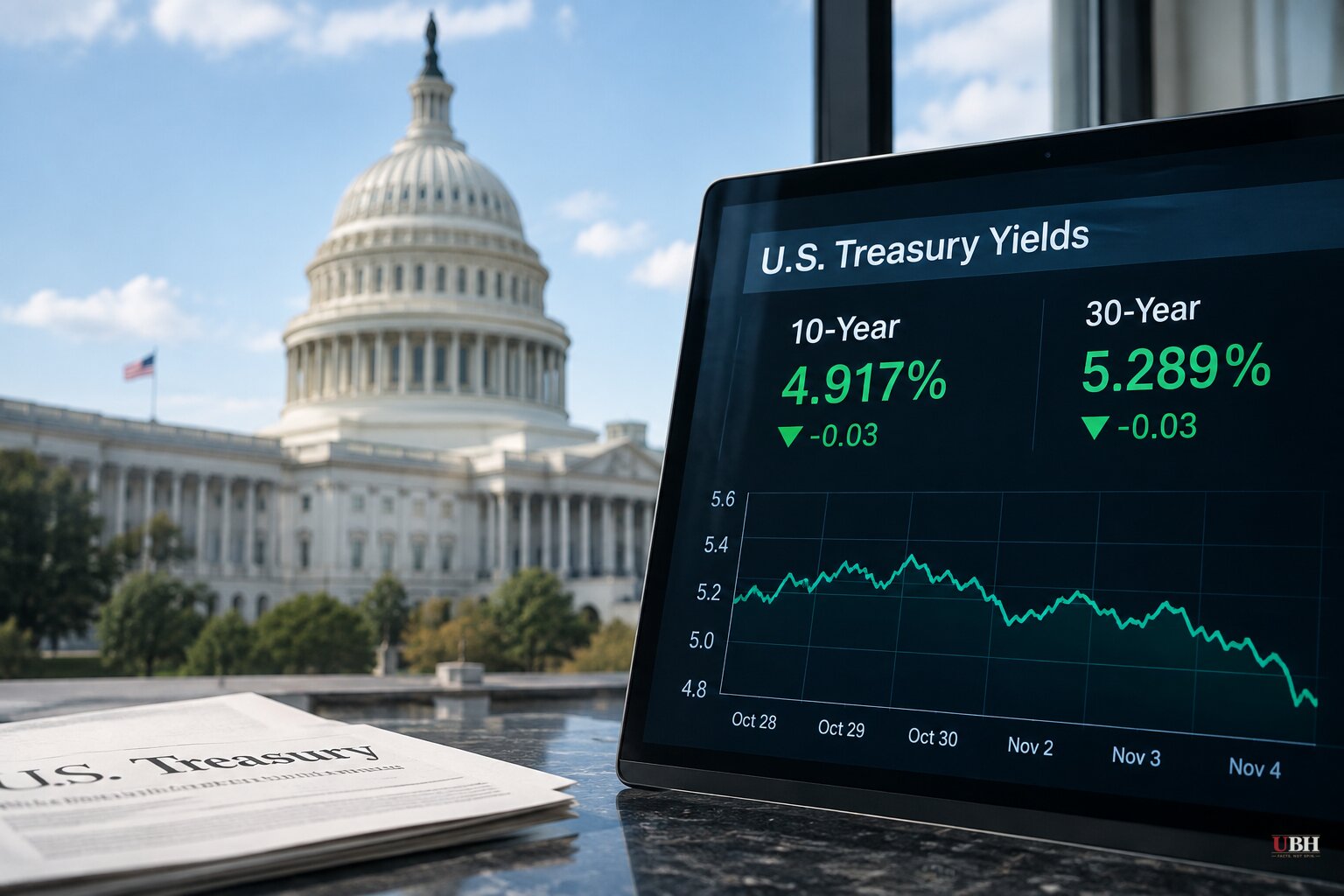
Since Democrats were projected overnight to win both chambers of Congress, the clearest market signal has come from the bond market, not stocks. Treasuries rallied on Wednesday morning, Nov. 4.
The 10-year Treasury yield fell 3 basis points to 4.917%. The 30-year dropped 4 basis points to 5.289%. The 2-year barely moved, down marginally to 4.606%. Yields fall when bond prices rise.
The 30-year had pushed above 5% this summer. Investors are now treating Treasuries as the safe place to park money while Washington's new balance of power sorts itself out.
Why bond desks like gridlock
The projected margins are large. CNBC's projection has Democrats winning at least 250 House seats and at least 54 Senate seats. The party flipped Senate seats from Republicans in Iowa, Kansas, North Carolina, Ohio, South Carolina, Maine and Texas.
The bond logic is simple. A Democratic Congress will find it harder to pass a Trump spending agenda. A Trump veto pen will block much of what Democrats send him.
"Fiscal gridlock seems the likely default," UBS's Paul Donovan told clients Wednesday. He added that Trump "has seemingly retreated from an earlier pledge to veto everything the Democrats suggest."
Deutsche Bank's Jim Reid made the same connection. Divided government "has generally made it harder for fiscal stimulus to be passed," he wrote, which "eased concerns on the fiscal trajectory a bit."
The numbers behind the worry
Those concerns are not abstract. Federal deficits run between 6% and 7% of GDP. Interest on the national debt now costs more than $1 trillion a year.
That is taxpayer money going to debt service instead of anything voters can see. Neither party's recent record on borrowing is clean.
Gridlock slows new spending. It does not cut existing spending, and no source in this story points to a specific deficit-reduction plan from either side.
JPMorgan's traders flagged "reduced deficit spending" as a focus for Wall Street after the midterms. They said it "can be achieved by asserting power over the budget and likely wading through a government shutdown."
Not everyone sees a big shift
Stephen Brown of Capital Economics argued the results change less than the headlines suggest. "The magnitude of the gains for the Democrats in the midterms does not change too much for the near-term policy outlook," he said, because the party "still lacks a filibuster-proof majority in the Senate and President Trump has veto power to block legislation."
Investing Live's market note points to a second risk. Renewed debt ceiling brinkmanship could raise volatility and weigh on the dollar if markets price a more fractious 2027. The U.S. Dollar Index slipped to 101.30 as futures sold off Tuesday evening, according to BigGo Finance.
Stocks abroad: mixed, with AI names under pressure
Overseas equities were mostly higher Wednesday, and the AP reported U.S. futures edging up with oil prices lower.
In Europe, Paris's CAC 40 rose 0.4% to 8,055.02 in early trading. Germany's DAX climbed 0.5% to 25,995.13. London's FTSE 100 edged up 0.1% to 10,646.43.
In Asia, Hong Kong's Hang Seng gained 1.5% to 23,888.46. The Shanghai Composite rose 2.2% to 3,686.17, rebounding from a year low on Tuesday.
Japan's Nikkei 225 fell 1.4% to 62,188.63. SoftBank Group, an OpenAI investor, dropped 3.2%. Memory chipmaker Kioxia fell 5.4% after October-December guidance missed expectations.
Taiwan's Taiex lost 0.8%. South Korea's Kospi rose 0.6% to 5,683.80. Australia's S&P/ASX 200 fell 0.6% after the central bank raised interest rates Tuesday.
The AI trade was already shaky before the vote. On Friday, Oct. 30, the Nasdaq Composite fell about 2.86%. Intel dropped 28.58% to close at $65.76, according to Epoch Times commentator Edward Chin's tally.
What to watch next
The eurozone's flash consumer price index for October is due Wednesday. The Bank of England announces a rate decision Thursday, Nov. 5.
The larger unresolved question is whether the bond rally holds once Congress faces actual budget deadlines. No source gives a date for the first showdown. JPMorgan's desk expects it to end in a shutdown.
Sources used for this briefing
7 links from 7 independent newsrooms (syndicated copies of the same report count once)
These are the sources it draws on, linked so you can verify.


