
Unbiased headlines. Facts, not spin.
Unbiased Headlines is an independently owned news organization. We bring you the facts, not opinions, written fresh from 110+ named sources. Sources linked so you can verify it yourself.
 finance
Breaking / Critical (9/10)
S&P 500 Closed Down 4.4%, Nasdaq 100 Lost 6.4% in AI Rout; Asian Stocks Slide Friday as US Futures Edge Up
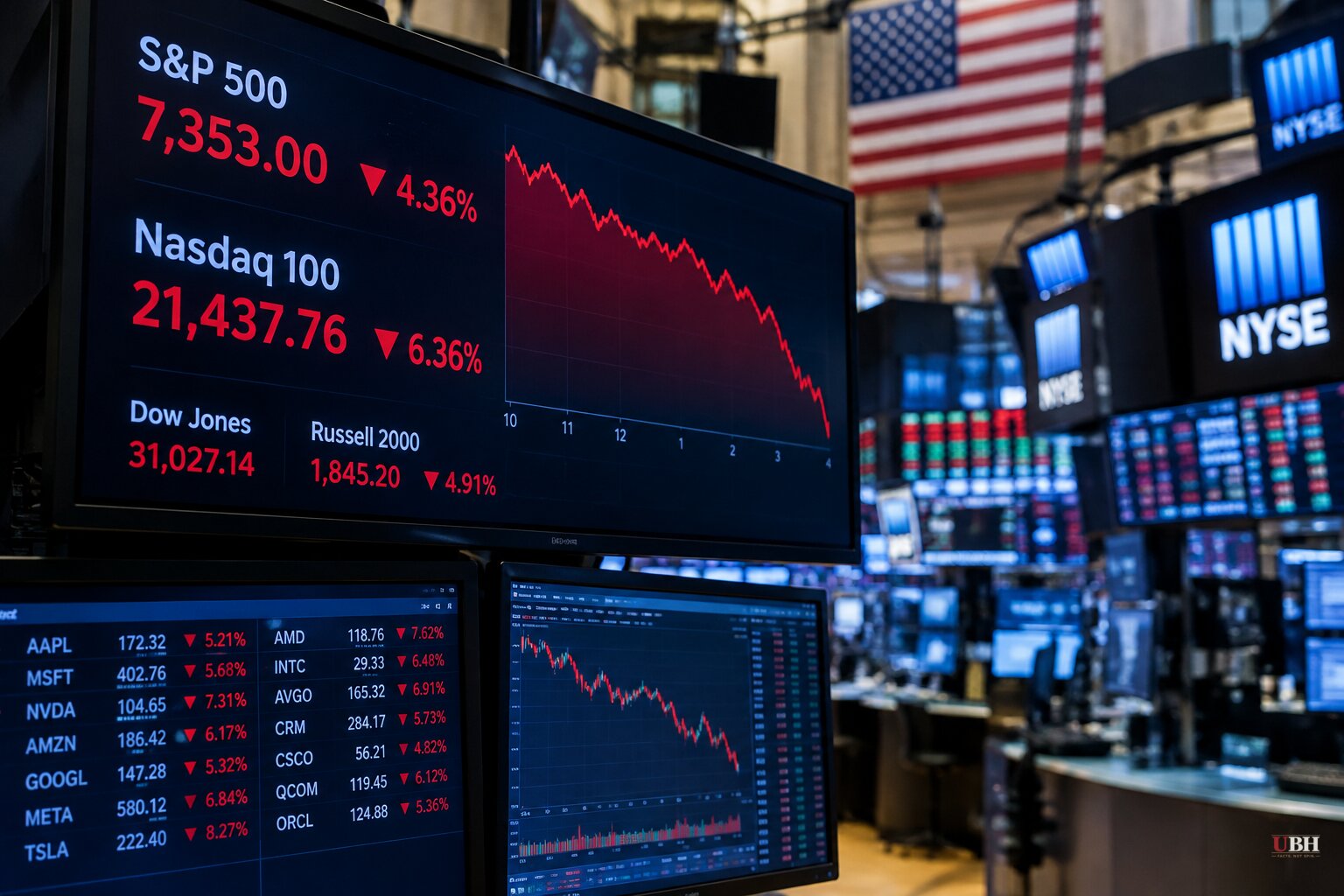
Thursday's close put hard numbers on the damage. The S&P 500 fell 334 points, or 4.36%, to 7,353, its worst day since the April 2025 tariff selloff. The Dow lost 1,833 points, or 3.44%, and the Nasdaq Composite dropped 5.52% to 24,315.
The Nasdaq 100 sank 6.36%, its worst session since March 2020. An index of chipmakers fell about 12%, its worst day in roughly six and a half years. All 30 Dow components finished lower.
Asia sells off, U.S. futures edge up
The pain carried into Friday, Nov. 6. Japan's Nikkei slid almost 6%, its worst drop since April 7, 2025. Taiwan's TAIEX fell 4.5%. South Korea's Kospi plunged almost 9% at the open, triggering a 20-minute trading halt, and was down 6.7% in Friday trading.
Christopher Forbes, head of Asia and Middle East at CMC Markets, said clients were "long index, long stocks, and they all got carried out." He described margin calls and complaints "all night, all day."
U.S. futures point to a calmer start. S&P 500 contracts were up 0.2% and Nasdaq 100 contracts up 1.1% in pre-market trading. Those are indications, not an opening price. Investors are also watching the latest U.S. jobs report, due at 1:30 p.m. GMT.
Estimates of the value erased vary by measure. CNN put the U.S. market loss at roughly $2.5 trillion on Thursday, Bloomberg at around $3 trillion off the S&P 500, and The Guardian at more than $3.2 trillion off the U.S. stock market. Separately, Bloomberg reported the Nasdaq 100 fell further into a correction, leaving it down nearly 15% from its Oct. 6 record.
Who got hit
Nvidia fell 9.3% and is down 2.6% for the year, after annual gains of roughly 39%, 171% and 239% in the prior three years. AMD tumbled 17.3%. Memory chipmakers led the carnage: SanDisk lost 22% and Micron 17%.
Neocloud firms that rent out AI computing power also dropped. CoreWeave fell about 10% and Nebius about 15%. CoreWeave is down 76% from its June 2025 peak, and Nebius is down 58% from its peak this June.
The selling was not limited to tech. Walmart fell too. A momentum-focused ETF had one of its worst days in more than a decade, and investors rushed into Treasuries.
Some stocks rose. AppLovin jumped 31% after beating profit and revenue expectations and approving a buyback of up to $3.2 billion. Tapestry gained 7.1% after raising its forecasts. Energy and consumer staples held up best.
The political explanation and its limits
Market participants tie the rout to Tuesday's midterms. Democrats won both chambers of Congress and key governorships. In Texas, Democrat Gina Hinojosa defeated Republican Gov. Greg Abbott after campaigning on a temporary data center moratorium and cutting certain tax incentives for data center builders. Google, Meta, Oracle and OpenAI have all made big data center investments in the state.
Chris Zaccarelli, a chief investment officer, said the narrative has shifted from "AI changes everything" to "Blue wave means data centers will never be built again in this country." Michael O'Rourke, chief market strategist at JonesTrading, said Wednesday's rally "jumped the gun" and that a policy change would be "a structural shift."
President Trump blamed the election outright. "Such a sad thing to watch!" he wrote on Truth Social. "Your 401(k)s have, therefore, dropped." Peter Schiff of Euro Pacific Asset Management wrote on X: "Yesterday's stock market rally in the face of the Democratic landslide made no sense... Expect more days like today."
The timeline complicates a pure election story. Under the surface, chip and data center stocks were already falling on Wednesday, even as the major indexes rose. Kyle Rodda of Capital.com noted the AI trade was "already on shakier foundations," with Magnificent Seven earnings undershooting growth expectations and signs that AI spending is slowing. Qualcomm fell after its outlook disappointed and smartphone-chip revenue dropped 26% to $5.14 billion. The Epoch Times noted the selloff came despite a mostly solid third-quarter earnings season, with a majority of reporting S&P 500 companies beating estimates.
Greg Taylor of PenderFund Capital Management put it in broader terms. "I'm getting flashbacks to 2008 or 2001," he said, adding that the unwind "needed to happen as we have too much focus on AI and it became too big a part of the market."
Other forces are in play too. Voters cited high gas prices and the impact of AI and data centers, and investors had bet a divided Washington would hasten the end of a war in Iran that rekindled inflation and pushed interest rates higher. Voters across party lines say they are wary of AI and dislike the power bill increases tied to data centers, and Breitbart reported that data center measures appeared on ballots in at least 41 jurisdictions in 10 states.
What is still unsettled
Hinojosa is governor-elect and has not taken office. The sell-off is a bet on what may come.
Both the S&P 500 and Dow remain up for the year, by 7.4% and 7%, while the Nasdaq is up roughly 5%. It sits more than 10% below its Oct. 6 record close. Friday's U.S. open will show whether Thursday's selling continues or the bounce indicated by futures holds.
Sources used for this briefing
7 links from 7 independent newsrooms (syndicated copies of the same report count once)
These are the sources it draws on, linked so you can verify.


