
Unbiased headlines. Facts, not spin.
Unbiased Headlines is an independently owned news organization. We bring you the facts, not opinions, written fresh from 110+ named sources. Sources linked so you can verify it yourself.
 finance
Breaking / Critical (9/10)
Kospi Halts on 9% Plunge and Nikkei Enters Bear Market After Nasdaq Closes 5.5% Lower on AI Selloff
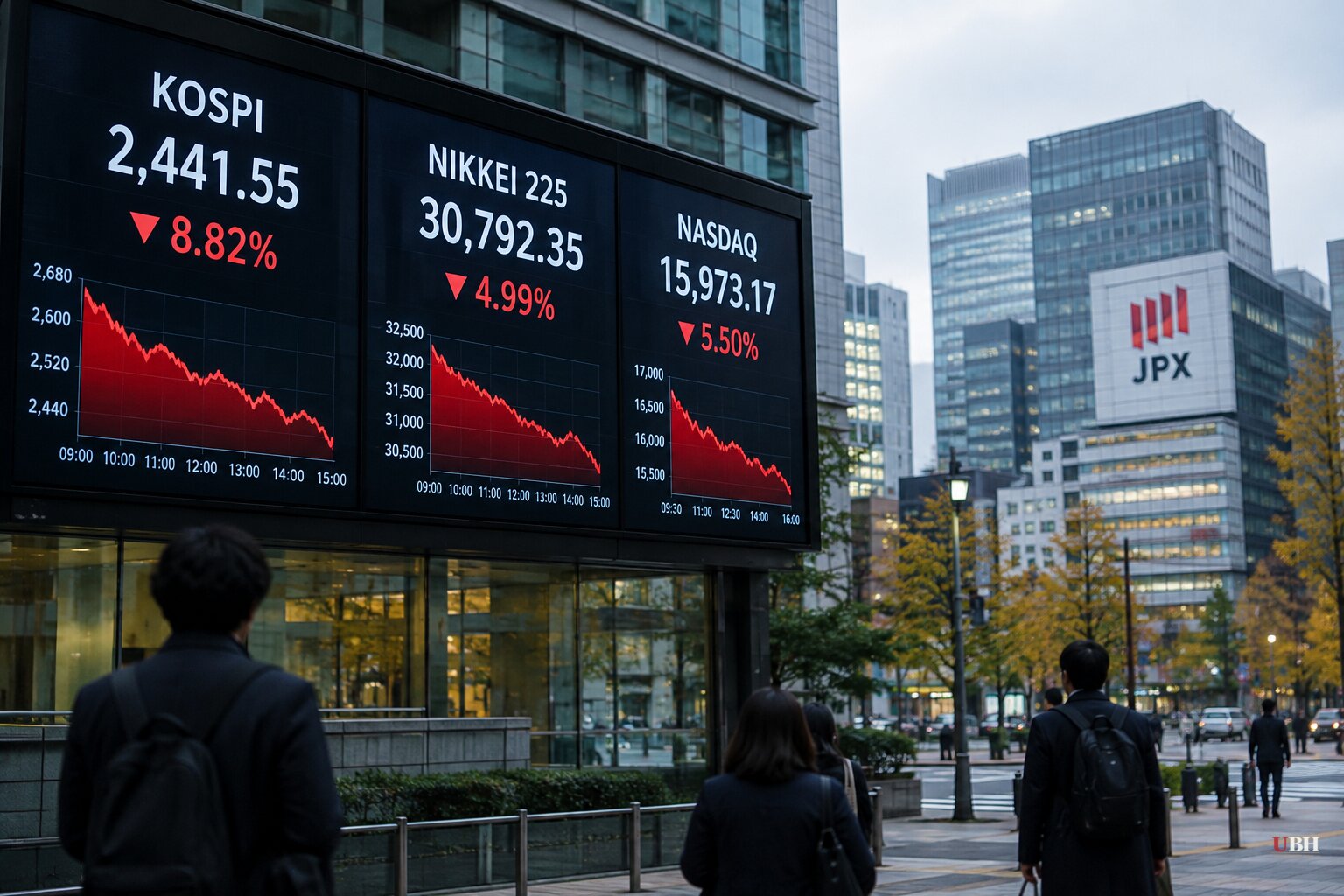
Since Wednesday's post-midterm rally reversed into Thursday's AI rout, the selling has spread to Asia, where Japan's Nikkei 225 has entered a bear market and South Korea's Kospi has been halted by a circuit breaker.
The damage in Asia came as markets opened Friday, Nov. 6, local time, which was Thursday evening in New York.
Asia takes the next hit
The Kospi dropped more than 6% in the first reports and kept sliding. By the open it was down 8.55%, which triggered a 20-minute trading halt. It later extended losses to nearly 9% and fell below 5,000.
Samsung Electronics and SK Hynix each shed more than 9% at the open.
The Nikkei 225 fell about 5.9% to 6%, putting it more than 20% below its June peak, the technical definition of a bear market. The broader Topix lost 5.2%, and the MSCI Asia Pacific Index lost 2.9%.
Chip names led the Japanese decline. Advantest fell 12%, SoftBank Group 11%, Kioxia Holdings 11%, and Tokyo Electron nearly 9%.
Bloomberg reported that the performance gap between the tech-heavy Nikkei and the broader Topix has widened more than at any point in decades.
Not everything fell the same way. Hong Kong's Hang Seng lost about 1% and Australia's ASX 200 slipped 0.7% to 0.9%. Bloomberg reported that investors in Hong Kong were rotating out of AI supply-chain stocks and into discounted Chinese internet platforms.
The final Wall Street tally
The closing numbers are now in. The Nasdaq Composite fell 1,421 points, or 5.52%, to 24,315, closing more than 10% below its record close from last month. The S&P 500 lost 334 points, or 4.36%, to 7,353. The Dow dropped more than 1,800 points, or 3.44%.
All three had their worst day since April 2025. The Russell 2000 small-cap index fell more than 4%.
All 11 S&P 500 sectors closed lower, though consumer staples, energy, health care and utilities held up better than tech.
Micron and AMD each fell 17%. CoreWeave dropped 10%. Nvidia fell 9% and is now negative for 2026. The Magnificent Seven together shed more than $1 trillion in market value.
The Nasdaq 100 fell 6.4% and lost $2.3 trillion in market value, its steepest one-day drop since March 2020. A gauge of chipmakers fell 12%. The Philadelphia Semiconductor Index is down almost 16% this week, heading for its worst week since April 2025.
For the week, the Nasdaq is down 4.4%, the S&P 500 almost 3%, and the Dow just 0.5%. Year to date, the Nasdaq is still up roughly 5%, the S&P 500 is up 7% and the Dow is up 7.4%.
What traders and the president are saying
Traders tie the selloff to Democratic wins in the House, the Senate and governorships including Texas. Their worry is a slowdown in data center construction. Chris Zaccarelli, a chief investment officer, said the market narrative has shifted from "AI changes everything" to "Blue wave means data centers will never be built again in this country." Some lawmakers have called for more AI regulation, and a few have called for a moratorium on data center construction.
President Trump blamed the election results on Truth Social. "Such a sad thing to watch!" he wrote. "Your 401(k)s have, therefore, dropped."
Peter Schiff of Euro Pacific Asset Management said Wednesday's rally "made no sense" and that Thursday's selloff "makes perfect sense. Expect more days like today."
Others say the drop is an entry point. Victoria Greene, CIO of G Squared Private Wealth, told CNBC that "the AI trade, in my opinion, is not dead here" and called the drop "a good discount." She is looking at memory stocks, pointing to executives' talk of a capacity crunch on earnings calls. She added that buying a volatile dip tends to work "as long as we're still in a non-recessionary period."
The election is not the only pressure on the sector. Neocloud firms including CoreWeave, IREN and Nebius have been battered in recent weeks over concerns that they will not be able to borrow enough to fund their buildouts. The selloff also came during a third-quarter earnings season in which most reporting S&P 500 companies beat expectations.
Futures and the jobs report
S&P 500 futures were down 0.6% Thursday evening, Nasdaq-100 futures down 0.8%, and Dow futures down 291 points, or 0.6%. By early Friday in Asia, Nasdaq 100 futures had edged up 0.3%.
The October payrolls report is due Friday morning. The consensus estimate is 59,000 jobs added, with the unemployment rate steady at 4.2%.
A weak number would add recession worries to a market already trading on fears about AI spending. Whether Democrats in Congress move to restrict data center construction, rather than just talk about it, remains unanswered.
Sources used for this briefing
7 links from 7 independent newsrooms (syndicated copies of the same report count once)
These are the sources it draws on, linked so you can verify.


