
Unbiased headlines. Facts, not spin.
Unbiased Headlines is an independently owned news organization. We bring you the facts, not opinions, written fresh from 110+ named sources. Sources linked so you can verify it yourself.
 finance
Major Story (7/10)
Kospi Sits 43% Below June Record at 5,383 as Korean Retail Investors Who Followed Government's Call Into Stocks Push Back
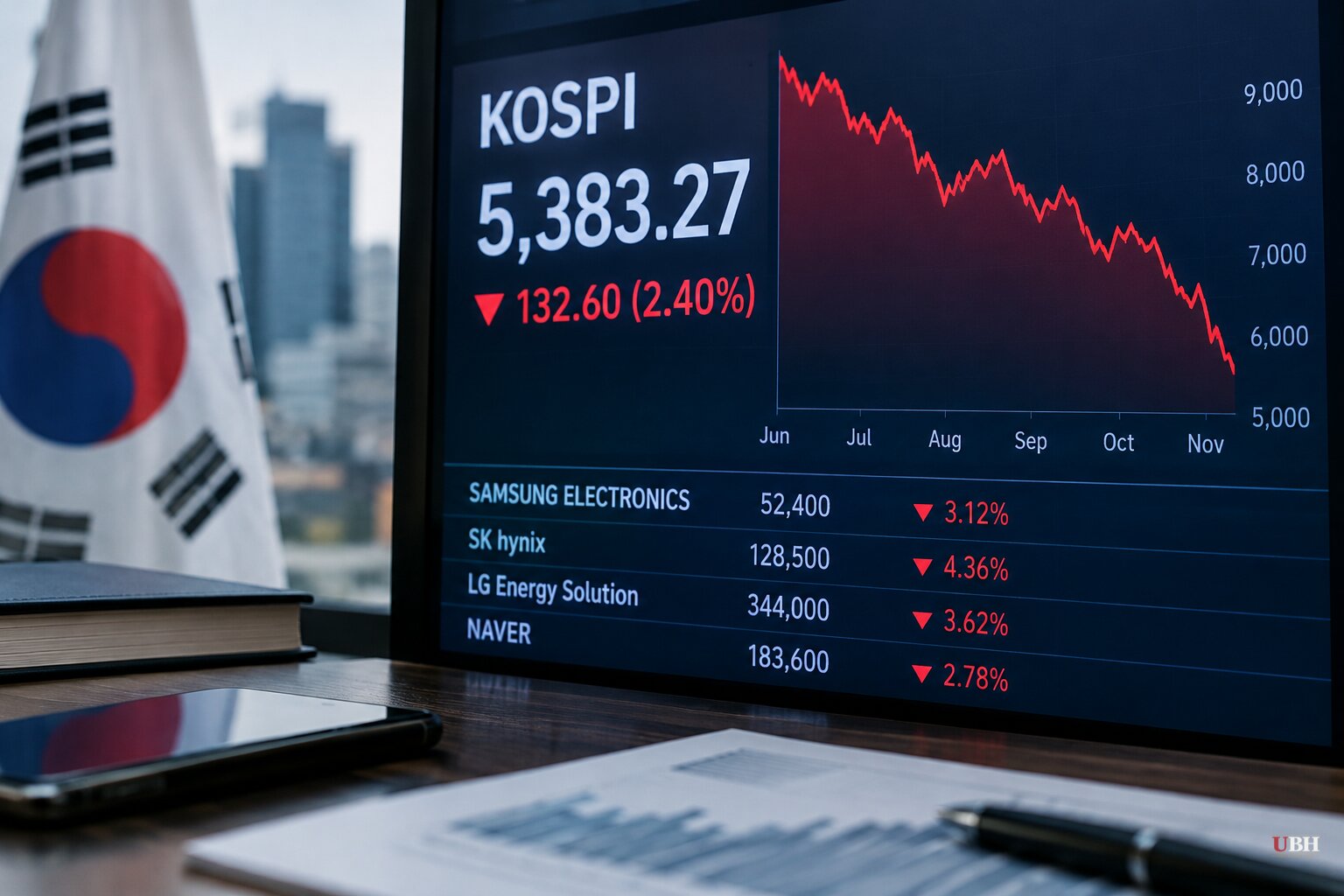
Since the Kospi hit its record 9,385 in June, South Korea's market has lost roughly 43% to 44% of its value, and the fallout has moved from trading floors to politics.
The index closed its latest session at 5,383, its lowest close since April, according to figures cited by TodayPress TV. That session was a 5.3% decline. SK Hynix shares are down 58% from their peak and Samsung is down 46%.
Bloomberg puts the total wipeout at more than a trillion dollars. In the same period, Seoul property prices have climbed for a record 91 straight weeks.
Retail investors point at the government
That gap is the source of the anger. Individual investors told Bloomberg they heeded the government's call to favor stocks over real estate while officials championed the Kospi's AI-driven surge to its June record.
Those same investors now hold losses on equities while the housing market they were nudged away from keeps rising. Bloomberg describes a retail backlash that is testing public faith in Lee and his government.
The government made the Kospi a political trophy on the way up. It now owns the way down, at least in the eyes of the people who say they followed its advice.
Borrowed money is the accelerant
Korean retail investors piled in with leverage. TodayPress TV reports that they used margin loans, leveraged ETFs tied to Samsung and SK Hynix, personal savings and pension funds.
Citi's count from the July crash: 1.2 million leveraged accounts faced margin calls and 360,000 were forcibly liquidated.
The mechanism is simple. When prices hit a liquidation threshold, brokers sell clients' holdings to close positions. That pushes prices lower and triggers more forced sales. Jed Ellerbroek, a portfolio manager at Argent Capital, described the current moment as a capitulation phase for data center and semiconductor stocks.
The US signal for Seoul
TodayPress TV reports that the Nasdaq 100 fell 6.4% in the latest US session. It puts the index's losses at more than $2 trillion and the wipeout across US equities at more than $3 trillion in a single day. Nvidia dropped 9.3% and US semiconductor stocks fell 12.3%, the outlet reports.
One of the largest Korea-linked ETFs traded in New York lost 12.6%. That is more than twice Seoul's 5.3% decline.
Korea's exchange has a three-stage halt system. An 8% fall suspends trading for 20 minutes. A 15% fall triggers a second halt. A 20% fall ends trading for the day. The largest one-day drop in Kospi history is 12.06%.
Why Korea takes the hit harder
Richard Gray, a Washington foreign policy think tank analyst writing in ChinaTalk, argues that Korea's market works as a single, highly leveraged node in the AI financial structure. He notes that from March 2025 to June 2026 the Kospi rose 241%, adding nearly $3.3 trillion in market value.
In June, SK, Samsung and Naver announced chip plant and data center plans worth $880 billion, which Gray says is more than half of Korea's annualized GDP. He says SK Hynix and Samsung together hold 83% of the global high-bandwidth memory market and 63% of DRAM. Micron, the closest American rival, holds 18% and 24%.
Gray also points to two structural discounts. One is a "Korea discount" tied to weak corporate governance and shallow capital markets. The other is a "memory discount" on every major memory maker, with emergent Chinese competitors now adding pressure.
The result is a market that is effectively a bet on two companies in one industry, financed in part by household borrowing.
What comes next
The next test is whether another leg down in AI chip stocks pushes Seoul toward the 8% halt threshold again while retail leverage is still in the system. Citi's July count shows how quickly margin calls can turn into forced selling.
The political question is separate and unresolved: whether investors who followed the government's push into equities will hold officials accountable while Seoul home prices keep rising.
Sources used for this briefing
5 links from 5 independent newsrooms (syndicated copies of the same report count once)
These are the sources it draws on, linked so you can verify.


