
Unbiased headlines. Facts, not spin.
Unbiased Headlines is an independently owned news organization. We bring you the facts, not opinions, written fresh from 110+ named sources. Sources linked so you can verify it yourself.
 finance
Major Story (8/10)
Taiwan Caps Short Selling and Readies Stabilization Fund After Taiex Falls 9% Intraday, Closes 4.5% Lower
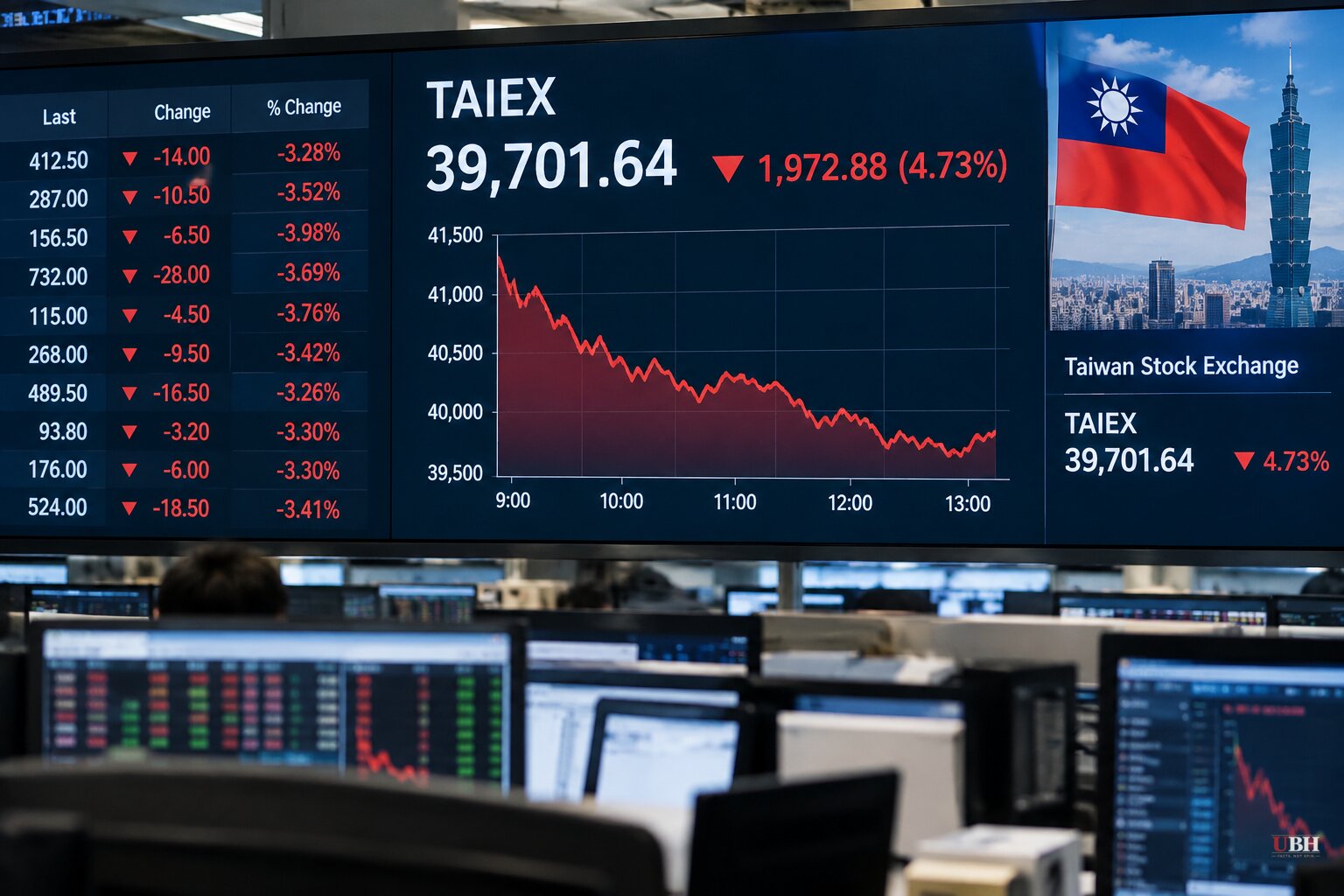
Since Wall Street's AI-driven rout on Thursday, Nov. 5, which CNN put at roughly $2.5 trillion in lost US market value, the selloff has hit Asia's tech-heavy exchanges hardest. Today, Nov. 6, it reached Taipei, and the government responded.
The Taiex fell as much as 3,737.67 points soon after the open, an intraday low of 37,837.05 and the largest intraday point drop on record, according to BigGo Finance's tally. That was roughly 9%. It recovered part of the loss and closed down 1,872 points, or 4.51%, at 39,701.64.
For the week, the index lost 5,510 points, a 12.19% decline. Equity Pandit calls it the worst weekly performance since 2001.
What Taiwan did
The Financial Supervisory Commission said it will cap intraday short-sale orders for borrowed securities at 3% of a stock's average daily trading volume over the prior 30 days. The previous cap was 30%. It will also raise the minimum margin requirement for short selling to 130% from 90%. Both changes take effect Monday, Nov. 9.
The Finance Ministry said the National Financial Stabilization Fund will activate measures to stabilize the market. It will deploy money "as conditions warrant."
The fund then held an emergency meeting at 2:30 p.m. local time, its 131st extraordinary committee session, and authorized its executive secretary to deploy money as needed, according to BigGo Finance. That is the fund's tenth intervention in its history. Its authorized ceiling is NT$500 billion, about $15.3 billion. The Legislative Yuan has scheduled review of an amendment that would raise the ceiling to NT$1 trillion, about $30.5 billion.
Premier Cho Jung-tai said he directed the FSC to "closely monitor developments in both international and domestic stock markets and to remain flexible in determining how to stabilize the domestic market." He added that Taiwan's economic fundamentals are sound and that "the profitability and potential of our various industries remain quite robust."
Taiwan has used trading curbs before in severe turmoil, most recently in 2025 when Trump's tariff policy rattled global equities.
TSMC and the foreign exodus
Taiwan Semiconductor Manufacturing Co. led the slide. Its shares dropped as much as 9.8% and closed down 4.69% at NT$2,135.
Foreign investors have been heading for the exits. They net sold a record NT$994.3 billion, about $30.4 billion, in October. Another NT$524.4 billion, about $16 billion, went out through Nov. 6. The Finance Ministry's own statement called continued foreign selling a sign of "a significant deterioration in market confidence."
Why the selling hit
The trigger is the US midterm result. Democrats won the House and Senate, and investors fear that the new Congress will slow or regulate AI infrastructure spending. Data-center backlash over environmental and community impact became a campaign issue. A Columbia Business School study cited by CNN estimates AI-related infrastructure investment drove nearly all observed US GDP growth by the end of last year.
The fear is untested. The winners of the midterms are not due to take office until early next year. Doubts about whether the huge AI outlays will earn their money back are adding to the pressure, according to Equity Pandit.
Not everyone reads this as a lasting break. Jung In Yun, founder and CEO of Fibonacci Asset Management Global, said the selloff was likely triggered by investors reassessing AI investment and policy expectations. He still believes demand for computing power will keep growing, along with demand for memory chips from Samsung Electronics and SK Hynix.
Regional picture
Kospi and Nikkei 225 each closed down about 6% today, and the Taiex finished 4.5% lower. European markets were also lower in early trading. Stoxx 600 was down 1.1% shortly after 5 a.m. ET.
US futures were mixed in early trading. The Dow was down 0.8%, the S&P 500 up 0.3% and the Nasdaq up 1.4%. These are pre-market indications, not trading prices. Nvidia and SpaceX were each up around 4% pre-market after sinking more than 9% on Thursday.
What comes next
The short-selling limits go live Monday. The Finance Ministry has not said how much money the stabilization fund will put in or when. If it needs more than the NT$500 billion ceiling, it needs lawmakers, and that amendment is already on the Legislative Yuan's calendar.
The Taiex, which Taipei Times notes soared to record highs this year as Taiwanese piled into local stocks, has been pushed into bear-market territory, according to The Edge Malaysia. Whether foreign selling slows will set the tone for Monday.
Sources used for this briefing
6 links from 6 independent newsrooms (syndicated copies of the same report count once)
These are the sources it draws on, linked so you can verify.


