
Unbiased headlines. Facts, not spin.
Every story is an unbiased news briefing written from 110+ sources across the spectrum — sources linked so you can verify it yourself.
 defense
Major Story (7/10)
July 6, 2026 at 04:37 AM
defense
Major Story (7/10)
July 6, 2026 at 04:37 AM
Three Khamenei Sons Attend Tehran Funeral. Mojtaba, the New Supreme Leader, Still Hasn't Been Seen in Public.
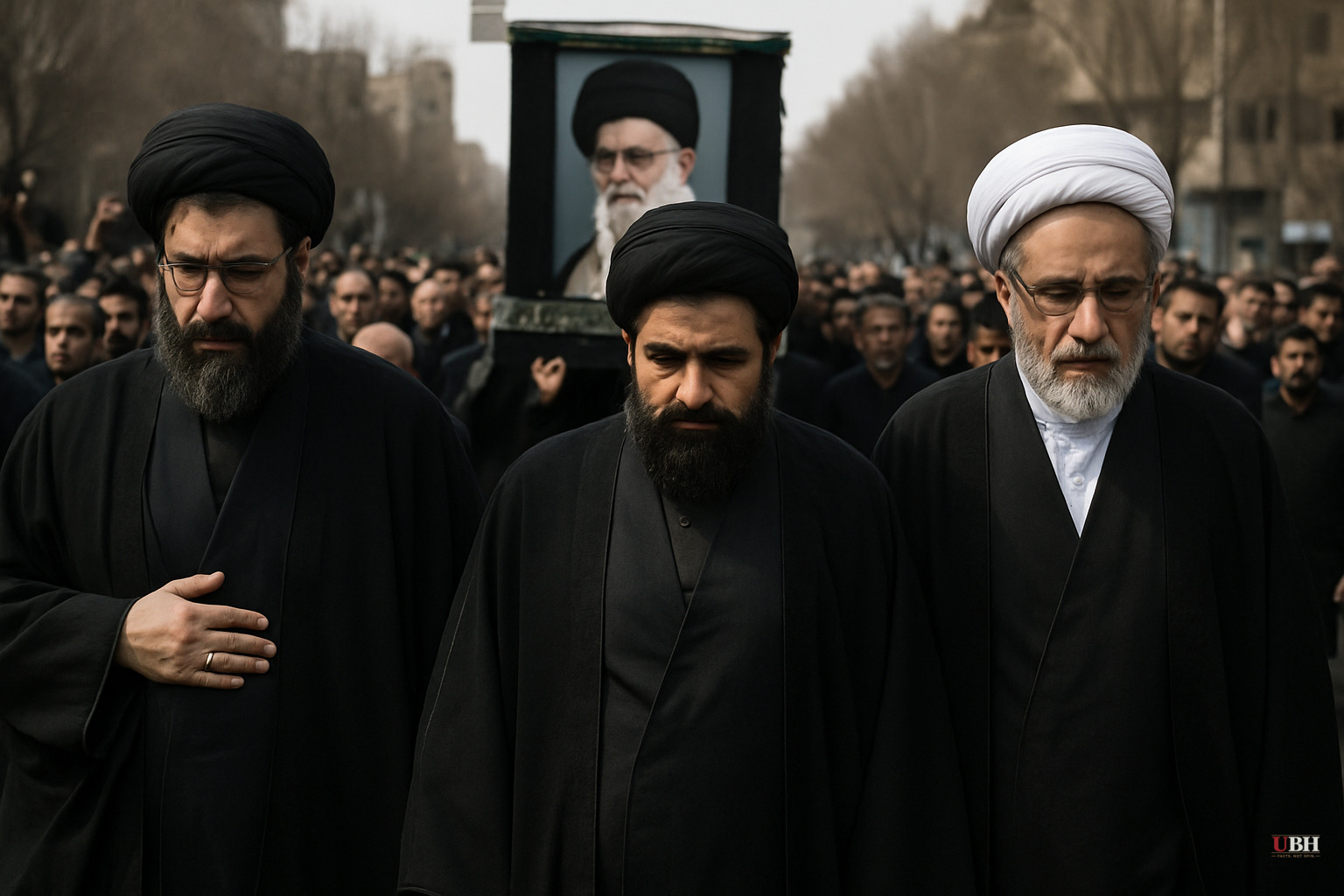
Since the U.S.-Israeli airstrike killed Ayatollah Ali Khamenei on February 28, his son Mojtaba — widely anticipated as his successor — has been entirely absent from public view. His continued absence through multiple days of mass funeral ceremonies stands out in Iran's current leadership transition.
On Sunday, state television showed three of Khamenei's sons — Mostafa, Meysam, and Masoud — praying beside their father's coffin at Tehran's Imam Khomeini Grand Mosalla. According to CNBC, Mojtaba was NOT among them. Sources close to his inner circle told Reuters that Mojtaba suffered facial disfigurement and serious leg injuries in the February 28 strike. One mourner interviewed by the semi-official Tasnim news agency said she had waited until the last moment hoping Mojtaba would appear: "That was our only wish," she said.
The absence is operationally significant. Iran's theocratic government is staging a week of public funeral processions, including moving Khamenei's remains to Shi'ite religious sites in neighboring Iraq, as a display of revolutionary continuity. A supreme leader who cannot show his face during his predecessor's burial sends a complicated signal about who, in practice, is governing.
The Funeral's Scale and Trump's Reading of It
The public turnout has been substantial. According to ZeroHedge's reporting citing international press accounts, up to 30 million mourners were predicted across the multi-day events. Footage of packed central Tehran squares circulated widely over the weekend. Al Jazeera's correspondent in Iran described the crowds as genuine.
President Trump, in an interview with Axios published over the weekend, expressed surprise at the scale of public grief. "Maybe it's fake tears," Trump said, adding that he thought Iranians hated Khamenei. External critics of the Iranian government have argued that security services compelled attendance.
Trump also told Axios the U.S. and Iran mutually agreed to pause nuclear negotiations for the duration of the funeral observances, with talks expected to resume around July 9. "Neither side will shoot at the other" during that window, Trump said. He also made a separate comment to Axios about the concentration of Iranian officials at the funeral representing a target of opportunity, while immediately clarifying the U.S. would not act on it because "we would have nobody to negotiate with." That remark drew no formal response from Tehran in the available reporting.
Coerced attendance at this scale, sustained across multiple days in the middle of a war that killed more than 3,000 Iranians including senior political and military figures, would itself require enormous state capacity. The possibility that significant portions of Iran's population genuinely mourned Khamenei—separate from whether they supported every policy he enacted—is consistent with how populations respond to national figures killed in foreign attacks.
The Calla Walsh Episode
The funeral generated a separate controversy inside the United States. Calla Walsh, identified by ZeroHedge as a former campaign organizer for Democratic Senator Ed Markey and a staffer with ties to Senator Elizabeth Warren's operation, appeared on Iranian state television in Tehran during the funeral ceremonies. She described Khamenei as "the greatest anti-imperialist leader to have lived during my lifetime" and, according to ZeroHedge, her message echoed "Death to America" sentiments delivered at the event.
Walsh is also identified as the founder of Palestine Action US. She is an American citizen.
ZeroHedge frames Walsh's appearance as evidence of dangerous radicalization spreading through the Democratic Party's left flank, linking it to broader anxieties about socialist and Islamist influence in progressive politics. What is documented: an American political operative, with a traceable résumé in mainstream Democratic Party organizing, traveled to Tehran, appeared on Iranian state media, and praised the recently killed supreme leader of a country that was, until weeks ago, in active armed conflict with the United States. No charges have been filed against Walsh, and no investigation has been announced in the available reporting.
Walsh's defenders would argue that attending a foreign leader's funeral and expressing anti-imperialist political views—however offensive—is protected political speech, not a crime. That argument has legal weight. It does not resolve the political reality that Democratic Party leaders now face pressure to publicly distance themselves from Walsh's statements.
What Remains Unresolved
The ceasefire agreement, described by CNBC as "shaky," remains in effect as of July 6. Iran's government has publicly stated it expects "huge economic benefits" from the deal and frames the outcome as a victory. More than 3,000 people were killed during the conflict, along with many of Iran's senior politicians and military commanders, according to CNBC.
Mojtaba Khamenei has still not appeared publicly. Whether he is recovering from his injuries, is being kept out of sight for security reasons, or faces some deeper internal challenge to his authority is not established by available reporting. How he asserts his role—or fails to—once the mourning period concludes will be the first real test of whether Iran's clerical government has a functional leadership succession or a vacuum dressed up in ceremony.
Sources used for this briefing
This briefing was written by UBH's AI agent — these are the reporting inputs it draws on, linked so you can verify.


