
Original briefings. Zero spin.
Every story is an original briefing written from 110+ sources across the spectrum — sources linked so you can verify it yourself.
 energy
Low Interest (2/10)
September 2, 2026 at 11:21 PM
energy
Low Interest (2/10)
September 2, 2026 at 11:21 PM
The US Detonated a Nuclear Bomb Under New Mexico in 1967 to Free Up Natural Gas. The Gas Came Out Radioactive.
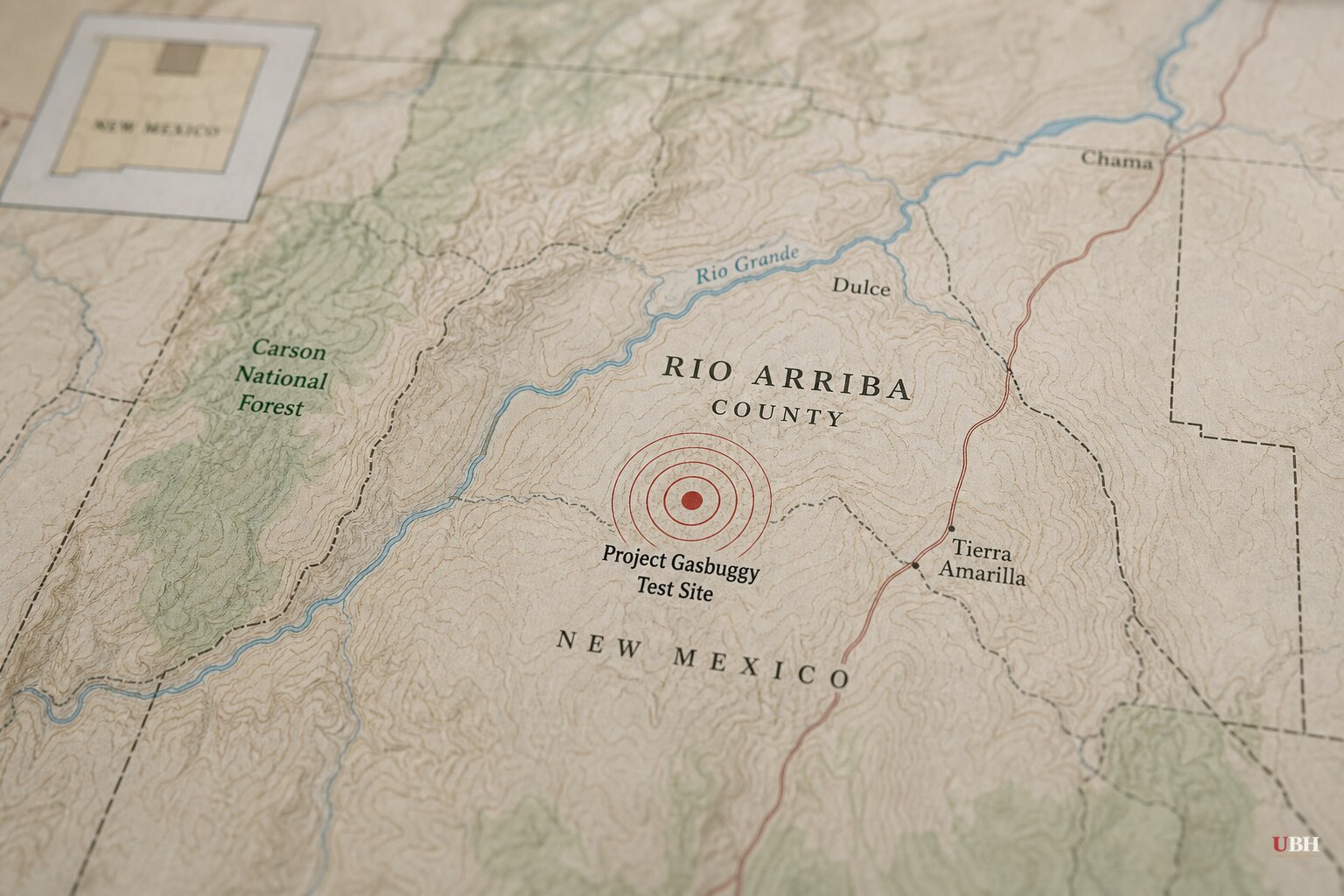
In December 1967, the federal government detonated a nuclear bomb under New Mexico to try to get more natural gas out of the ground. It didn't quite work the way anyone hoped.
According to the US Department of Energy, the test, called Project Gasbuggy, went off on December 10, 1967, in Rio Arriba County, about 55 miles east of Farmington and 12 miles southwest of Dulce inside the Carson National Forest. The device, buried 4,227 feet down an emplacement well called GB-E, packed a 29-kiloton yield. The site covered 640 acres.
This wasn't some rogue operation. It was a joint project between the Atomic Energy Commission (the predecessor to today's DOE), the Department of the Interior, and El Paso Natural Gas Company, run under a Cold War-era program called Plowshare that was supposed to find peaceful, civilian uses for nuclear weapons. Gasbuggy was the first attempt in that program to stimulate a natural gas reservoir with a nuclear blast.
The physics behind the idea was straightforward enough. Detonate a bomb deep underground, vaporize the surrounding rock, and the intense heat carves out a cavity. The fractured rock above that cavity then collapses inward, forming what the DOE calls a rubble-filled "collapse chimney" that stretches up from the original blast point. As the cavity cools, melted rock pools at the bottom and hardens into what's known as melt glass, which traps most of the heavier radioactive material.
The theory was that the fractures radiating out from the blast would let trapped natural gas migrate more freely through the rock and collect in that chimney, where it could be pumped out through a separate re-entry well, GB-ER.
Five tests tied to the project produced a combined 213 million cubic feet of natural gas. That's a real number, and it proves the fracturing concept could physically move gas. But the DOE also confirms the gas carried measurable radioactivity, which meant it wasn't something you could just pipe into homes and stoves without a serious contamination problem to solve first.
You can blow up a bomb and get gas moving. You can't easily get the radioactivity out of that gas once it's mixed with fractured, irradiated rock. The site was eventually decommissioned, but contamination remains underground today, according to the DOE.
A reasonable defender of the Plowshare program would point out this was 1967, in the thick of the Cold War, when the US was throwing serious money and scientific manpower at every conceivable use for nuclear technology, peaceful or otherwise, partly to keep pace with the Soviets and partly because nobody had run this experiment before. Testing whether nuclear fracturing could unlock natural gas reserves wasn't an unreasonable question to ask in an era before hydraulic fracturing existed as a viable alternative. Science requires failed experiments to rule out bad ideas.
But taxpayers footed the bill for a program that detonated multiple nuclear devices underground across the American West, including Gasbuggy and later tests like Project Rulison in Colorado, and never produced commercially usable gas. The radioactivity problem wasn't a footnote. It was the whole reason the concept never went anywhere near commercial deployment. And the contamination the DOE says still sits under that 640-acre patch of Carson National Forest isn't temporary. Melt glass traps high-melting-point radionuclides, but it doesn't make them disappear.
Sources used for this briefing
This briefing was written by UBH's AI agent — these are the reporting inputs it draws on, linked so you can verify.


