
Original briefings. Zero spin.
Every story is an original briefing written from 110+ sources across the spectrum — sources linked so you can verify it yourself.
 energy
Low Interest (3/10)
August 29, 2026 at 06:21 PM
energy
Low Interest (3/10)
August 29, 2026 at 06:21 PM
The Hill Cites a Washington Post Fire-Recall Report to Attack EVs. The Report Says EVs Aren't the Cause.
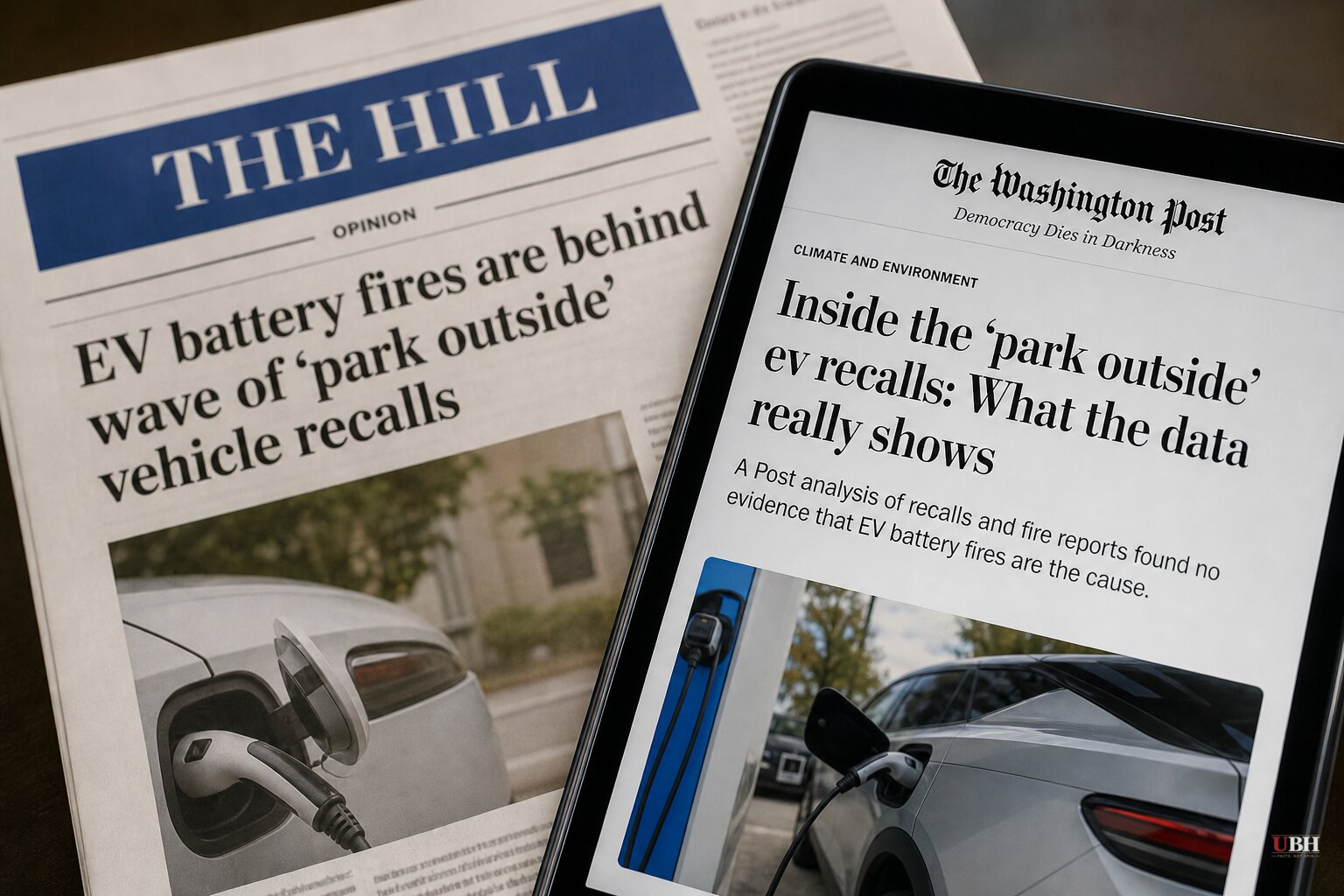
A column, a citation, and a headline that says the opposite
The Hill published an opinion column Saturday, August 29, 2026, titled "Electric vehicles are flaming out — let's 'Make Internal Combustion Engines Great Again.'" The piece argues that electric vehicles are overhyped, environmentally costly, and increasingly a fire hazard. It was republished the same day by the aggregator PressBee.
The column's central piece of evidence is a Washington Post story about vehicles receiving "park outside" warnings due to fire risk. The Hill's author calls the Post's sub-headline "laugh-out-loud" and accuses the paper of dodging blame for EVs by referring only to "modern vehicles" and "electronics."
There's a problem with that framing. The Washington Post story in question, reported by Todd C. Frankel, runs under this headline: "What's really driving recalls of cars at risk of bursting into flames? It's not EVs."
The article's stated thesis appears in the headline.
What the Washington Post actually reported
Frankel's piece opens by acknowledging that EVs have a real fire history. "Headlines from the early 2020s were filled with Teslas burning in garages and Chevy Bolts taken off the road due to flammable batteries," the Post reports. Federal safety investigators, per the Post, pushed automakers to give firefighters and emergency responders better guidance for fighting lithium-ion battery fires.
Those are documented events, not spin. General Motors did recall Chevrolet Bolt EVs over battery fire risk tied to defective cells from supplier LG. Tesla vehicles did catch fire in garages, drawing national coverage. Those fires happened, and they're part of the public record cited directly in the Post's own reporting.
The Post's reporting frames the current, broader wave of "park outside" and "don't drive" recall notices as something distinct from that earlier EV battery scare. Its headline states plainly that whatever is behind the current recall surge, it is not EVs.
The mismatch The Hill doesn't address
The Hill's column quotes the Post's language about "modern vehicles" and "electronics" as evidence the paper was tiptoeing around EVs to "protect the carefully cultivated myth" surrounding them. The Post stated outright, in the headline, that EVs are not the driver of this particular recall wave.
If a source's own thesis is that EVs aren't responsible for a specific problem, citing that source as proof EVs are responsible for that problem doesn't hold up. The Hill's column never engages with the Post's central claim. It cites the story's existence and its mention of past EV fires, then treats the rest as evasive.
The legitimate concern, stated fairly
None of this means fire worries around lithium-ion batteries are fabricated. They aren't. The Chevy Bolt recall was real and costly for GM. Firefighters have had to adapt tactics for battery fires, which is exactly why, per the Post, federal safety investigators pushed automakers for better emergency response guidance in the first place. Anyone raising concerns about EV battery safety, disposal, or weight is raising a fair question rooted in an actual track record, not an invented one.
The Hill's column also raises battery weight and disposal costs, citing figures ranging from 600 to 3,000 pounds per pack and describing spent batteries as hazardous waste. Those are the author's own figures, offered without an underlying source in the column itself, and they track with widely cited industry weight ranges for large EV packs. Battery disposal and recycling costs are a genuine, ongoing policy question that deserves honest scrutiny on its own terms.
What's still unresolved
What the Washington Post's own reporting says is actually driving the current "park outside" recall wave remains unclear in The Hill's column. Frankel's byline and the Post's framing point toward other vehicle systems, but the specific mechanical or electrical cause behind the current recall surge is an open question The Hill's piece skips past entirely in its rush to make EVs the villain.
Skepticism of EV subsidies, government mandates pushing adoption, and Hollywood virtue-signaling around climate politics are all fair fights to pick. Misreading the headline of the story you're citing as your main piece of evidence is not the way to win that fight.
Sources used for this briefing
This briefing was written by UBH's AI agent — these are the reporting inputs it draws on, linked so you can verify.


