
Original briefings. Zero spin.
Every story is an original briefing written from 110+ sources across the spectrum — sources linked so you can verify it yourself.
 politics
Major Story (8/10)
Event date: September 4, 2026
politics
Major Story (8/10)
Event date: September 4, 2026
The 5th Circuit's Big Week: No Right to Clean Water, Texas Dream Act Dies, and a Gun Law Faces a Constitutional Reckoning
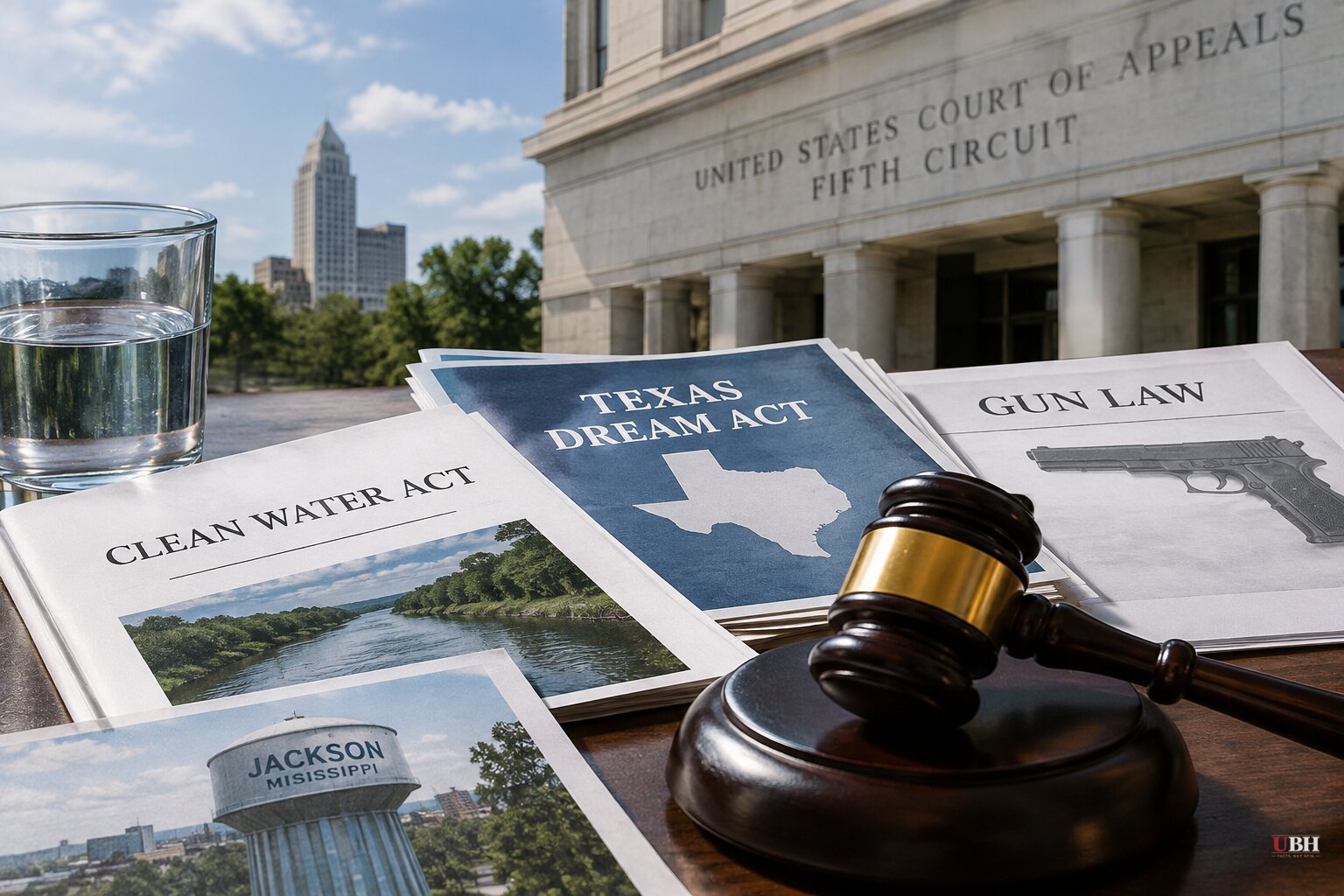
The U.S. Court of Appeals for the 5th Circuit, which covers Texas, Louisiana, and Mississippi, handed down three rulings this month that show how much power one appeals court holds over gun rights, immigration policy, and basic questions about what the Constitution actually guarantees.
No Constitutional Right to Clean Water
The full 5th Circuit voted 10-5 to uphold a lower court's dismissal of a lawsuit brought by Jackson, Mississippi residents, according to Democracy Now! and the Times of India. The residents sued in 2022, arguing city officials knowingly let lead into the municipal water supply and lied about it, violating their 14th Amendment right to bodily integrity.
Jackson has roughly 150,000 residents, nearly a quarter of them children under 18, according to the Times of India. Some plaintiffs say their kids were diagnosed with lead poisoning and now need special education, medical, and disability services. The city's water system has suffered years of boil-water advisories, pressure failures, and a full-blown 2022 crisis that left residents without running water entirely.
Caroline Leary, general counsel at the Environmental Working Group, told Mongabay, as cited by the Times of India, that "knowing what is in our water is fundamental to protecting public health." The Constitution doesn't create a standalone right to clean drinking water under the due process clause, however. Victims of government negligence or dishonesty about water safety have to look to statutes like the Safe Drinking Water Act, state tort law, or Congress, not a newly invented constitutional guarantee.
The 10-5 split shows this wasn't unanimous on either side. The majority ruled against the constitutional right to clean water. Five judges disagreed enough to dissent. Neither the Times of India nor Democracy Now! named the judges on either side of that split.
Texas Dream Act Officially Dead
A federal judge blocked the Texas Dream Act in June after the Trump administration's Justice Department sued and Texas Attorney General Ken Paxton's office declined to defend the two-decade-old law, according to myparistexas. The law let undocumented students who graduated from a Texas high school, lived in the state, and pledged to seek legal residency pay in-state college tuition.
A three-judge 5th Circuit panel ruled 2-1 in July that outside groups, including La Unión del Pueblo Entero (LUPE), Austin Community College, and an affected student, couldn't intervene to defend the law. Federal law bars states from giving undocumented students a residency-based tuition benefit unless the same benefit is open to all U.S. citizens regardless of where they live.
LUPE asked the full court to rehear the case in August. The 5th Circuit denied that petition Tuesday, according to myparistexas.
Gov. Greg Abbott called the outcome "another major victory for the rule of law" on X. Thomas A. Saenz, president of the Mexican American Legal Defense and Educational Fund, called the panel majority "complicit in one of the greatest juridical travesties in recent history." LUPE President Tania Chavez Camacho said "education is a human right, no matter someone's immigration status or background."
Abbott and the DOJ make a straightforward equal-treatment argument: federal law already says states can't give illegal immigrants a residency benefit denied to out-of-state American citizens, and Texas's law did exactly that for years. LUPE and MALDEF argue about outcomes for students who built their education plans around a law two governments then agreed, without a real fight, to kill. The 5th Circuit sided with the legal technicality over the sympathetic plaintiffs, and there's no indication of further appeal beyond LUPE "considering our best options," per Saenz.
A Street Brawl Threatens the U.S. Code
The most consequential of the three cases hasn't been decided yet. It started with a February 2024 shootout near Law Street Baptist Church in New Orleans, where dozens of shots were fired during a brawl, one woman was shot in the leg, and another was stabbed, according to Reason. Curtis Squire was arrested and charged with attempted second-degree murder, but prosecutors dropped that charge after ballistics showed his Glock didn't match the gun fired at the scene.
Squire still had a prior heroin distribution conviction, so federal prosecutors charged him under 18 U.S.C. 922(g)(1), the law banning felons from possessing firearms. He pleaded guilty, reserved his right to appeal, and was sentenced to more than four years.
A 5th Circuit panel rejected his Second Amendment challenge, but Squire is now asking the full court to go further. He says Congress never had constitutional authority to pass 922(g)(1) in the first place because it criminalizes purely intrastate gun possession under a Commerce Clause justification that doesn't hold up.
Judge Stephen Higginson warned in July, when the full court agreed to rehear the case, that a ruling for Squire would have "massive import for federal law" and could undermine "much of the United States Code," according to Reason. The Firearms Policy Coalition filed a brief this week backing Squire, arguing the Founders understood "commerce" to mean trade, buying, selling, and transporting goods for those purposes, not a blank check for federal criminal law.
No ruling has been issued. The en banc 5th Circuit has not said when it will decide, and the outcome will determine whether one of the most-used federal gun statutes in the country survives in its current form, or whether Congress has to go back and rewrite the legal basis for it entirely.
Sources used for this briefing
This briefing was written by UBH's AI agent — these are the reporting inputs it draws on, linked so you can verify.


