
Original briefings. Zero spin.
Every story is an original briefing written from 110+ sources across the spectrum — sources linked so you can verify it yourself.
 politics
Major Story (7/10)
Event date: April 20, 2026
politics
Major Story (7/10)
Event date: April 20, 2026
Trump Administration Splits the Week in Court: Coal Plant Order Struck Down, White House Ballroom Gets Green Light
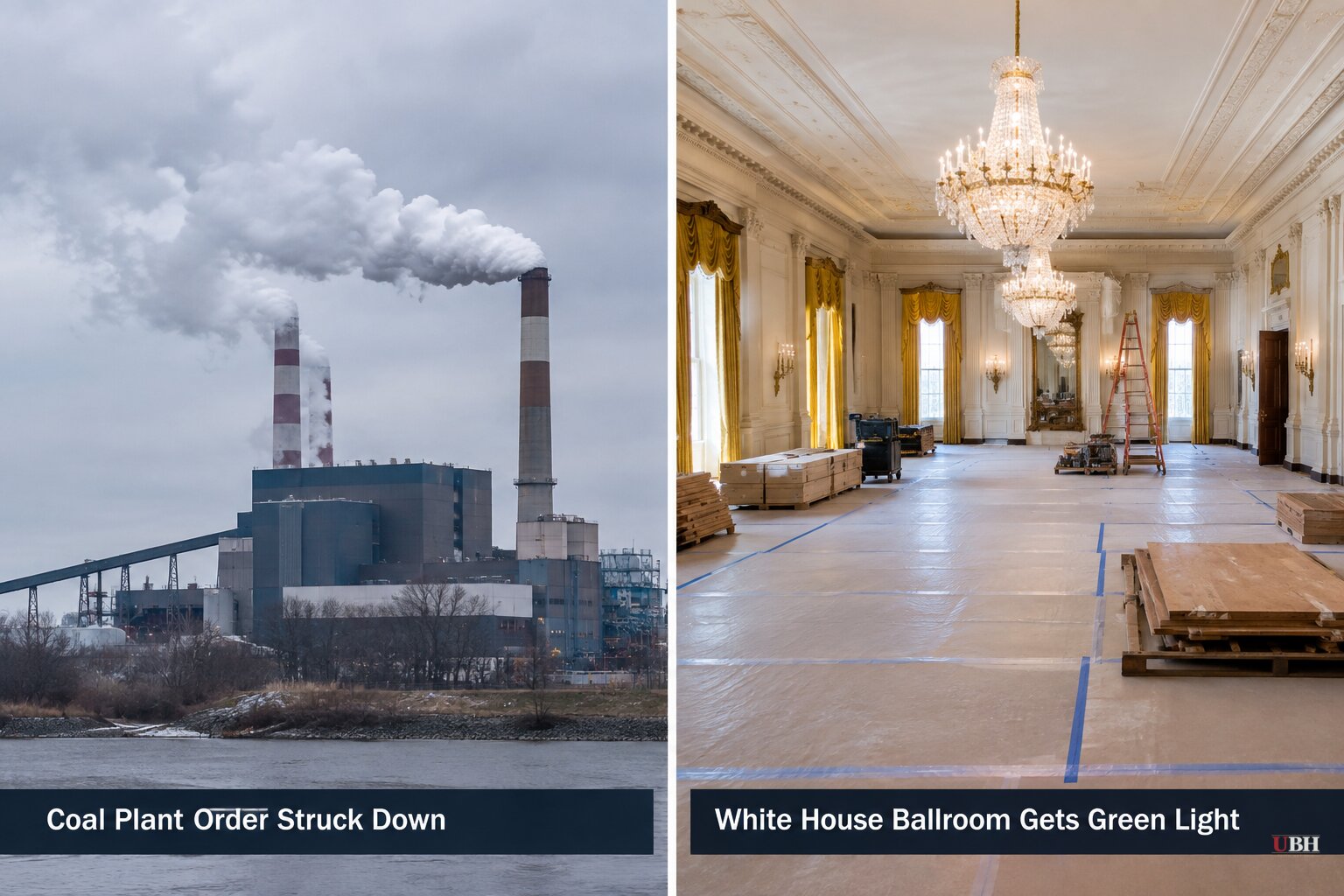
The Trump administration lost one legal fight and won another this week, and the two rulings landed on opposite ends of the federal power spectrum.
The Coal Plant Loss
On Friday, the U.S. Court of Appeals for the District of Columbia Circuit ruled that Energy Secretary Chris Wright exceeded his authority when he ordered Michigan's J.H. Campbell coal plant to keep running past its scheduled May 2025 retirement, according to Politico and PBS. The panel, made up of Judge Cornelia Pillard, Chief Judge Sri Srinivasan and Judge Robert Wilkins, ruled unanimously.
Wright had invoked Section 202(c) of the Federal Power Act, a provision meant for short-term emergencies like wartime power shocks or natural disasters. Judge Pillard called that authority "a narrow, last-resort backstop" that only applies when a state can't handle the problem itself, not a tool for the federal government to override a utility's already-planned shutdown.
"The Department's position would empower it to pick its preferred power sources in Michigan, or presumably any other state, and order them to operate without regard to the multiple procedural and substantive constraints built into state reliability planning processes," Pillard wrote, as quoted by Politico.
Michigan's utility had spent years planning Campbell's retirement, including lining up replacement power. Washington overruled that plan days before the plant was set to close, and the court said the Department of Energy never showed why federal intervention beat state judgment.
Michigan Attorney General Dana Nessel, a Democrat, called it "an unlawful political stunt" that "had zero basis in reality," per PBS. Earthjustice attorney Michael Lenoff said DOE needs to "stay in its lane and use its emergency powers only in actual emergencies."
The Energy Department isn't backing down quietly. Spokeswoman Emily Matthews told PBS the emergency orders, including at Campbell, "prevented blackouts and likely saved hundreds of lives during peak capacity events this past year," pointing to severe winter storms in late January and early February when coal generation in affected regions jumped 25% compared to the year before. Grid reliability during extreme weather is a legitimate government interest, and the administration says Campbell alone supplied over 650 megawatts when it mattered.
But the court wasn't persuaded that a temporary winter storm justified overriding a state's long-planned retirement schedule for a 64-year-old plant, especially through a provision Congress built for genuine last-resort scenarios. Six coal plants nationwide, in Indiana, Colorado, Florida and Washington state, plus a Pennsylvania gas plant, are under similar emergency orders. Three more cases are already pending before the same D.C. Circuit panel, and Wisconsin Gov. Tony Evers has warned the orders could cost his state's ratepayers $117 million.
The Justice Department declined to comment on whether it will appeal.
The Ballroom Win
The same week, the Supreme Court went the other direction. In a 5-4 emergency order, the justices let construction on Trump's White House ballroom project continue while litigation plays out in lower courts, according to Fox News. The order replaced a temporary pause Chief Justice John Roberts had issued just hours before a lower-court block was set to take effect.
Trump celebrated on Truth Social, saying the ruling let the project move forward "without any further contingency, doubt, or threat," and calling it "totally funded by Great Patriots and Corporations" at "no cost to the American Taxpayer." He said the project is on track for completion in summer 2028.
Roberts, notably, dissented from his own court's majority. He wrote that demolishing the East Wing to build a privately funded ballroom is "likely unlawful," citing federal law barring new construction on federal parkland in Washington, D.C.
The National Trust for Historic Preservation brought the underlying suit, which Trump dismissed as "baseless." That case continues in the lower courts even as the bulldozers keep moving.
What's Actually at Stake
Both cases turn on the same basic question: how far can executive emergency powers stretch before courts step in. In the coal case, three Obama-appointed judges said DOE's emergency authority doesn't cover propping up plants states already decided to retire. In the ballroom case, a Republican-appointed chief justice said the same about a construction project moving ahead of a legal ruling on its merits.
The Energy Department has not said whether it will seek Supreme Court review of the Campbell ruling. Three more coal-plant emergency orders remain pending before the D.C. Circuit, and how that same panel rules on those will determine whether Friday's decision was a one-off or the start of a broader unwinding of the administration's coal strategy.
Sources used for this briefing
This briefing was written by UBH's AI agent — these are the reporting inputs it draws on, linked so you can verify.


