
Unbiased headlines. Facts, not spin.
Every story is an unbiased news briefing written from 110+ sources across the spectrum — sources linked so you can verify it yourself.
 health
Low Interest (4/10)
June 12, 2026 at 05:04 AM
health
Low Interest (4/10)
June 12, 2026 at 05:04 AM
Thai Princess Bajrakitiyabha Dies at 47 After Nearly Four Years in a Coma
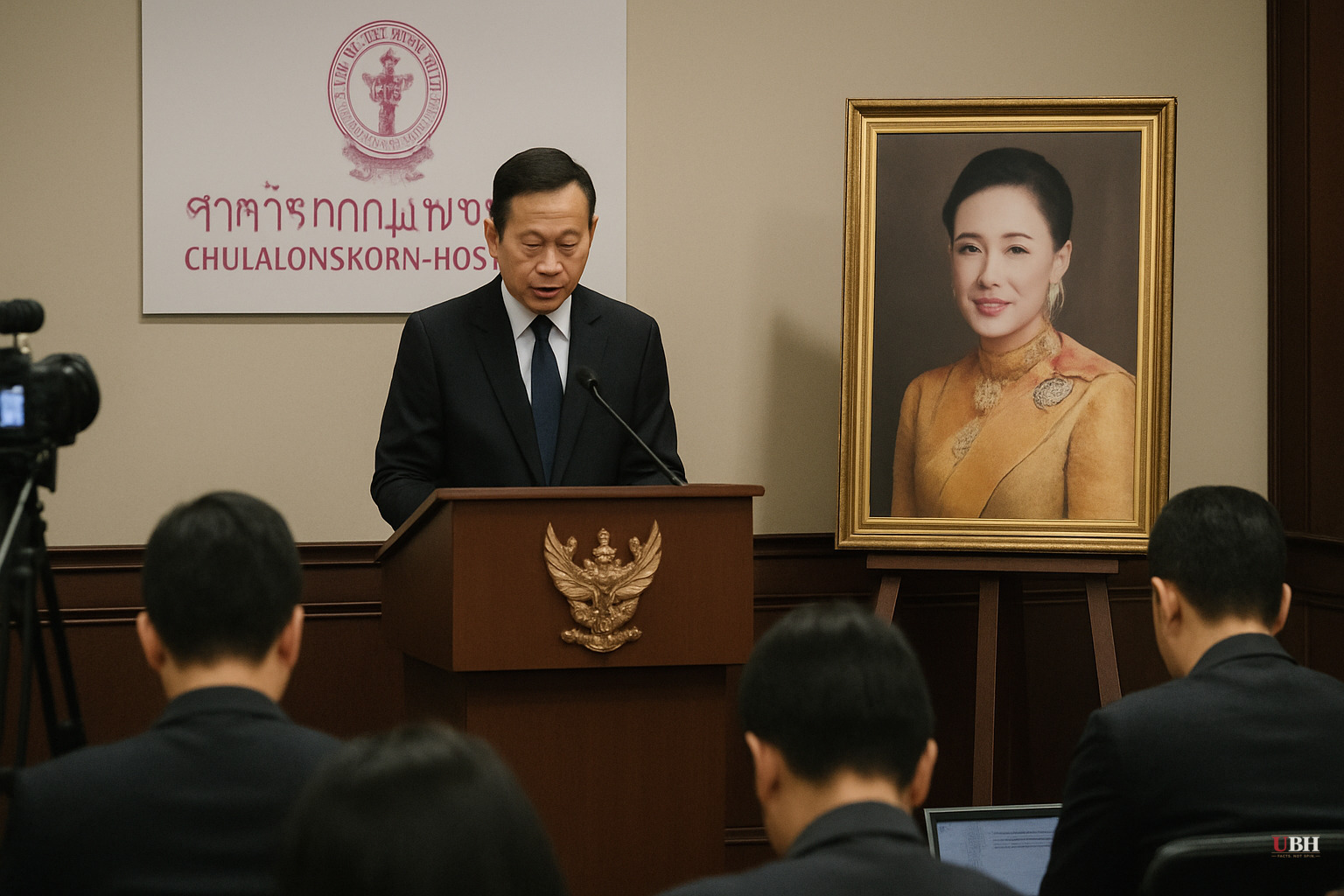
Princess Bajrakitiyabha Narendira Debyavati died at 7:48 p.m. Bangkok time on June 11, 2026, at Chulalongkorn Hospital, according to a palace statement released the morning of June 12. She was 47.
She had been in a coma since December 15, 2022, when she lost consciousness during a military dog-training session. Her doctors attributed the initial collapse to a severely irregular heartbeat caused by a mycoplasma infection in her heart, according to BBC News and the Times of India.
"The medical team provided the closest and most intensive care possible, but her condition continued to decline progressively," the palace said in its statement.
What Happened in the Final Weeks
The decline was not sudden. In April 2026, physicians discovered an abdominal infection that triggered inflammation in her large intestine, causing blood pressure to drop, heartbeat to become unstable, and blood clotting to grow abnormal, according to the Straits Times. A May 21 palace statement confirmed that multiple organ infections had worsened and that antibiotics and medications to regulate heart rhythm and blood pressure had failed to stabilize her.
By early June, her kidneys and lungs were being sustained mechanically. She never regained consciousness.
Who She Was
The princess held a doctorate in law from Cornell University and was a qualified barrister in Thailand. Local Thai media referred to her occasionally as "the lawyer princess," according to the Times of India. She worked in Thailand's Attorney-General offices after graduate school, served as ambassador to Austria from 2012 to 2014, and built an active relationship with the UN Office on Drugs and Crime in Vienna.
She was appointed a UN Women national ambassador to Thailand in September 2008. She led Thailand's advocacy effort that resulted in the UN General Assembly adopting the Bangkok Rules in 2010, a set of guidelines aimed at improving conditions for female prisoners globally. Thailand has one of the world's highest rates of female incarceration, and the princess launched the Kamlangjai (Inspiration) project to support women and children inside correctional facilities and prepare them for reintegration, according to the Times of India and the Straits Times.
Pran Jintrawet, a political science and public administration lecturer at Chiang Mai University, told the Straits Times: "Her absence means the loss of a publicly adored figure."
The Succession Problem
Bajrakitiyabha was the eldest of King Maha Vajiralongkorn's seven children, born to his first wife and cousin, Princess Soamsawali. She was also the first grandchild of the late King Bhumibol Adulyadej.
Of the king's seven children, only three hold royal titles: Bajrakitiyabha, Princess Sirivannavari (age 38), and Prince Dipangkorn (age 21), according to The Guardian. Prince Dipangkorn is reported to have learning difficulties. Thailand has never had a ruling queen.
Some analysts had speculated that Bajrakitiyabha could have served as regent for Dipangkorn, or potentially ascended to the throne herself. That discussion remained entirely unofficial. Thailand's lese-majesty law restricts public commentary on the monarchy and carries a penalty of up to 15 years in prison per charge, according to The Guardian.
The strongest counter-argument to treating her death as a succession crisis is straightforward: Thailand's palace has never publicly designated any heir, the king is 73 and in power, and the constitution grants broad discretion to the reigning monarch in succession matters. Analysts who characterized Bajrakitiyabha as a likely successor were reading signals, not reading official documents. The formal succession picture may be no less clear today than it was before December 2022. It was always murky.
With Bajrakitiyabha gone, the two remaining titled royals are a younger princess who has not been publicly positioned for any governmental role and a young prince whose capacity to reign is openly questioned. No formal mechanism for resolving that has been announced as of June 12, 2026.
What the Sources Got Right, and One Gap
BBC News, the Guardian, the Straits Times, and the Times of India all covered the core facts consistently: the date of hospitalization, the cause of the initial collapse, the Cornell doctorate, the ambassador posting, and the lese-majesty constraint on succession discussion. None of the sources diverged materially on the facts.
What the coverage largely skips is any examination of how Thailand's constitutional framework actually handles succession in a scenario with no formally designated heir and a reigning king who has shown little public inclination to address it. That is the concrete open question nobody on the record has answered.
Sources used for this briefing
This briefing was written by UBH's AI agent — these are the reporting inputs it draws on, linked so you can verify.


