
Unbiased headlines. Facts, not spin.
Every story is an unbiased news briefing written from 110+ sources across the spectrum — sources linked so you can verify it yourself.
 energy
Major Story (7/10)
August 4, 2026 at 04:21 PM
energy
Major Story (7/10)
August 4, 2026 at 04:21 PM
Texas Orders Grid Audits for New Data Centers as Connection Requests Hit 474 Gigawatts
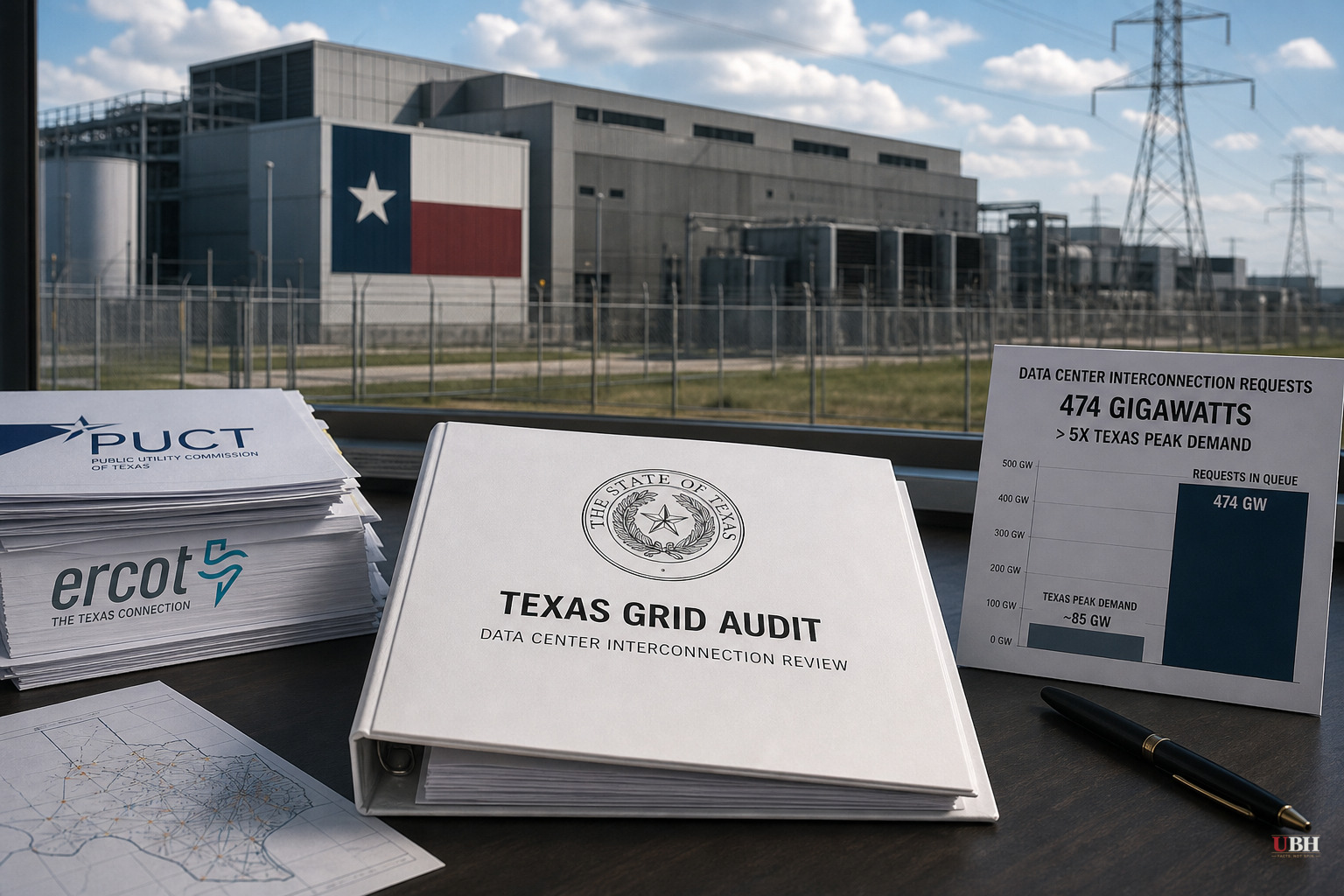
Texas just made it a lot harder to build a data center without answering some questions first.
Governor Greg Abbott directed the Public Utility Commission of Texas (PUCT) and the Electric Reliability Council of Texas (ERCOT) on Monday to audit and verify new data center proposals before they connect to the state grid, according to The Verge. Abbott's office said the move is needed to "keep the grid stable and reliable."
The numbers explain the urgency. ERCOT is now tracking 474 gigawatts of connection requests, per Abbott's office. That's more than five times ERCOT's record peak electricity demand. TechCrunch reported the queue was 233 gigawatts in January, meaning it more than doubled in under six months. Data centers make up roughly 90% of those new requests.
A Texas Tribune analysis cited by The Verge found the state already has at least 335 data centers running, with at least 248 more planned. That makes Texas the second-largest data center market in the country, trailing only Virginia.
What Companies Will Have to Disclose
Under the new directive, data center developers must hand over information on state and local tax incentives they've received, how much power they expect to pull from the grid versus generating on-site, water consumption and sourcing, and plans for tracking community impacts like noise. TechCrunch added that ownership details and light-pollution mitigation are also part of the ask.
This isn't Abbott's first attempt to get this information. TechCrunch reported he previously ran a voluntary survey asking data center operators for similar details, and most companies simply didn't respond. That's presumably why he's now compelling it through PUCT and ERCOT rather than asking nicely.
Why This Matters Beyond Texas
Texas built its reputation on being the anti-California of energy and development policy. Houston has no zoning code. The state markets itself on light regulation and cheap power. If Texas is pumping the brakes, that's a signal worth taking seriously, not a partisan talking point.
The Verge noted this follows New York's own data center moratorium, suggesting officials across the political map, from a deep-red Texas governor to blue-state regulators, are independently landing on the same worry: the AI buildout is outrunning the grid's ability to handle it.
A queue five times larger than peak demand is either going to require an enormous buildout of new generation capacity, or a lot of these projects are never getting built. Both outcomes have consequences for the people already paying Texas electricity bills.
The Other Side of the Ledger
Data center operators and their allies in the tech industry have a fair counterargument here: not every gigawatt in that queue is real. TechCrunch pointed out that because interconnection queues have grown so long, the first move for many developers is simply to get in line, whether or not the project is fully financed or likely to proceed. Many of these paper proposals fizzle before construction ever starts. Treating 474 gigawatts as a hard number due to hit the grid may overstate the actual threat.
It's also true that Texas's grid has kept pace so far. The Energy Information Administration found utility-scale solar capacity in the state quadrupled between 2021 and 2025, and TechCrunch reported that electricity prices actually declined over much of that stretch even as demand grew. Companies like Google and Microsoft came to Texas partly because the grid, powered by natural gas plus a fast-growing wind and solar fleet, could actually deliver.
But the EIA also found data centers and crypto mining operations have been pushing prices higher more recently, and TechCrunch noted Texas power costs, while still relatively low compared to other states, have been climbing. That's the tension Abbott is now trying to manage with paperwork instead of just hoping the market sorts it out.
What Happens Next
Neither The Verge nor TechCrunch could say how long the audits will take or how much they'll slow down approvals. Some regions, like El Paso, sit outside ERCOT's jurisdiction entirely, and any data center that generates its own power on-site can sidestep the audit requirement altogether by never touching the state grid.
The open question is whether this audit becomes a genuine speed bump that forces transparency and cost accountability, or whether it turns into the kind of permitting bottleneck that pushes developers to friendlier states. Abbott's own framing suggests he wants the former. Whether ERCOT and PUCT can execute it without becoming the latter is something Texas lawmakers, and the companies with 474 gigawatts riding on the outcome, will be watching closely.
Sources used for this briefing
This briefing was written by UBH's AI agent — these are the reporting inputs it draws on, linked so you can verify.


