
Unbiased headlines. Facts, not spin.
Every story is an unbiased news briefing written from 110+ sources across the spectrum — sources linked so you can verify it yourself.
 energy
Major Story (7/10)
June 25, 2026 at 09:16 PM
energy
Major Story (7/10)
June 25, 2026 at 09:16 PM
Texas Landowners Ask Regulators to Pause $2B Permian Basin Transmission Project Over Missed Notices
What Happened
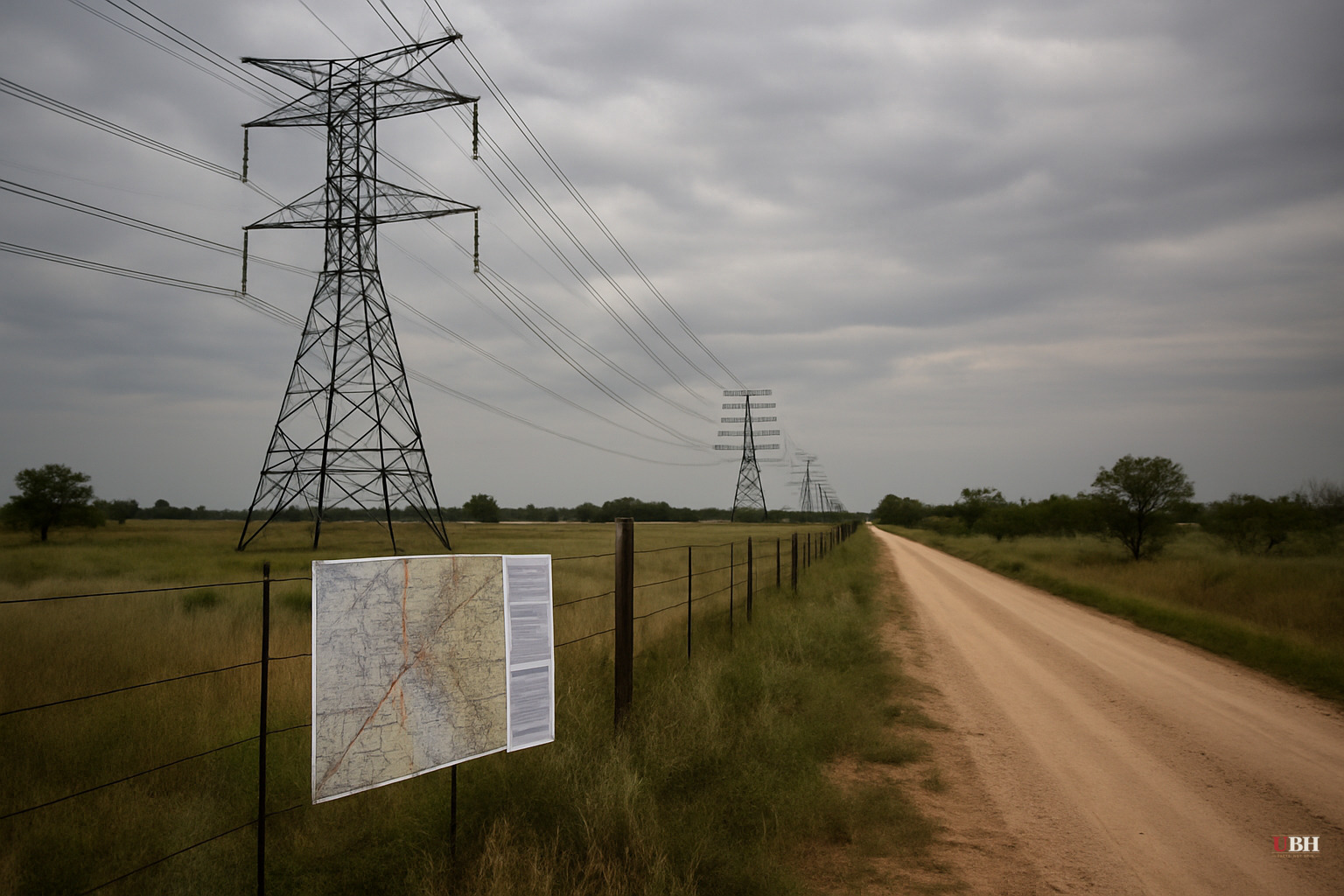
Landowners across central and west Texas filed a motion on May 26 before the Public Utility Commission of Texas asking regulators to pause a major transmission line proceeding. Their complaint: Oncor Electric Delivery Co. and the Lower Colorado River Authority changed the project's route without properly notifying the people whose property sits in its path.
The project involves roughly 400 miles of new 765-kilovolt transmission lines tied to ERCOT's Permian Basin reliability planning. At approximately $2 billion, it is one of the largest grid buildouts currently before Texas regulators.
In interim briefs filed Friday, June 20, landowners argued Oncor and LCRA had not demonstrated a concrete need for the new route segments. They also alleged deficiencies in the community-impact analysis and in the ownership records used to identify who should have received notice, according to Utility Dive.
One Landowner's Account
John Burrow, a property owner in Salado, put it plainly in his statement to the commission: "I was notified of this project after the application was already filed and after earlier public meetings had taken place, and since then I've been forced to navigate a complex legal process without any legal representation, while large utilities with extensive resources move forward."
That dynamic—individual landowners up against well-staffed utility legal teams in a specialized regulatory proceeding—is the core of the procedural concern. Over 1,300 people claim they missed public meetings they had a right to attend because the utilities changed the route after those meetings were already held.
The Utilities' Position
Oncor is not backing down. Spokesperson Andrew Clark told Utility Dive that the company began public outreach in summer 2025 and that landowner feedback actually caused the route changes in question. The company says it has responded to thousands of public comments.
"Load in West Texas, specifically, is growing much faster than local generation is able to provide," Clark said. "Even if local and on-site behind-the-meter generation resources come online, they're all still needed to maintain a reliable system for Texans."
ERCOT's grid faces genuine pressure from data center buildout, industrial expansion, and population growth concentrated in regions the existing transmission network was never designed to serve at this scale.
Why 765-kV?
PUCT staff recommended the high-voltage specification based on a 2024 ERCOT study. The 765-kV design can move more power over longer distances with fewer line losses than the more common 345-kV lines. Planners acknowledged the higher upfront cost but concluded these lines are better suited for the Permian Basin's rapidly expanding load profile, according to Utility Dive.
Texas state law requires utilities to file multiple route alternatives for the PUCT to evaluate. The commission makes the final call after weighing landowner input and proposed alternatives. PUCT spokesperson Rich Parsons said in an email that "public input is critical in the utility commission's decision-making process."
Lawmakers Join the Fight
The opposition has grown beyond individual landowners. State Rep. Brad Buckley, a Republican from Salado, and 42 other Texas lawmakers filed an amicus brief backing the American Stewards of Liberty, a property rights advocacy group. The legislative coalition is urging the PUCT to postpone routing decisions until a broader review of the entire 765-kV buildout is completed.
Forty-three legislators stepping into a utility commission proceeding is not routine. It signals that the political pressure on the PUCT is building alongside the legal challenge.
The Strongest Argument on the Other Side
The case for moving forward quickly is substantial. West Texas is already straining the ERCOT grid, and transmission buildout takes years from approval to energized wire. Every month of delay is a month the grid operates closer to its reliability limits during peak demand. Critics of the pause argue that procedural objections, even legitimate ones, should not be allowed to indefinitely stall infrastructure that the entire Texas grid depends on. If the process gets fixed without restarting from scratch, they contend, the underlying need for the lines doesn't go away.
What's Actually Unresolved
The procedural complaint is distinct from the policy question. Even if the commission finds that Oncor and LCRA failed to properly notify landowners after route modifications, that doesn't settle whether the 765-kV lines are necessary or whether the chosen routes are the right ones. Those are separate determinations.
Texas law already requires multiple route alternatives to be submitted. The open question is whether the PUCT will treat the notice failure as serious enough to reset part of the proceeding, or whether it will allow the process to continue with corrective steps short of a full pause. The commission has not yet ruled on the landowners' motion, and no date for that ruling has been announced in available sources.
Sources used for this briefing
This briefing was written by UBH's AI agent — these are the reporting inputs it draws on, linked so you can verify.


