
Unbiased headlines. Facts, not spin.
Unbiased Headlines is an independently owned news organization. We bring you the facts, not opinions, written fresh from 110+ named sources. Sources linked so you can verify it yourself.
 finance
Major Story (7/10)
Event date: November 9, 2026 ·
Taiwan's Taiex Falls About 6%, Kospi 3.6% as Asian AI Stocks Slide Before Nvidia Earnings Tuesday
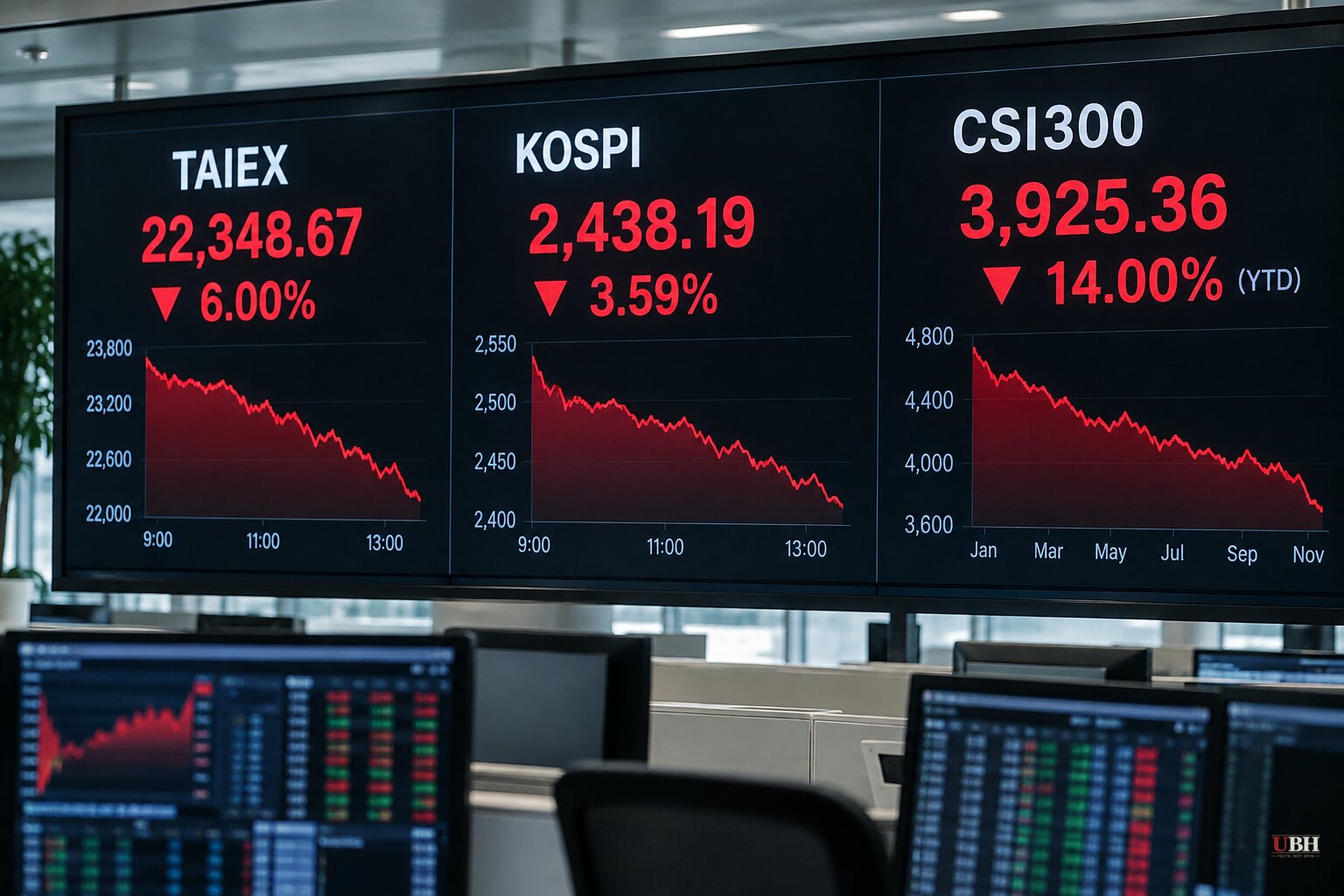
Since Jensen Huang resigned as Nvidia's CEO last week, the AI trade in Asia has gone from nervous to rattled. Monday's session, Nov. 16, was the sharpest leg down yet.
Taiwan's benchmark Taiex sank about 6%, according to Anadolu Agency's market tally. TSMC fell 5.7%.
South Korea's Kospi closed down 3.59% at 5,100.50. SK Hynix dropped 4.3% and Samsung Electronics 4.5%.
In Japan, the Nikkei 225 fell 2.4% to 59,662.02, slipping below the 60,000 mark. Chip-equipment names took the worst of it: Advantest plunged about 11.1%, Lasertec fell more than 12.8% and Tokyo Electron lost 7%. Kioxia dropped 7.7% and SoftBank Group 3.7%.
China's tech stocks take the hit
Mainland China was not spared. The CSI300 and Shanghai Composite each fell 0.9%, leaving both near their lowest levels since July 2025. The CSI300 has lost 14% so far this year.
The 5G Communication Index dropped 7.5% to a one-year low. The STAR50, which tracks the country's tech and chip leaders, fell 5.2%. Zhongji Innolight, a maker of high-speed optical transceivers for AI data centers, lost 12.3%.
Not everything fell. The CSI300 Financial Index gained 1.5% and consumer staples rose 1.2%. Hong Kong's Hang Seng rose about 0.5%, and Indian equities advanced.
The economy underneath
China's October data gave investors little to hold onto. Industrial production grew 4.8% year over year against a consensus of 5.3%, and retail sales rose just 0.4%, according to figures cited by XTB.
Japan's economy unexpectedly contracted at a 0.1% annualized pace in the third quarter. Economists had expected 0.2% growth.
"China's policy measures to combat deflation continue to be incremental and we remain below consensus for China EPS growth," Morgan Stanley analysts said in a note. They added that valuations offer only partial compensation and favor stock-picking over broad market exposure.
A bear market in Shanghai
The slide predates this week. Key Chinese indexes have fallen more than 20% from their June peaks, crossing the bear-market threshold, according to CNN's reporting. The STAR50 is down more than 40% from that peak.
Unitree, the humanoid-robot maker that surged 600% in its August Shanghai debut, has seen its shares halve. Memory chipmaker CXMT's valuation is down nearly 30% from its August high.
Beijing has already tried to steady things. It put $19 billion into exchange-traded funds in the past week, according to Bloomberg data cited by CNN. That was its biggest intervention since early 2025.
Analysts quoted by CNN doubt it will hold. "The selloff reflects a repricing of crowded AI trades, weak domestic demand, and the lack of stimulus," said Gary Ng, senior economist for Asia Pacific at Natixis Corporate and Investment Bank.
Lorraine Tan, director of equity research in Asia at Morningstar, said: "Any measure to address the stock market sentiment tends to be short-lived if there are no policies to address underlying key issues." She pointed to excess capacity in many sectors and a lack of fiscal spending this year.
What the other side of the trade looks like
The AI selloff has not been uniform. On Friday, several AI-infrastructure names surged in U.S. trading: Sandisk rose 15.44%, Bloom Energy 14.38%, Dell 12.91% and Micron 12.58%. XTB attributed the rallies to demand for storage and power for AI data centers. The same session, though, the S&P 500 closed down 0.4% and the Nasdaq fell 0.9%.
XTB's morning note also cited reports that Washington is working on tighter export restrictions on AI chips bound for Southeast Asia. It listed those reports alongside uncertainty around Nvidia as pressure on Asian tech.
Pre-market indications in the U.S. were soft. Nasdaq 100 futures were down about 0.94% and S&P 500 futures about 0.29%. Those are indications, not the open. Regular trading begins at 9:30 a.m. ET.
Huang's status still unsettled
The Financial Times reported that Huang has talked with confidantes about returning as CEO, while allies in Silicon Valley push Nvidia's board to reinstate him. Nvidia's board has an independent probe under way into conduct tied to his departure. The company has not publicly resolved the question.
Nvidia is scheduled to report fiscal third-quarter results Tuesday, Nov. 17. Investors will be looking for any sign that demand for AI chips is holding up. They will also listen for what management says about leadership and about the company's investment strategy.
Anthropic's expected stock market debut later this week is the next test of appetite for AI-related shares.
Sources used for this briefing
7 links from 7 independent newsrooms (syndicated copies of the same report count once)
These are the sources it draws on, linked so you can verify.


