
Unbiased headlines. Facts, not spin.
Unbiased Headlines is an independently owned news organization. We bring you the facts, not opinions, written fresh from 110+ named sources. Sources linked so you can verify it yourself.
 finance
Notable (6/10)
Event date: November 17, 2026 ·
Bipartisan bills target student loan rates of up to 9.07% as Trump's repayment overhaul reshapes borrowing
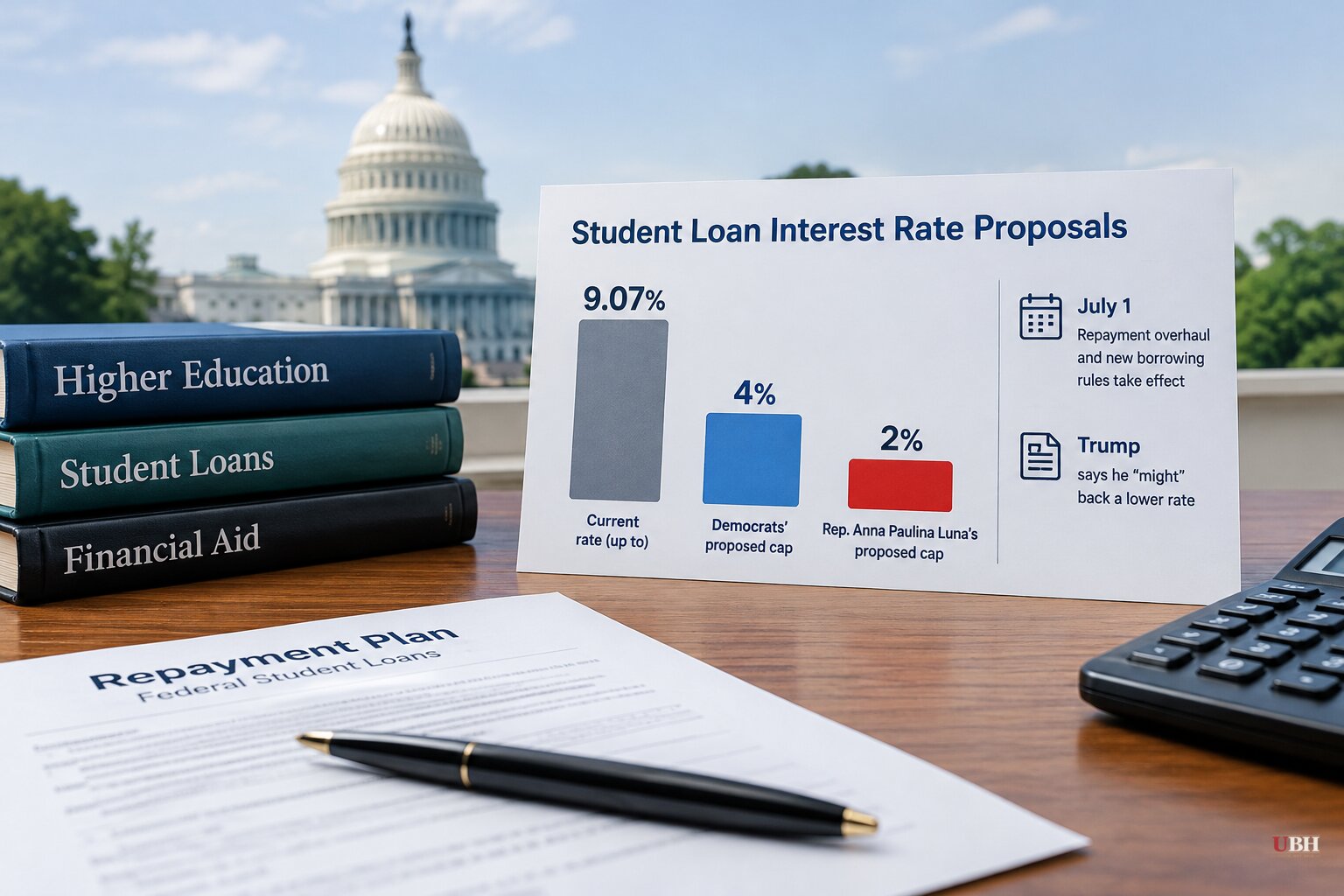
Federal student loan rates now run from 6.52% to 9.07%. Lawmakers in both parties say that is too high, which is rare in Washington.
Democrats have proposed wiping out interest on existing federal loans and capping rates for future borrowers at 4%. Republican Rep. Anna Paulina Luna has pitched a 2% cap. President Donald Trump told reporters last month he "might" support it.
A cap is not a cure-all. Kristin Blagg, an education researcher at the Urban Institute, said borrowers on standard repayment plans would feel it most, because their monthly payment is calculated from the interest rate. "Broadly, with a few exceptions, borrowers on income-based repayment plans are not going to feel the change between a 6% interest rate or a 2% interest rate," she said.
The exception is borrowers nearing the end of a 20- or 25-year income-driven timeline. The American Rescue Plan provision that made forgiveness tax-free expired in 2025, so the balance left at the end can now carry a tax bill.
What the administration has already done
The Education Department is offering a temporary one-percentage-point rate cut for borrowers who enroll in autopay. The deadline is December 31, and the benefit runs through June 30, 2028. Undersecretary Nicholas Kent said the benefit is "already driving up repayment rates and improving the overall health of the federal student loan portfolio."
One in five borrowers is in default, according to figures cited by EdSource. Total federal and private student debt is estimated between $1.6 trillion and $1.9 trillion. Sen. Dick Durbin's office puts the number of borrowers at nearly 43 million.
The July 1 overhaul also created the Repayment Assistance Plan, or RAP. If a borrower's RAP payment is smaller than the interest that accrues in a month, the unpaid interest is canceled, as long as the payment is made in full and on time.
Some borrowers say their bills have jumped anyway. Vincent Rasso, a UC Riverside graduate who borrowed nearly $30,000, said both new plans would at least double his $160 monthly payment. He said he can't afford to travel home for Thanksgiving because of it.
The Center for American Progress, a left-leaning think tank, estimates Black borrowers would pay 98% more when moving from the SAVE plan to RAP.
Caps on new borrowing push demand to private lenders
The One Big Beautiful Bill Act eliminated Grad PLUS and set new federal limits. Professional programs are capped at $200,000 and other graduate programs at $100,000. New borrowers face a lifetime cap of $257,500, and parent borrowing is limited too.
Private lenders are filling the gap. SoFi reported in late October that student loan originations hit $2.9 billion in the third quarter, nearly double a year earlier. Sallie Mae said graduate loans were up 119% year over year.
Jordan Matsudaira, who directs the Postsecondary Education & Economics Research Center at American University, estimates that once the changes are fully phased in, more than half a million borrowers will need roughly $20,000 a year from outside the federal system. Medicine, law and dentistry students, and those in high-cost states, are hit hardest, according to the center's analysis.
The administration says the point is to curb "excessive borrowing" and force schools to rein in prices. It estimates taxpayer savings of more than $409 billion, partly from ending forgiveness programs. A Department of Education spokesperson cited an American Enterprise Institute report identifying more than 50 graduate schools that have cut tuition since the law passed. Some of those cuts apply only to select students, such as alumni or employees' families.
Critics see it differently. Sara Partridge of the Center for American Progress said the changes "will restrict access to these pathways, which is both unfair and harmful to society." Experts also expect borrowers to turn to costlier and riskier private loans, which lack federal flexibility and forgiveness options.
Servicing failures and a Democratic push
More than 30 Democratic lawmakers, led by Sen. Elizabeth Warren and Rep. Ayanna Pressley, wrote to Education Secretary Linda McMahon about billing errors, improper interest accrual and delays in income-driven plan relief. The letter followed a request from eight state student-loan ombudsmen who cited "systemic failures." One example: a borrower whose forgiveness tracker counted payments that did not actually qualify.
The department says it has fixed repayment errors as they arose. The lawmakers noted that servicing problems predate Trump's changes, but argued that staff cuts made them worse. A Government Accountability Office report found the department stopped monitoring servicers for accuracy and call quality after staffing reductions.
The American Federation of Teachers has sued the department over stalled relief for borrowers pursuing Public Service Loan Forgiveness.
On November 18, Durbin and 11 other senators reintroduced the Student Loan Borrower Bill of Rights, which would set consistent servicing and disclosure standards across federal and private loans.
A Democratic split on forgiveness
Not every Democrat wants to relitigate cancellation. Former Transportation Secretary Pete Buttigieg told the "Pod Save America" podcast that the party "overtorqued" on student loans. "I have a very hard time explaining to my relatives in Michigan who did not go to college why they should be paying for people who do," he said. He added that he does not believe in a "magic wand" for everyone who borrowed.
Democratic strategist Julian Epstein went further, calling loan forgiveness "a scam" and "welfare for the most privileged." The Supreme Court struck down the Biden administration's cancellation effort in 2023.
What comes next
No rate-cap bill has passed either chamber, and Trump's "might" is the only signal from the White House. The autopay deadline is December 31. Borrowers have until then to lock in the temporary one-point reduction, while lawmakers decide whether to lower rates for everyone.
Sources used for this briefing
7 links from 6 independent newsrooms (syndicated copies of the same report count once)
These are the sources it draws on, linked so you can verify.


