
Unbiased headlines. Facts, not spin.
Unbiased Headlines is an independently owned news organization. We bring you the facts, not opinions, written fresh from 110+ named sources. Sources linked so you can verify it yourself.
 finance
Notable (6/10)
Event date: November 15, 2026 ·
Argentina's Bond Spread Tops 1,000 Basis Points as Private Analysts Call a Recession and INDEC Data Lands Tuesday
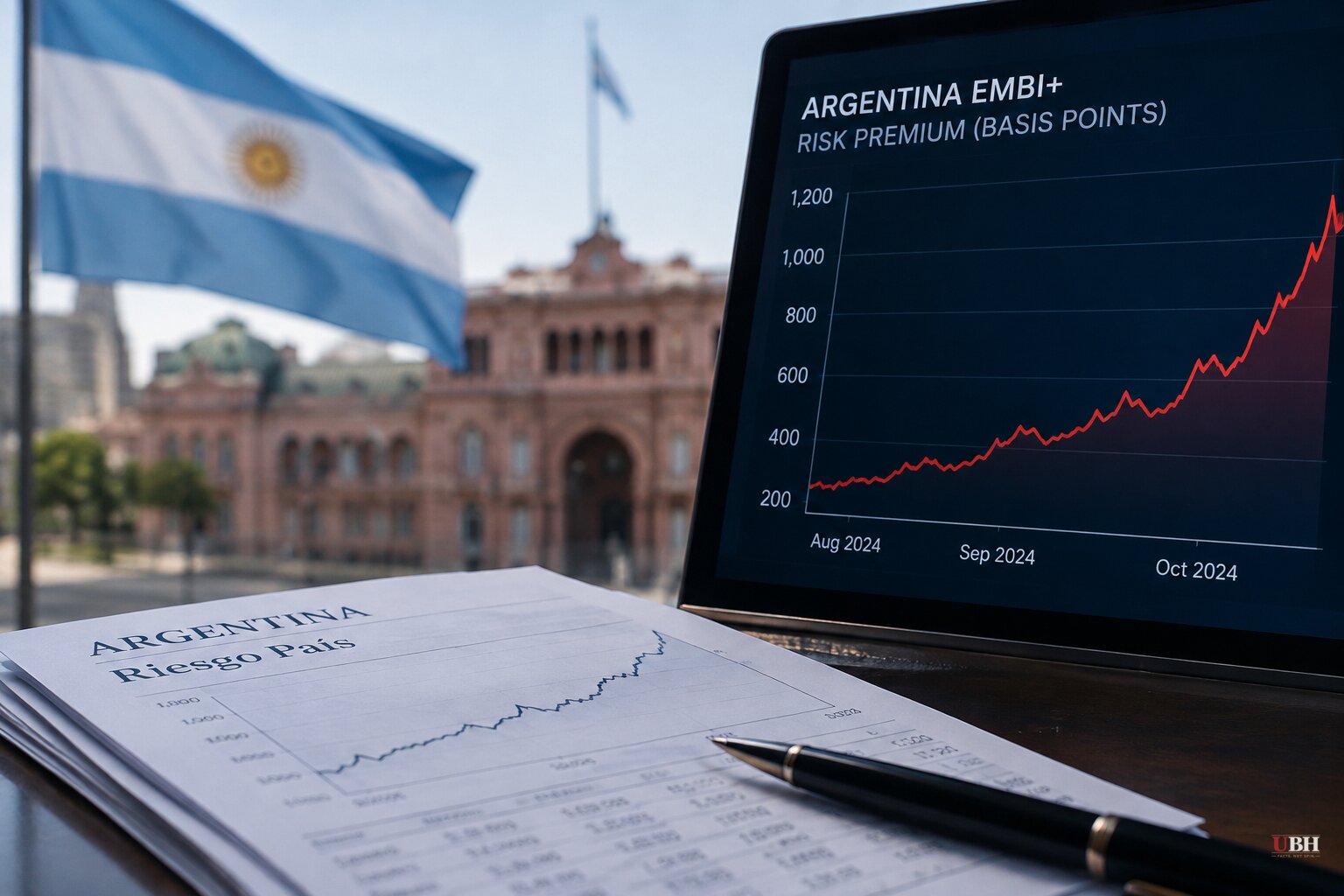
Argentina's dollar bonds have been sliding since early August, and late last week the slide pushed the country's risk premium into distressed territory for the first time in two years. The extra yield investors demand over U.S. Treasuries stood at 10.7 percentage points on JPMorgan's EMBI index, up from just above 4 points in early August. A reading above 1,000 basis points is the threshold widely associated with distressed debt.
The 2030 and 2035 sovereign notes fell more than 2 cents on the dollar in a single session, according to Bloomberg indicative pricing. Argentine dollar bonds are down about 20 percent since the start of August.
That is a sharp move from where things stood a month or two ago. The country's risk reading was above 700 basis points in October, and it has climbed roughly 300 points since.
The 2027 funding hole
Economy Minister Luis Caputo has a financing problem. Argentina owes nearly $17 billion in bond payments in 2027, and Fernando Marull, founder of the Buenos Aires consultancy FMyA, estimates a $10 billion gap has opened as borrowing costs have become prohibitive at home and abroad.
The government has not sold new local-law sovereign dollar debt since August. It rejected the yields investors demanded, some as high as 17 percent. Those instruments made up about $5 billion of the financing plan Caputo presented in July.
Marull said international borrowing is also unviable unless the risk premium falls substantially. MAP Latam said a large drop would be hard to engineer without clearer gains in economic activity and household incomes.
Recession call, official numbers pending
Argentina's statistics agency, INDEC, has not yet published third-quarter GDP. Its September monthly activity reading is scheduled for Tuesday, Nov. 24.
Private estimates point one way. The Orlando Ferreres y Asociados activity index showed a 1.2 percent drop in the third quarter from the second. Equilibra put the fall at 2.6 percent. The University of San Andrés business research center estimated a decline of as much as 2.66 percent.
The second quarter had already contracted 0.6 percent, so two straight quarterly declines would meet the usual definition of a technical recession. INDEC's monthly estimator fell 2.8 percent in July and rose just 0.1 percent in August. By one account, September would have needed growth of about 8.5 percent to avoid a quarterly decline, a pace analysts called unfeasible.
The IMF cut its 2026 growth forecast for Argentina in October to 2.1 percent from 3.5 percent. Private consultancies including Eco Go, Equilibra, FIEL and Empiria sit at roughly 1 percent or below, against the 3 percent projected in the government's budget. About 13,000 formal private-sector jobs were lost in July, according to figures reported in the local press.
Politics is moving the price
Investors are pricing the October 2027 presidential election. Milei's approval has fallen into the mid-30s, from above 40 percent in January. AtlasIntel's latest poll has 36 percent viewing him favorably and 62 percent unfavorably.
Fernando Losada, a managing director at Oppenheimer, said Argentina has underperformed because political risk ahead of next year's election "is and will continue to be elevated." Ramiro Blazquez Giomi, a strategist at StoneX, said markets once treated Milei's re-election as nearly certain but now face a far less predictable outcome. The concern he and others describe is a return of the Peronist opposition and the continuity of Milei's market reforms.
Polymarket cut Milei's odds of winning from 56 percent to 43 percent over the past month.
Global conditions are making it worse. The S&P 500 fell 10 percent from its peak, an index of emerging-market credit-default swaps rose for a fifth straight session, and investors rushed into Treasuries. David Austerweil, a portfolio manager at VanEck, said Argentina "lacks positive catalysts and is still a crowded long." Higher energy prices and expectations of higher U.S. interest rates are also adding pressure.
Milei has said the world faces "more inflation, higher interest rates and less economic activity" and that Argentina is "not immune."
The reform record under scrutiny
The pressure comes as the case for Milei's agenda is being tested from both directions. Congress cut about two-thirds of the articles from the Ley Bases before passing it in June 2024. A plan to privatize more than 40 state enterprises shrank to six companies of moderate importance, according to Reason's December issue. The state still supervised about 60 public companies as of 2025.
The first completed sale was Industrias Metalúrgicas Pescarmona. In February 2025 the national government and Mendoza province transferred 85 percent of the shares to the U.S. consortium ARC Energy for $27 million, with the buyer assuming significant debt.
Some free-market thinkers say Milei has not gone far enough. Economist Hans-Hermann Hoppe has criticized him for not acting radically enough. The central bank still operates, and restrictions on moving foreign currency were not lifted until April 2025. Milei answered that Hoppe lacks sufficient knowledge of monetary economics. He argues that lifting controls before closing the budget deficit risks hyperinflation, and that good policy mistimed can produce the worst outcome.
Another test comes Tuesday, when INDEC's September activity reading will show whether the quarterly contraction private analysts describe appears in official data. The government has not said how it will cover the $10 billion estimated gap in 2027 financing, and its local-law dollar issuance remains suspended.
Sources used for this briefing
6 links from 6 independent newsrooms (syndicated copies of the same report count once)
These are the sources it draws on, linked so you can verify.


