
Unbiased headlines. Facts, not spin.
Unbiased Headlines is an independently owned news organization. We bring you the facts, not opinions, written fresh from 110+ named sources. Sources linked so you can verify it yourself.
 finance
Major Story (7/10)
Event date: November 15, 2026 ·
South Korea Readies Stabilization Fund and Eases Buyback Limits Ahead of Monday Open After Kospi's 5% Drop
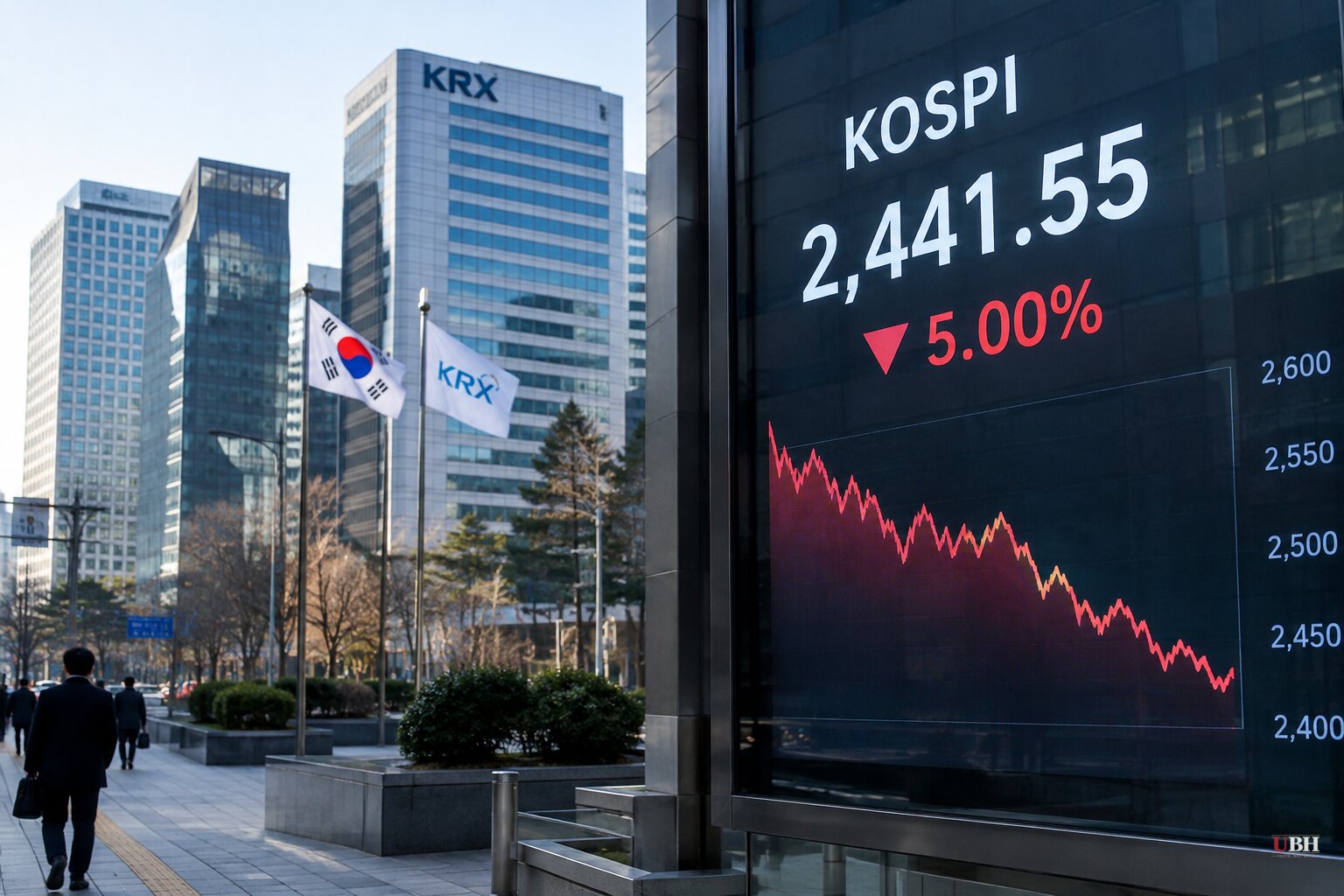
Since Friday's Nov. 20 rout that sent the Kospi down 5.21% to 4,869.96, Seoul has moved from silence to a package of measures, announced after an emergency meeting on Sunday, Nov. 22, ahead of Monday's open.
Finance Minister Lee Hyoung-il convened the so-called F4 meeting at the Government Complex Seoul. Bank of Korea Governor Shin Hyun-song, Financial Services Commission Chairman Lee Eok-won and Financial Supervisory Service Governor Lee Chan-jin attended. They discussed spillover from the U.S. selloff and contingency plans, according to a joint statement.
What Seoul announced
The government said it will overhaul the activation system for the Securities Market Stabilization Fund so it can be deployed immediately depending on market conditions. That is preparation, not spending. No capital injection has been approved.
Listed companies will get looser limits on daily share buyback orders for three months, starting Nov. 24. The Financial Services Commission plans to move on the related resolution on Nov. 23.
The Financial Supervisory Service and the Korea Exchange will also run a three-month special crackdown on illegal short selling and unfair trading. That targets illegal activity such as naked short selling. It is not a ban on legal short selling.
The government also plans to launch a Capital Market Reform Task Force "as soon as possible." Its job is to improve medium- to long-term supply and demand conditions and push tax and institutional changes that encourage long-term investment.
How bad last week was
The Kospi lost 7.95% for the week and closed below 4,900 for the first time in about 10 months. The Kosdaq fell 5.71% on Friday to 645.68, down 7.72% on the week.
The damage came from Wall Street. On Nov. 20 the Nasdaq Composite fell 5.28%, the S&P 500 dropped 3.70% and the Dow slid 1.93%. The Philadelphia Semiconductor Index plunged 10.73%. Semiconductors dominate Korea's market, which is why Seoul feels these swings so sharply.
Taiwan's picture is similar. The Taiex closed down 6.23% at 36,033.29 on Friday.
The short-selling question
Short-selling is the pressure point. Korea Exchange data show short-sale transactions on the Kospi and Kosdaq totaled 21.6 trillion won ($16 billion) over the 14 trading sessions from Nov. 2 through Thursday. Foreign investors accounted for 16.21 trillion won of that, or 75.1%.
Taiwan has already acted. Its Financial Supervisory Commission announced Saturday that, starting Monday, investors cannot place short-sale orders below the previous day's closing price for stocks that fell in the prior session. The Korean government has been wary of similar curbs. Restrictions on short selling have been cited as one obstacle to Korea's bid for developed-market status from MSCI, and officials worry that tighter rules would make the market less attractive to foreign investors.
That caution is the target of the loudest complaints. Jung Jeom-sik, floor leader of the main opposition People Power Party, wrote on Facebook on Sunday: "The government should prepare emergency measures in advance for the sharp decline expected in the stock market tomorrow. Retail investors have already suffered heavy losses and investors' confidence in KOSPI's soundness has been shaken."
Market watchers quoted by The Korea Times said earlier steps did little to calm trading. Earlier this month regulators temporarily eased collateral requirements for brokerages so investors who bought stocks with borrowed money would have more time before forced sales. Brokerages can still sell shares if values fall too far, and borrowers keep paying interest.
Will the fund actually be used?
The stabilization fund buys stocks using contributions from financial companies and other institutions. During the 2020 coronavirus crash, authorities set up a 10.76 trillion won vehicle. The money was never deployed after equities rebounded.
Citi Korea chief economist Kim Jin-wook said foreign investors have told Citi that even a signal the fund could be activated might help discourage short sellers, without the fund actually being used. Taiwan took a similar step: its National Financial Stabilization Fund Management Committee approved use of fund resources depending on market conditions on Nov. 6, and its short-selling rules have tightened in stages since.
What comes next
The Kospi opens Monday, Nov. 23, in Seoul, which is Sunday evening in New York.
The buyback relief takes effect Tuesday, Nov. 24. The government has not decided on an immediate capital injection into the stabilization fund; it says it will deploy the fund when needed after assessing market volatility, investor sentiment and the overall level of risk in financial markets. Whether the government will follow Taiwan in restricting short sales for stocks that fall is an open question that depends on how Monday trades.
Sources used for this briefing
7 links from 7 independent newsrooms (syndicated copies of the same report count once)
These are the sources it draws on, linked so you can verify.


