
Unbiased headlines. Facts, not spin.
Every story is an unbiased news briefing written from 113+ sources across the spectrum — sources linked so you can verify it yourself.
 politics
Major Story (8/10)
Event date: September 8, 2026
politics
Major Story (8/10)
Event date: September 8, 2026
Supreme Court Lets Trump Administration Use Overhauled Voter Citizenship Database for Midterms, 6-3
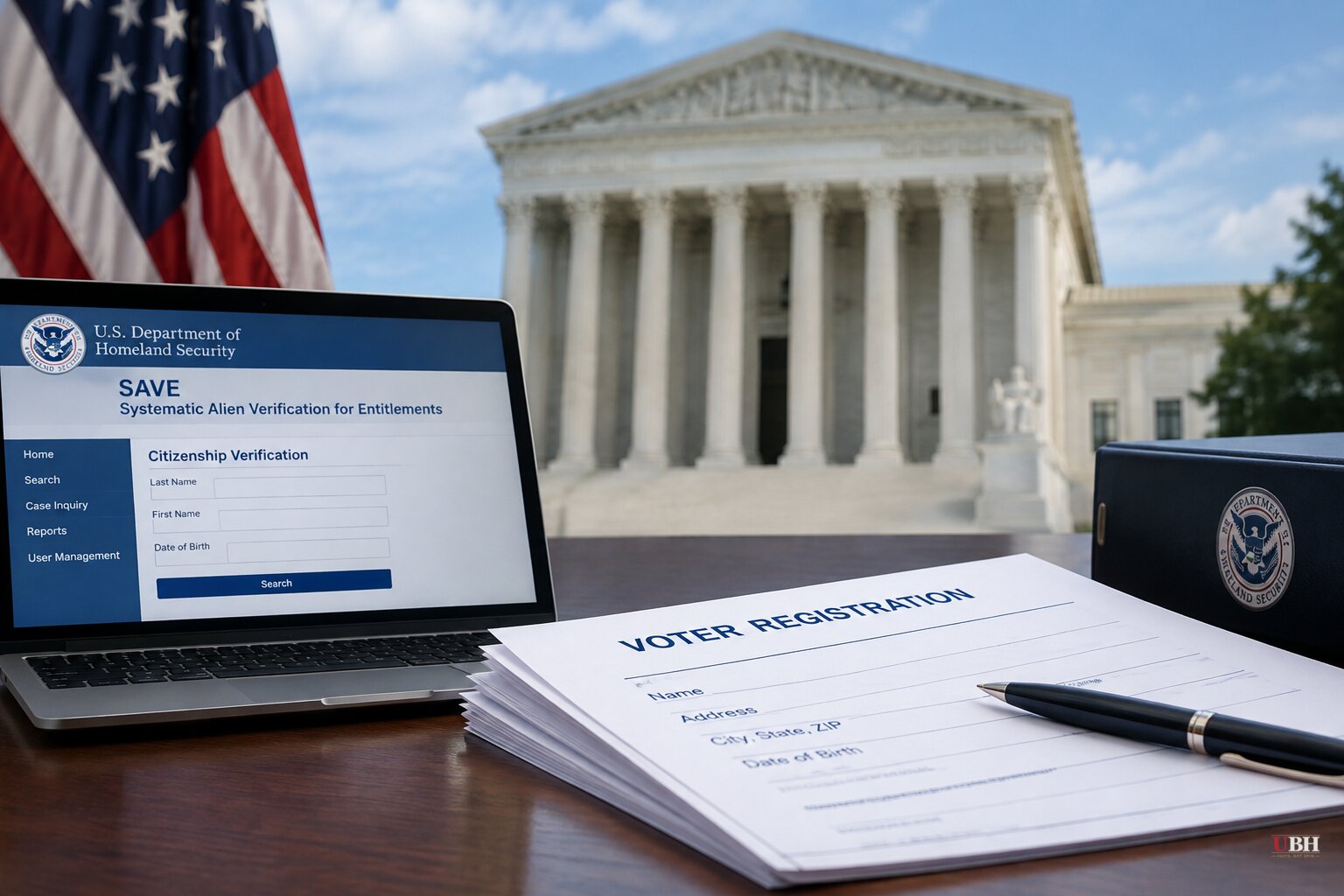
The Supreme Court ruled 6-3 on Friday, September 25, to let the Trump administration use its overhauled federal voter-citizenship database ahead of the November midterms, reversing a lower court block that had frozen the program since June.
The case centers on SAVE, the Systematic Alien Verification for Entitlements system Congress created in 1986 to help agencies check immigration status for benefits eligibility. After President Trump's March 2025 executive order directing agencies to help states verify voter citizenship, DHS rebuilt SAVE to pull in Social Security Administration records, add data on natural-born citizens, and allow states to run bulk queries on entire voter rolls instead of one name at a time.
U.S. District Judge Sparkle Sooknanan, a Biden appointee, blocked the overhaul in June, ruling it violated the Social Security Act and federal privacy law. She wrote that the "federal government has knowingly trampled on the privacy rights of American citizens in a manner that threatens the sacred right to vote." The U.S. Court of Appeals for the D.C. Circuit largely upheld her block on September 4, with Judge Gregory Katsas dissenting, arguing SAVE responses aren't the kind of protected "related records" the privacy law covers because DHS only echoes back information the state already supplied, plus a citizenship determination.
Solicitor General D. John Sauer asked the Supreme Court to intervene on September 8, calling Sooknanan's order "indefensible" and arguing it "threatens the integrity of upcoming elections" by stripping the government of "an effective tool to verify the eligibility of registered voters." Sauer also argued the voting-rights groups behind the suit, including the League of Women Voters, lacked legal standing.
The Court's unsigned majority opinion sided with the administration, writing that "the Federal Government has an obligation to respond to requests from state and local election officials seeking to verify the citizenship of voters" and that the lower court's order "prevents the Federal Government from using the program it believes is best suited to the task."
Justice Ketanji Brown Jackson dissented, joined by Justices Sonia Sotomayor and Elena Kagan. "The harm caused by burdening or disenfranchising even a few lawful voters outweighs the nonexistent harm that the Government experiences when it is prevented from taking an action that it likely lacks the authority to take," Jackson wrote.
What the ruling actually allows
This is an emergency order, not a final decision on the merits. The case returns to the lower courts, where the underlying privacy and Social Security Act claims will keep playing out.
The Court's order noted the National Voter Registration Act already bars sweeping purges of voter rolls in the final weeks before an election, which the justices said "limits the potential impact" of their ruling this cycle. States can still run individualized citizenship queries through SAVE, but the law caps how aggressively they can act on bulk results right before November.
Breitbart and the Epoch Times, drawing on Sauer's filings, framed the fight primarily around federal authority and standing, giving less weight to that NVRA guardrail. The Guardian's initial report was brief and did not detail the Court's reasoning on the purge-timing limit at all.
The core dispute, stated fairly
Critics, including the League of Women Voters and voting-rights groups, argue SAVE has already produced false positives: Texas's use of the expanded system last year flagged eligible citizens as noncitizens, according to evidence cited in the litigation reported by CNN's Tierney Sneed for KVIA. Judge Sooknanan's ruling rested on that record. Their underlying concern, that a database error can silently strip an eligible citizen's ability to vote, is a legitimate one that election-integrity advocates on any side would recognize.
The administration's counter, made by Sauer in filings covered by CBS News, is that SAVE itself doesn't disqualify anyone. "SAVE does not disqualify any voter; instead, it merely notifies the States whether the federal government can confirm citizenship," Sauer wrote, arguing any wrongful removal is a state decision, not a federal one. Studies of noncitizen voting cited by CBS and CNN have found it to be rare, but the administration's position is that even rare fraud justifies giving states a faster verification tool than the old one-record-at-a-time system.
Neither side's factual claim about SAVE's error rate has been resolved by a court on the merits. That fight continues in the D.C. Circuit and before Judge Sooknanan, whose original privacy-law and Social Security Act rulings were only stayed, not overturned.
What happens next
Republican-led states that had been waiting on this ruling can now resume bulk SAVE queries against their voter files. Whether any state moves to purge names before the NVRA's pre-election quiet period kicks in, and whether any of those removals end up contested in court the way Texas's did, is the next thing to watch. The underlying lawsuit, League of Women Voters et al. v. DHS, remains active and could return to the Supreme Court again once the lower courts rule on the merits.
Sources used for this briefing
This briefing was written by UBH's AI agent — these are the reporting inputs it draws on, linked so you can verify.


