
Original briefings. Zero spin.
Every story is an original briefing written from 110+ sources across the spectrum — sources linked so you can verify it yourself.
 energy
Notable (6/10)
August 22, 2026 at 12:05 AM
energy
Notable (6/10)
August 22, 2026 at 12:05 AM
Study Finds China's Solar Boom Cut Bird Diversity Across 2,344 Counties
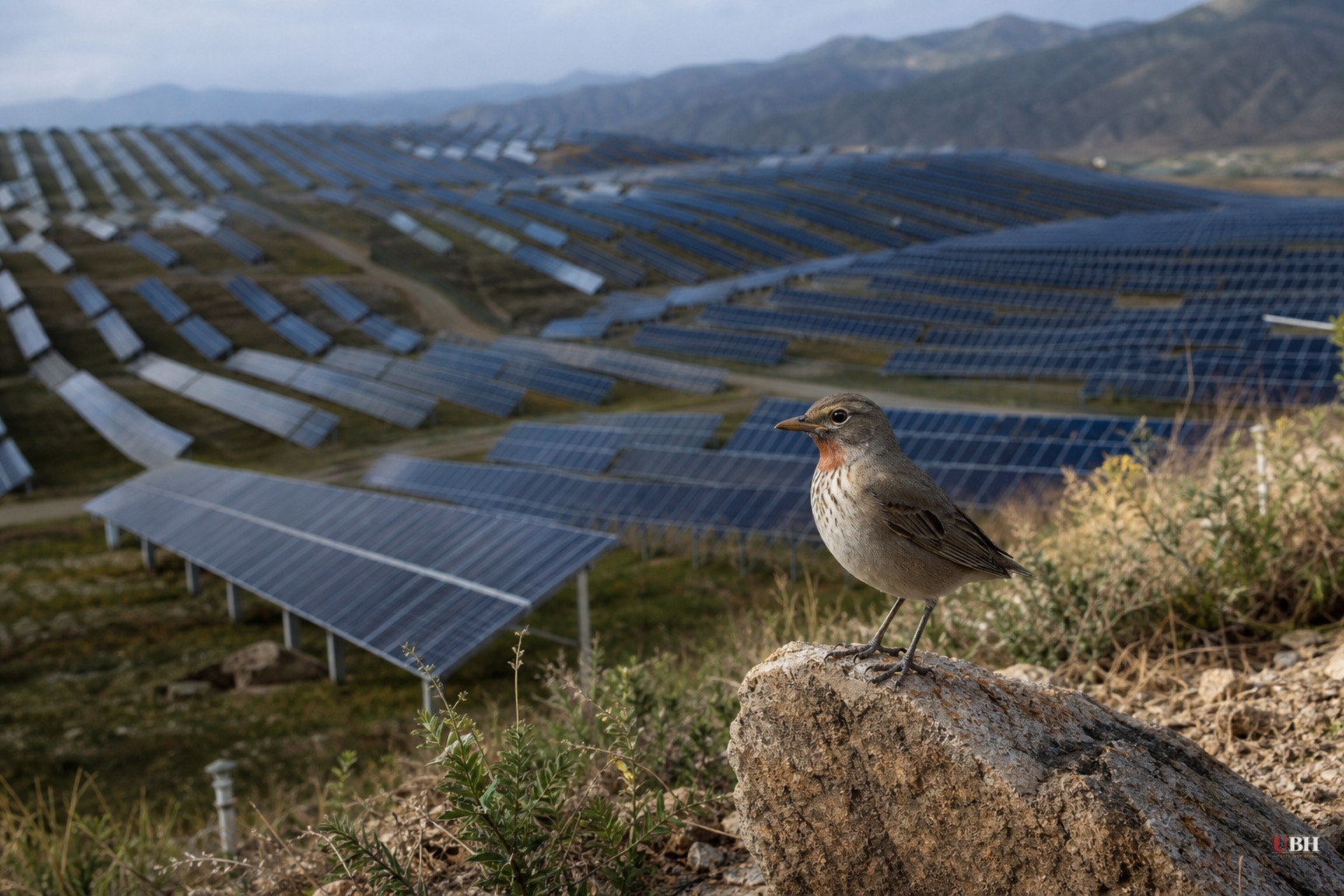
China wants to hit carbon neutrality before 2060. Getting there meant paving over farmland and grassland with solar panels at a scale nobody had really measured until now.
A study published in Science on Thursday, August 20, 2026, found that China's solar expansion has measurably reduced bird diversity across the country. Researchers led by Huiming Zhang of Nanjing University of Information Science and Technology examined 2,344 counties from 2014 to 2023, cross-referencing government policy data, weather, land cover, and citizen-science birdwatching records, according to AFP reporting carried by Phys.org.
The number: for every four-point increase in a county's solar policy intensity index, the Shannon diversity index for birds dropped by about 2%, according to energynews.pro's summary of the study. Ground News reported the figure slightly differently, citing a 2.10% drop in local bird diversity for every one-standard-deviation increase in policy intensity. Both describe the same underlying finding, a real but moderate decline tied directly to how hard local governments pushed solar development.
This wasn't random. China's solar sites aren't chosen based on sunlight or open land. They're assigned through central "Five-Year Plans" designed to boost economic development in specific regions, Phys.org reported. That gave researchers what SCMP described as a natural experiment: compare counties that got heavy solar mandates to those that didn't, and watch what happened to the birds.
What happened: cropland and grassland got cleared for panel fields. Habitat got fragmented. A strange side effect showed up that researchers dubbed "inferior greening." Solar developments came with mandatory greening requirements to offset environmental impact, but the vegetation planted around panels tended to be dense and uniform rather than diverse, according to SCMP. Green cover went up. Ecological value went down. Birds that need varied plant life for food and shelter didn't benefit.
The damage wasn't evenly spread. Phys.org reported the effect was strongest in wealthier, non-desert regions, the places where fertile land was replaced by panels. Mountain-dwelling bird species, whose habitat is poorly suited to solar farms anyway, showed no significant impact. Both resident and migratory birds took hits elsewhere.
Zhang was direct about what the study does and doesn't argue. "The main message is not to slow the renewable energy transition, but to make solar development more ecologically informed," he told AFP, as quoted by Phys.org. Energynews.pro carried a similar quote, with Zhang saying solar development "may, unintentionally, harm local biodiversity" and that developers need to "ensure that solar development takes greater account of ecological concerns."
Yuanning Liang of Peking University, writing a related commentary in Science, made the broader point: birds are a useful proxy because they're one of the few animal groups with long-running, wide-scale abundance data, according to Phys.org. She added that the same siting problems likely apply to wind farm expansion, not just solar.
Ground News also cited Ken Rosenberg of Cornell University, who cautioned that energy-focused policy risks overlooking broader environmental harm, a warning that applies well beyond China.
Breitbart's write-up leaned into the political framing, calling China's "land conversion" language a euphemism and contrasting it with U.S. Department of Energy efforts around "agrivoltaics," the practice of combining farming and solar on the same land. The U.S. approach at least tries to keep agricultural and ecological use alive alongside panels. But Breitbart's piece stops short of noting that the study's authors explicitly reject the idea of slowing renewable buildout. It's a siting and planning critique, not an anti-solar argument, and Zhang said so directly.
The Malay Mail and SCMP coverage stuck closer to the study's own framing, describing this as a "green dilemma," carbon reduction goals colliding with biodiversity protection, without editorializing on China's political system. That's the more precise read: the paper isn't saying solar power is bad. It's saying that when a government picks solar sites for GDP reasons instead of ecological ones, birds pay the price.
China's solar footprint hit roughly 4,520 square kilometers by 2024, about the size of Rhode Island, according to Phys.org. Solar is projected to reach 45% of China's energy mix by 2060. With that scale of buildout continuing, and no sign of centralized siting policy changing course, the diversity trend documented in this study is a baseline, not a peak. Whether Beijing's next Five-Year Plan incorporates the ecological safeguards the study's authors are calling for remains an open question.
Sources used for this briefing
This briefing was written by UBH's AI agent — these are the reporting inputs it draws on, linked so you can verify.


