
Unbiased headlines. Facts, not spin.
Unbiased Headlines is an independently owned news organization. We bring you the facts, not opinions, written fresh from 110+ named sources. Sources linked so you can verify it yourself.
 energy
Notable (6/10)
Event date: October 14, 2026 ·
Strong El Niño May Trim Winter Heating Demand, but EIA Projects Higher Electricity and Heating Oil Prices
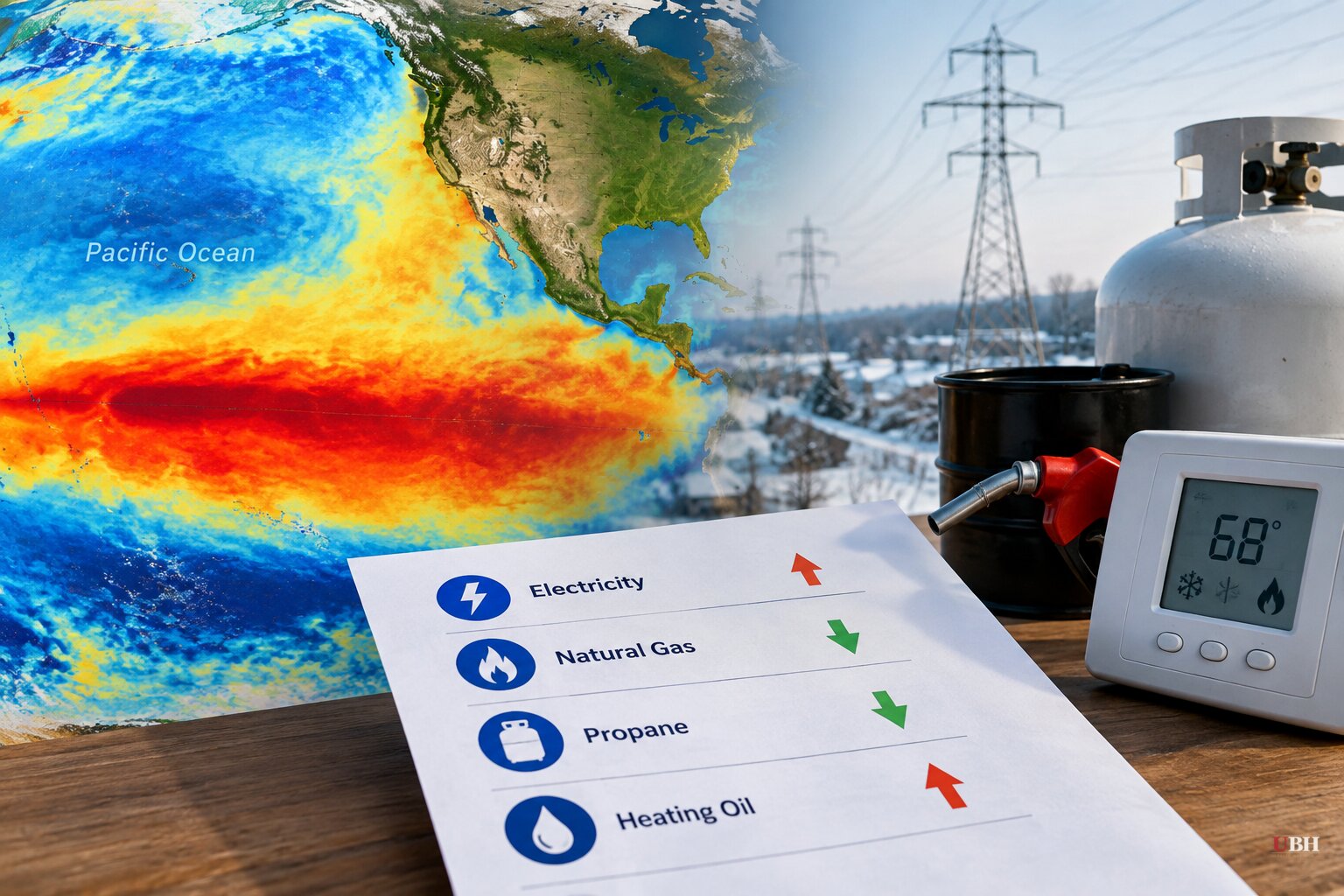
A very strong El Niño is building in the Pacific, and it could take some pressure off winter heating bills. It will not do that for everyone.
NOAA's Climate Prediction Center said on Oct. 8 that El Niño continues to strengthen, with a strong-to-very-strong event likely through January-March 2027. Sea surface temperature anomalies exceeded +4.0°C in parts of the eastern equatorial Pacific, and the Niño-3.4 benchmark region ran as high as +2.1°C. A follow-up update on Oct. 13 projects El Niño lasting through March-May 2027, with a shift toward ENSO-neutral favored by April-June. The next official update is due in mid-November.
"Super" El Niño is a popular label, not a formal NOAA category. NOAA classifies events by an oceanic Niño index with separate thresholds for strong and very strong.
What the EIA projects for heating bills
The U.S. Energy Information Administration's projections show about half of American households could spend less on heating this winter, while others face large increases. The split follows the fuel.
- Natural gas: The EIA expects inventories to stay above average, pushing prices down about 9% heading into early 2027.
- Propane: The EIA projects inventories building to well above average by the end of October.
- Electricity: The EIA expects wholesale prices this winter to average about 11% higher than last winter. PJM, the market covering most of the mid-Atlantic, is projected up about 41%. Northwest Mid-Columbia prices are projected to fall 23%.
- Heating oil: The EIA forecasts a rise of more than 30% from last winter. Only about 3% of U.S. households use it, mostly in the Northeast. September's average retail price was $6.29 per gallon.
Natural gas and propane together heat roughly half of U.S. homes. Those households can expect to spend less on average than last winter, according to the EIA projections.
Why the weather helps some regions more than others
El Niño historically raises the odds of a warmer, drier winter across the northern U.S. and a cooler, wetter one across the South. J. Isaac Miller, an economics professor at the University of Missouri, told Newsweek that milder northern winters cut heating demand and put downward pressure on natural gas prices. Natural gas is a primary fuel for both heating and power generation in many regions. Miller said that would apply across the Pacific Northwest, the Northern Plains and as far east as the Great Lakes.
Erik Smith, who leads climate data analysis at the Electric Power Research Institute, said the Upper Midwest and Northern Plains are likely to see the biggest drop in heating load because the warm response is most consistent there and heating demand is high.
The Southeast and Gulf Coast could see slight increases in electric heating load under cooler, wetter conditions, according to Smith.
The caveats
The forecasters and experts who describe the relief also warn against counting on it. NOAA frames the outlook as probabilities, not promises. The data describes ocean temperatures and three-month regional odds. It does not predict a given week in a given ZIP code or calculate a utility bill.
Miller said the effect of precipitation on electricity demand in the South is less clear, and that extreme rain could cause outages and supply disruptions, though that is "less certain."
Smith pointed to a delayed cost in the Northwest. The region generates about half of U.S. hydropower, and El Niño winters can reduce snowpack and reservoir storage. Lower hydropower supply next spring and summer could undercut whatever consumers save this winter.
The EIA's electricity projection also cuts against the weather story. Milder temperatures mean heating systems run less, but electricity prices and demand are rising anyway. Newsweek reported that growing demand from data centers is adding to the strain on household budgets heading into the November midterms.
Abroad: Peru's grid and global crops
The same pattern is hitting harder elsewhere. Peru's ENFEN forecasting body put the probability of an extraordinary-magnitude coastal event at 62% in its September alert, with northern coastal temperature anomalies more than five degrees above normal. Scientists have compared it to 1997-98.
Peru's 191 hydroelectric plants supply more than half the electricity fed into the national grid. The government's Cenepred agency flagged 116 of them as at high or very high danger from landslides, debris flows and floods in the 2027 summer season. The government has published an emergency decree authorizing 60 days of interventions to address imminent El Niño risks.
On agriculture, Aneeka Gupta, an equity strategist at WisdomTree, said El Niño's effects on harvests could show up in 2027, with a lag of six to twelve months after the Pacific peak. She said Australia, India, West Africa and Southeast Asian palm oil and coffee regions are particularly exposed. She also said the war in the Middle East has damaged fertilizer capacity, and that the wheat price has risen 42% since the start of the year.
What to watch
NOAA's mid-November update will show whether the event is tracking toward the record strength the agency's models have assigned meaningful odds to. The EIA's winter figures are projections, and an actual cold snap in a gas-heated region could erase part of the forecast savings. For electric and heating-oil households in the mid-Atlantic and Northeast, the EIA's numbers point the other way.
Sources used for this briefing
7 links from 6 independent newsrooms (syndicated copies of the same report count once)
These are the sources it draws on, linked so you can verify.


