
Unbiased headlines. Facts, not spin.
Unbiased Headlines is an independently owned news organization. We bring you the facts, not opinions, written fresh from 110+ named sources. Sources linked so you can verify it yourself.
 energy
Notable (6/10)
Enverus Ranks Grid Operators on FERC Large-Load Mandate: SPP Leads but Holds 5% of Data Center Pipeline
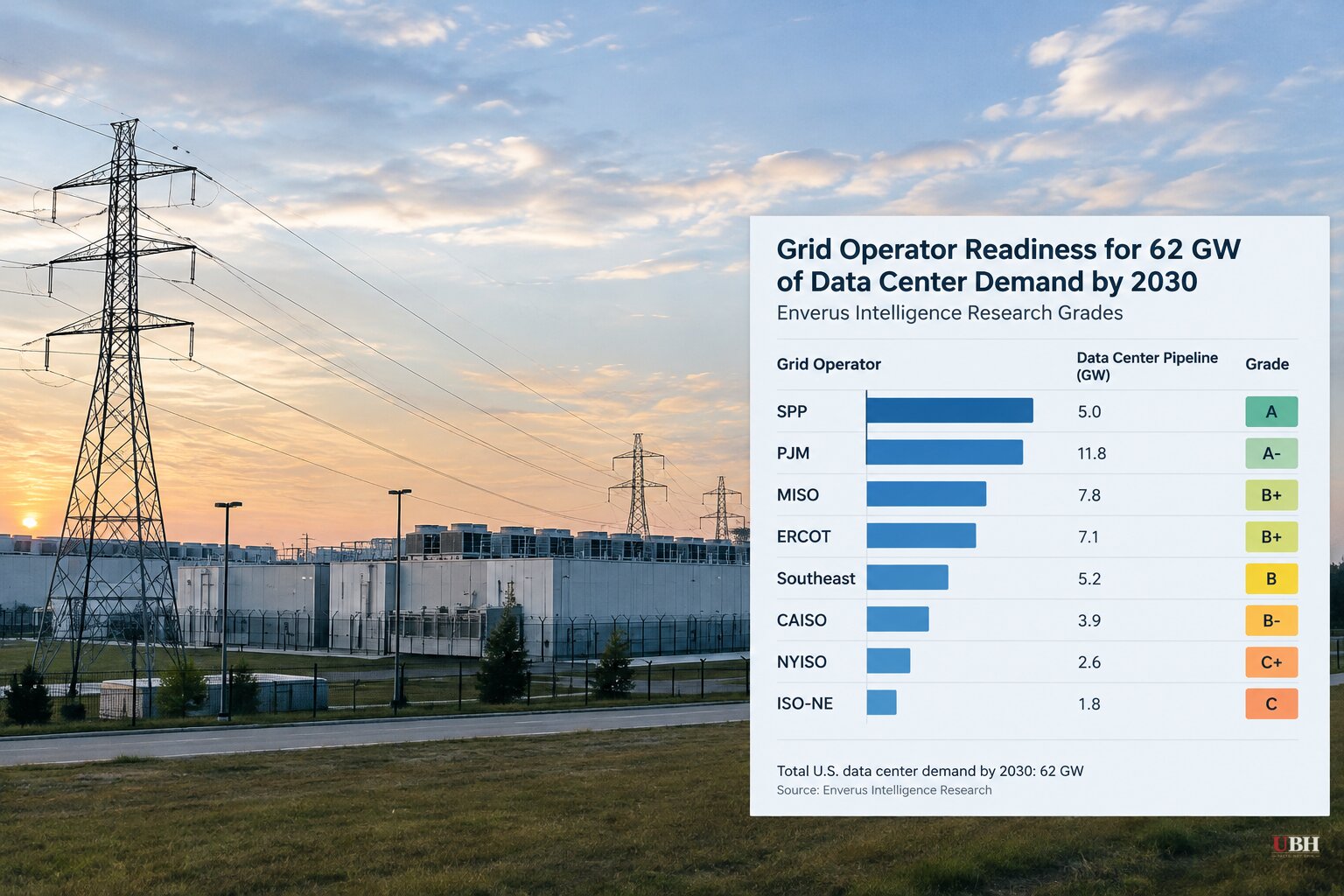
Since FERC's June 2026 show-cause orders told every grid operator to prove its interconnection rules can handle the load, the question has been who is actually ready. Enverus Intelligence Research (EIR) now has a grade, and the news is not great for the places where the money is going.
EIR's finding: the regions attracting the most data center development are, almost without exception, the least prepared to connect it.
The orders require each ISO/RTO to show its framework can absorb the 62 GW of new U.S. data center capacity expected by 2030. EIR scored the operators against the five reform areas FERC laid out.
A patchwork, not a standard
FERC did not hand down a single template. It encouraged each regional operator to tailor reforms to its own system and needs.
The result, per EIR, is uneven. Some FERC-regulated regions are well along in updating how they connect large loads. A few have barely started. ERCOT, which sits outside FERC's jurisdiction, is rewriting its own rulebook separately.
Developers and investors are left to navigate different timelines, costs and risks region by region, largely on their own, according to EIR.
The burden also lands on utilities. They have to rewrite operational playbooks, plan for short-term grid impacts, account for unpredictable load behavior and revise capital expenditure forecasts.
SPP leads, but the projects are elsewhere
EIR rated the Southwest Power Pool (SPP) as the most prepared region. It is the only one with FERC-approved large-load tariffs.
SPP's High Impact Large Load (HILL) and High Impact Large Load Generation Assessment (HILLGA) frameworks pair generation with load. They also reduce network upgrade costs, facilitate colocation, limit cost sharing to ratepayers and improve study efficiency.
The region also offers the most flexible route to fast grid access: Conditional High Impact Large Load Service, or CHILLS. It allows an almost immediate connection for a new or expanding large load.
There is a price. The customer must accept conditional, non-firm service for 7 years while upgrades are built, and it takes on peak-demand curtailment risk.
The catch is scale. SPP represents only about 5% of the identified high-confidence large-load pipeline. EIR defines those as projects where the developer has land, access to power, gas and fiber, and the project has been announced.
PJM: biggest pipeline, heavy reliance on bypassing the grid
PJM has the largest high-confidence pipeline, at roughly 11.8 GW. More than half of it, 58%, is expected to be served behind the meter.
EIR reads that as a sign that speed to power is a top priority for developers.
Amyra Mardhani, power and energy transition associate at EIR, said bypassing the grid should in theory speed up energization. She cautioned that behind-the-meter and co-located loads still draw from and feed into the grid at the margins.
That qualifier matters for the numbers. A project that avoids the grid on paper can still create grid impacts, so a large behind-the-meter share does not remove the need for PJM's interconnection rules to work.
What the grades mean for money already committed
The mismatch EIR describes is simple. The best-prepared operator has a small slice of the credible projects. The largest pipeline sits in a region where more than half the capacity plans to route around the grid.
For utilities, the cost of that gap shows up in capital plans. For developers, it shows up in how long they wait and what conditions come attached, like SPP's seven-year non-firm service.
The open question is whether the operators furthest behind can finish rewriting their rules in time to serve the 62 GW expected by 2030. Their show-cause responses are where that will be tested.
Sources used for this briefing
1 link from 1 independent newsroom (syndicated copies of the same report count once)
These are the sources it draws on, linked so you can verify.


