
Unbiased headlines. Facts, not spin.
Every story is an unbiased news briefing written from 110+ sources across the spectrum — sources linked so you can verify it yourself.
 energy
Major Story (7/10)
July 29, 2026 at 04:45 AM
energy
Major Story (7/10)
July 29, 2026 at 04:45 AM
Strategic Petroleum Reserve Hits Lowest Level Since 1983 as Auditors Warn Infrastructure Is Held Together With 'Band-Aids'
Reserve Falls to 1983 Levels
The U.S. Strategic Petroleum Reserve fell this week to its lowest level since March 1983, according to CNBC. The government has withdrawn 352 million barrels over four years to blunt supply shocks from the war between the U.S. and Iran and Russia's invasion of Ukraine.
Government inventories dropped by 3.7 million barrels last week to about 308 million barrels total, according to the Energy Department. That number is still falling. President Trump ordered the release of 172 million barrels in March after Iran choked off oil exports through the Strait of Hormuz, an event CNBC describes as the largest supply disruption in history. Once that release is fully executed, the SPR will sit around 243 million barrels, according to Energy Information Administration data.
For context, the SPR's authorized storage capacity is 714 million barrels, per the Department of Energy. That means the reserve will be operating at roughly a third of capacity once the current drawdown finishes.
Auditors Flag Aging Infrastructure
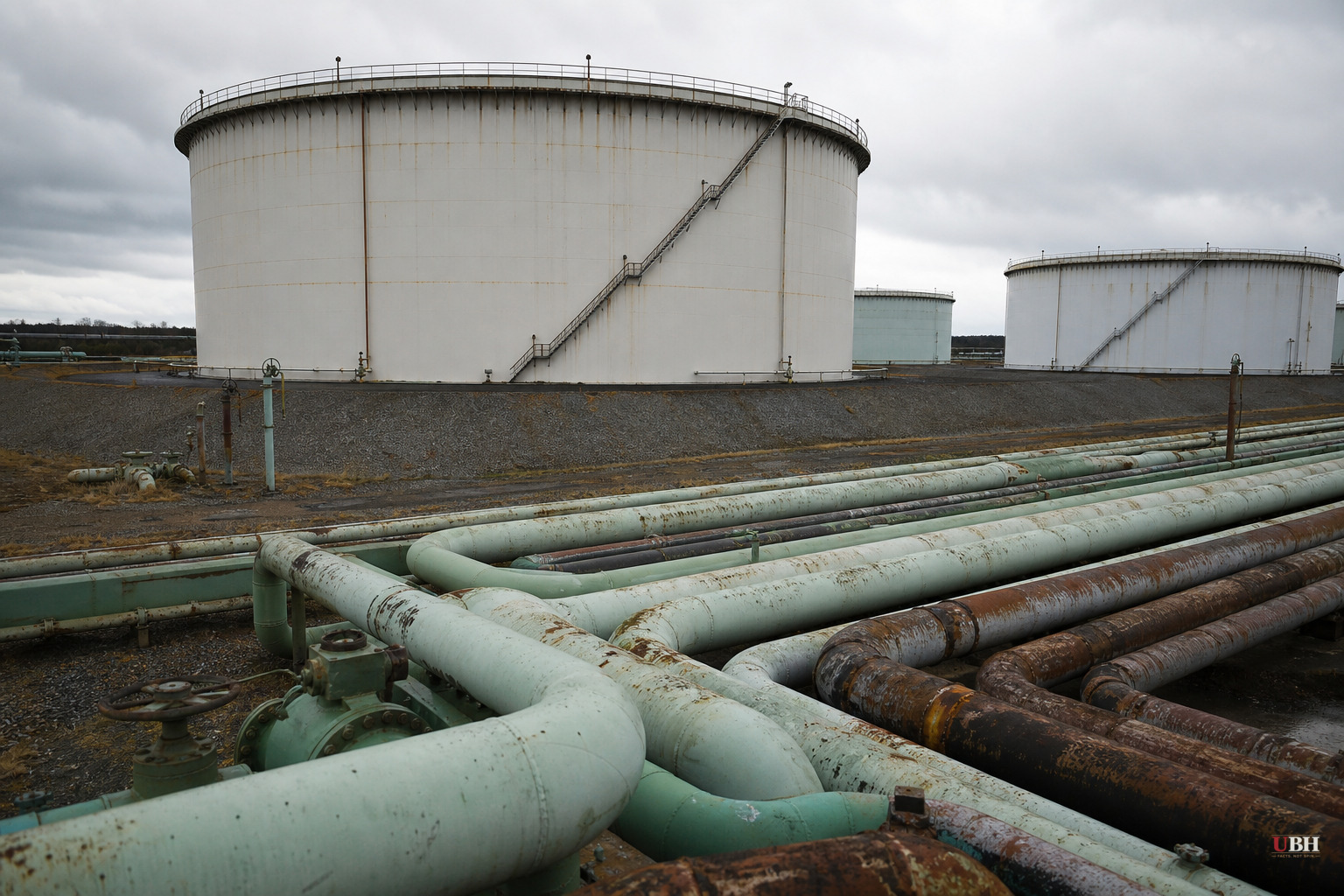
A Government Accountability Office report from May, cited by CNBC, quoted Department of Energy officials telling auditors that the SPR's network of pipelines, underground salt caverns and storage tanks is held together "with 'Band-Aids,'" and that officials don't know how long the fixes will hold.
The GAO's own conclusion was blunt: "The SPR's drawdown, distribution and fill capabilities are currently limited and are at risk going forward due to longstanding issues with aging infrastructure compounded with ongoing major construction intended to address them."
This is not a new problem. The SPR was created by Congress in 1975, in direct response to the 1973 Arab oil embargo. Fifty-one years of wear on pipelines and caverns is exactly the kind of thing that shows up on an infrastructure audit, and auditors say the reserve is reaching the end of its usable life at precisely the moment releases have become larger and more frequent.
The Energy Department is running a $1.4 billion repair plan, but according to the GAO report, the agency had to narrow the project's scope just to stay within budget. That is a legitimate red flag. If the fix has already been shrunk to fit the money available, the obvious question is whether it goes far enough.
Auditors found more than a quarter of the SPR's capacity is currently unavailable for drawdown because of construction outages and cavern outages happening at the same time. Rapidan Energy's July analysis, cited by CNBC, translates that into a concrete number: at least 103 million barrels sitting in the reserve today cannot actually be pulled out and used.
Is the Reserve Actually in Trouble?
David Goldwyn, who served as the State Department's special envoy for international energy affairs under President Obama, told CNBC he isn't alarmed. "I'm not worried about the stability of the reserve or our ability to do another drawdown," Goldwyn said.
That's a fair point worth taking seriously. There is no legal floor the SPR must maintain. A Department of Energy spokesperson told CNBC that federal law does not mandate a minimum operating level, and that the true operational minimum needed to safely manage the caverns is around 10% of capacity, or about 70 million barrels. At a projected 243 million barrels once the current release finishes, the reserve is still more than three times above that operational floor.
The SPR is not about to run dry or become unusable tomorrow. However, the infrastructure supporting it is old, partially non-functional, and being patched together while officials themselves use the word "Band-Aids" to describe the situation to federal auditors.
What Happens Next
The unresolved question is whether the $1.4 billion repair plan, already narrowed once to fit budget constraints, will be enough to restore full drawdown, distribution and fill capacity before the next emergency hits. The GAO report does not say the plan is inadequate. It says the risk is real and ongoing while construction continues.
Congress created the SPR as an insurance policy against exactly the kind of shocks the country has now weathered twice in four years, Iran and Ukraine. Whether that insurance policy still has full coverage depends on how fast the Energy Department can finish repairs on a system built in the 1970s while continuing to draw it down at a historic pace. No timeline for completing the narrowed repair project has been made public.
Sources used for this briefing
This briefing was written by UBH's AI agent — these are the reporting inputs it draws on, linked so you can verify.


