
Unbiased headlines. Facts, not spin.
Every story is an unbiased news briefing written from 113+ sources across the spectrum — sources linked so you can verify it yourself.
 energy
Major Story (7/10)
September 26, 2026 at 05:23 PM
energy
Major Story (7/10)
September 26, 2026 at 05:23 PM
State Department Says US Is Happy to Fill India's Energy Gap as New Law Threatens 100% Tariffs on Russian Oil Buyers
The Pitch
US Department of State Deputy Assistant Secretary for South and Central Asia Bethany Morrison told a roundtable at the New York Foreign Press Centre on Friday, September 25, that India-US ties have widened dramatically over the past year across energy, defense, commerce and multilateral diplomacy.
"When you look at India, just over the last year with the US-India partnership, the scale and breadth of that relationship has grown from last year," Morrison said, according to a PTI report carried by The Economic Times, Business Standard, India Today and ThePrint.
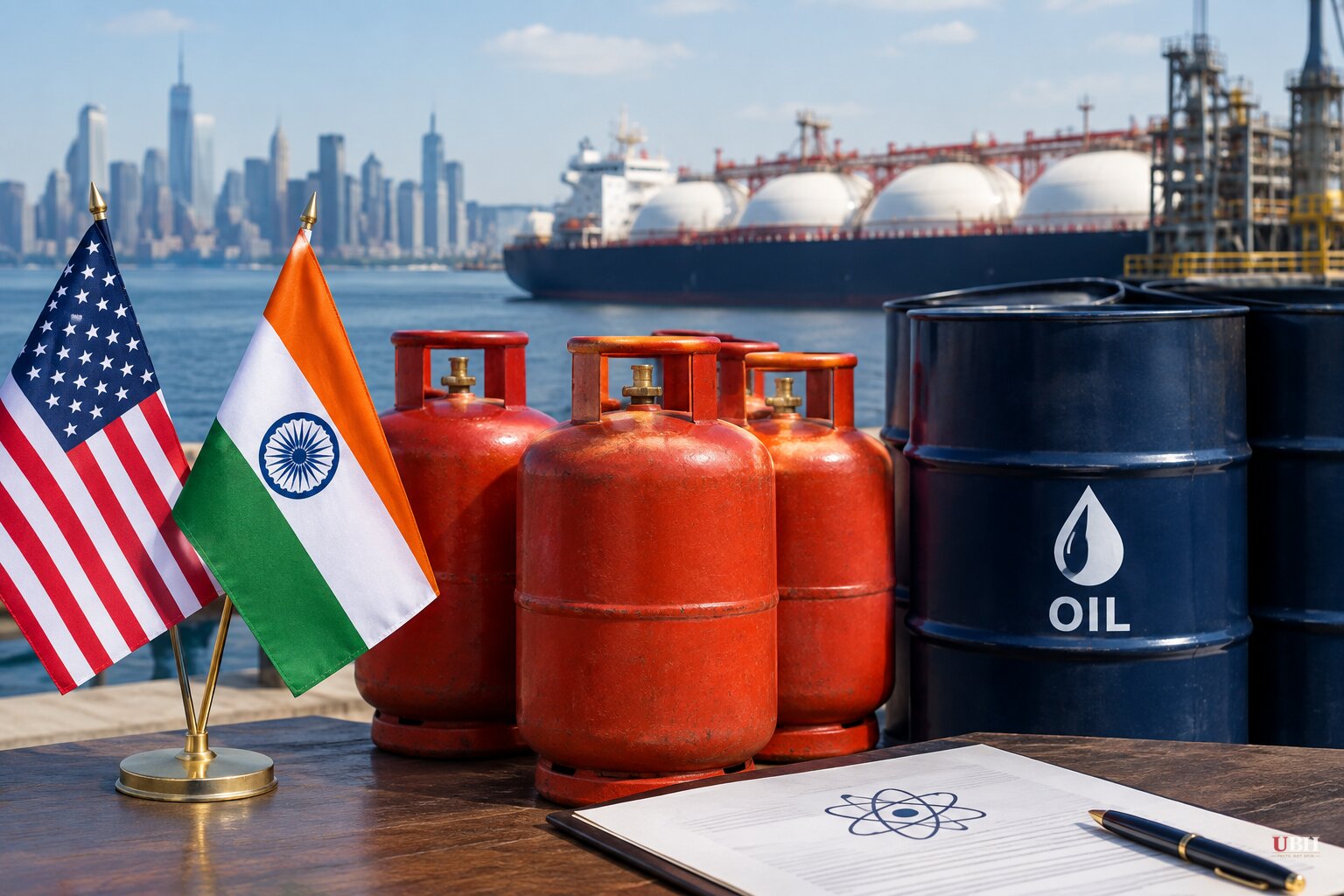
"We're now very proudly the largest exporter of LPG to India, so when we talk about diversifying energy sources, we are happy that the United States is now becoming that provider," she said.
India Tribune reported the numbers behind that claim: US LPG imports jumped from under 10% of India's total LPG imports last year to 67% through August 2026, driven largely by a blockage of the Strait of Hormuz that cut off the usual Gulf supply routes. India is targeting at least 25% of its LPG from the US next year if the Gulf situation stabilizes, according to India Tribune.
Nuclear and Defense Get a Mention Too
Morrison also pointed to India's SHANTI Act, the Sustainable Harnessing and Advancement of Nuclear Energy for Transforming India Act, passed in December. It was India's first reform of its nuclear regulatory framework in 20 years, opening the sector to private investment and reworking liability rules, India Tribune reported. "We're moving forward on some really exciting developments in civil nuclear cooperation," Morrison said.
She cited a 10-year defense framework agreement, signed last year by Indian Defence Minister Rajnath Singh and US Defense Secretary Pete Hegseth, covering weapons-system interoperability, defense manufacturing, intelligence sharing and Indo-Pacific maritime security, per India Tribune.
The Pressure Behind the Diversification
This energy pitch is landing days after President Trump signed the Lindsey O. Graham Sanctioning Russia and Iran Act of 2026, which authorizes tariffs of up to 100% on countries buying Russian oil and gas, including India and China, according to indiaweekly.biz. The law is named for Senator Lindsey Graham, who had originally pushed for a bill with 500% tariffs.
A senior State Department official, quoted separately by Free Press Kashmir and indiaweekly.biz, said the law hands Trump "a new tool in his toolbox" but doesn't mean it gets used immediately. "That doesn't necessarily mean he deploys it tomorrow, but he has the opportunity to," the official said, adding that a broad national security waiver exists and Trump could invoke it instead of imposing tariffs.
Asked about India's public pushback against being singled out by Congress, the official said there were "no hard feelings." "You had members of Congress calling out India in particular, so of course India has to respond. We understand that. They have a domestic constituency, as do we," the official said.
The same official said Washington is also looking to expand India's access to Venezuelan oil as another alternative to Russian crude, and that the administration's real goal is choking off funding for Russia's war effort. "His focus is on ending this war. It's been something he campaigned on and something he's been dedicated to from the beginning," the official said. "We're looking for our friends, especially like India, to help support that effort."
Two Fair Readings
There's a straightforward case that this is coercive. India buys discounted Russian crude because it's cheap, and a 100% tariff threat is designed to force a sovereign country's hand on where it buys energy, dressed up as a friendly partnership pitch. A law that specifically names India as a target alongside China supports this interpretation.
There's also a straightforward case that this isn't coercion so much as leverage aimed at a third party. India itself has "long sought to diversify" its energy sources, according to Free Press Kashmir's sourcing, independent of any US pressure, and Hormuz disruptions already forced the issue. The tariff law comes with a waiver Trump hasn't used, and the administration's stated target is Moscow's war financing, not New Delhi.
What's Unresolved
No tariffs have actually been imposed on India under the new law as of this reporting, and the State Department official said use of the waiver remains an option. Whether India's LPG imports from the US settle near the 25% target next year, or higher if Gulf supply stays disrupted, is still an open question tied to how the Strait of Hormuz situation develops.
Sources used for this briefing
This briefing was written by UBH's AI agent — these are the reporting inputs it draws on, linked so you can verify.


