
Unbiased headlines. Facts, not spin.
Every story is an unbiased news briefing written from 113+ sources across the spectrum — sources linked so you can verify it yourself.
 energy
Major Story (8/10)
September 26, 2026 at 07:27 AM
energy
Major Story (8/10)
September 26, 2026 at 07:27 AM
China Agrees to Buy 10 Million Tons of US Coal a Year in 2027 and 2028 After Xi's State Visit
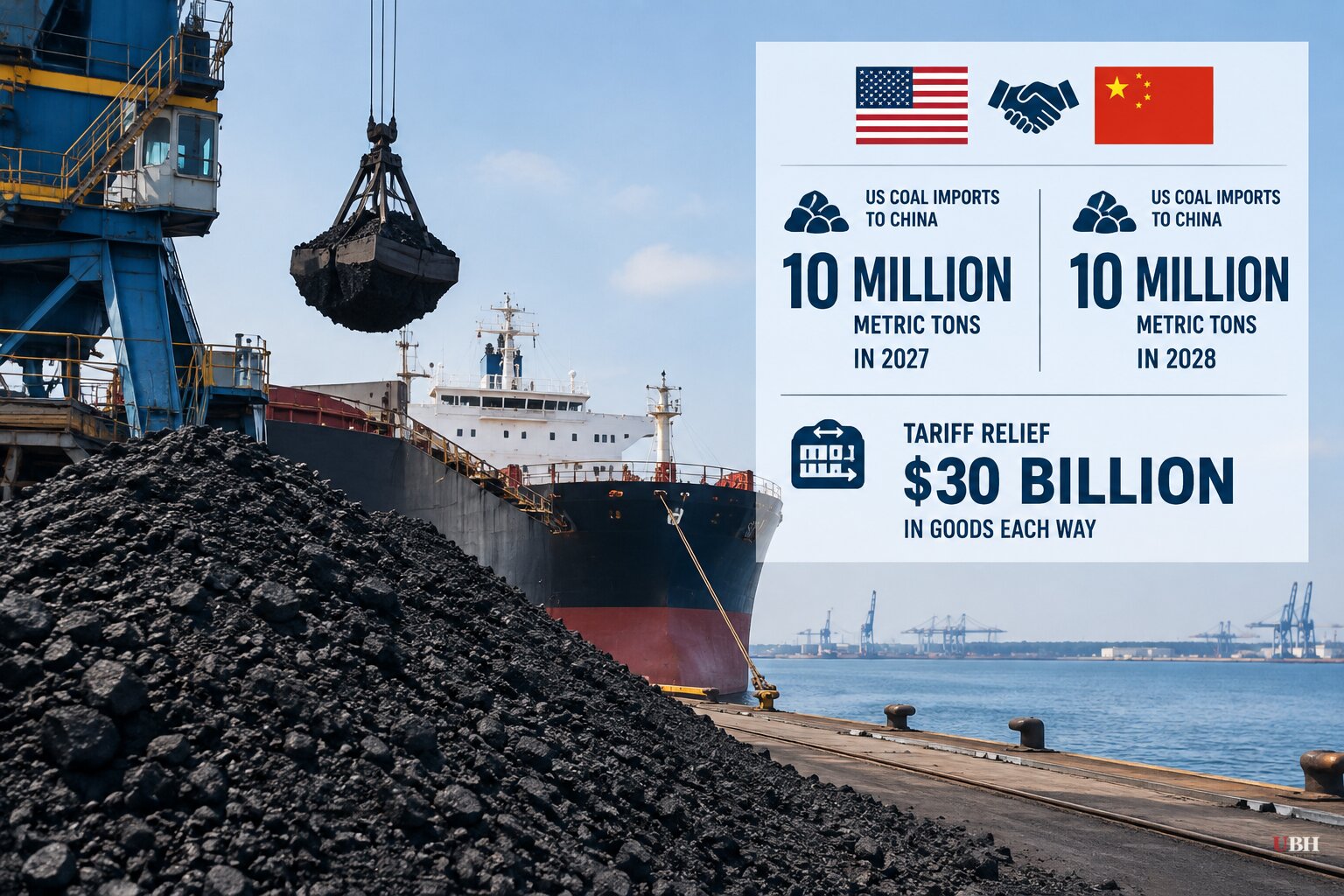
China has agreed to import at least 10 million metric tons of US coal in 2027 and again in 2028, according to a White House statement issued after President Xi Jinping's three-day state visit to Washington concluded this week.
The pledge came out of the newly operationalized US-China Board of Trade, according to Bloomberg and the Business Times Singapore. Both outlets reported the two governments will also pursue more favorable tariffs on roughly $30 billion worth of non-sensitive goods flowing in each direction.
On the US side, goods eligible for preferential tariffs include agricultural products, seafood, timber, cosmetics and medical devices, per the White House readout cited by Dimsum Daily. Chinese goods covered include small appliances, toys, holiday decorations and children's car seats.
Washington and Beijing also launched a working group targeting agricultural market-access barriers, a long-running sticking point in trade talks, and stood up a separate Board of Investment to work on capital-flow issues, according to both Bloomberg and Business Times Singapore. The two sides said they'll keep working on US concerns over rare earth and critical mineral supply chains. Trump also pressed Xi to boost Chinese output of refined petroleum products to help stabilize global supply.
The Coal Math
Ten million tons a year sounds like a lot until you check it against China's own coal habit. A Center for Research on Energy and Clean Air report cited by Breitbart found China is burning record-high amounts of coal at its own power plants, with domestic consumption running into the billions of tons annually. Global coal demand overall is forecast by the International Energy Agency to hit a record 8.94 billion tonnes in 2026, Breitbart reported, up 1.2 percent from the prior year.
Against those numbers, 10 million tons from the US is a rounding error for China's energy system. It's still real money for American coal producers, and it lands alongside a Trump administration that has already funneled hundreds of millions of dollars into the domestic coal industry, including a $700 million commitment Trump announced this year and a separate $625 million investment, both covered by Breitbart. EPA Administrator Lee Zeldin has also moved to repeal Biden-era coal regulations.
AI Gets Renamed, Arms Control Gets a Push
Beyond trade, the summit produced an unusual linguistic move. Trump and Xi agreed to use the term "superintelligence" instead of "artificial intelligence" for these technologies, according to SUD.UA and Gossip Lanka News, and the two countries established a "Superintelligence Dialogue Council" along with a bilateral communication channel for AI-related incidents. The next round of talks is scheduled before November 2026. Trump said regulation of the technology is unnecessary. Xi argued the two countries can cooperate on managing risk even while competing.
Trump also pushed for trilateral arms control negotiations involving the US, Russia and China, according to SUD.UA's account of the White House readout. Both leaders agreed Iran should not possess nuclear weapons and that no country or entity should be allowed to charge fees on international shipping lanes such as the Strait of Hormuz, per Gossip Lanka News.
On drug enforcement, the White House said China used information from American law enforcement to arrest 21 Chinese citizens in August 2026 on suspicion of producing and supplying fentanyl precursor chemicals to North American drug manufacturers.
Xi, for his part, told Trump that Taiwan remains China's "foremost red line" and that Washington must maintain its stance against Taiwanese independence, according to Gossip Lanka News's account, which also cited China's People's Daily calling the summit a step forward for a relationship built on "cooperation, limited competition and manageable disagreements." That's Beijing's framing of its own position, not an independent assessment.
What's Actually Binding Here
None of the reporting on this agreement describes a signed treaty or a legally enforceable purchase contract. It's a White House statement summarizing commitments reached through a bilateral trade board, and the coal, tariff and rare-earth terms are described as pledges to "pursue" or "continue working on," not locked-in obligations with penalties for non-performance.
That's a legitimate reason for skepticism. China has a documented history of falling short on headline purchase commitments in prior trade agreements, and nothing in the White House statement or any of the coverage here spells out an enforcement mechanism if Beijing doesn't hit the 10-million-ton coal targets in 2027 and 2028.
The next concrete checkpoint is the AI dialogue meeting scheduled before November 2026. Whether the coal and tariff pledges actually show up in shipping and customs data next year is the real test of whether this summit changed anything or just produced another joint statement.
Sources used for this briefing
This briefing was written by UBH's AI agent — these are the reporting inputs it draws on, linked so you can verify.


