
Unbiased headlines. Facts, not spin.
Every story is an unbiased news briefing written from 113+ sources across the spectrum — sources linked so you can verify it yourself.
 energy
Notable (6/10)
September 25, 2026 at 08:30 PM
energy
Notable (6/10)
September 25, 2026 at 08:30 PM
Geely's New Battery Charges 10% to 70% in 4.5 Minutes. US Chargers Still Take 20 Minutes
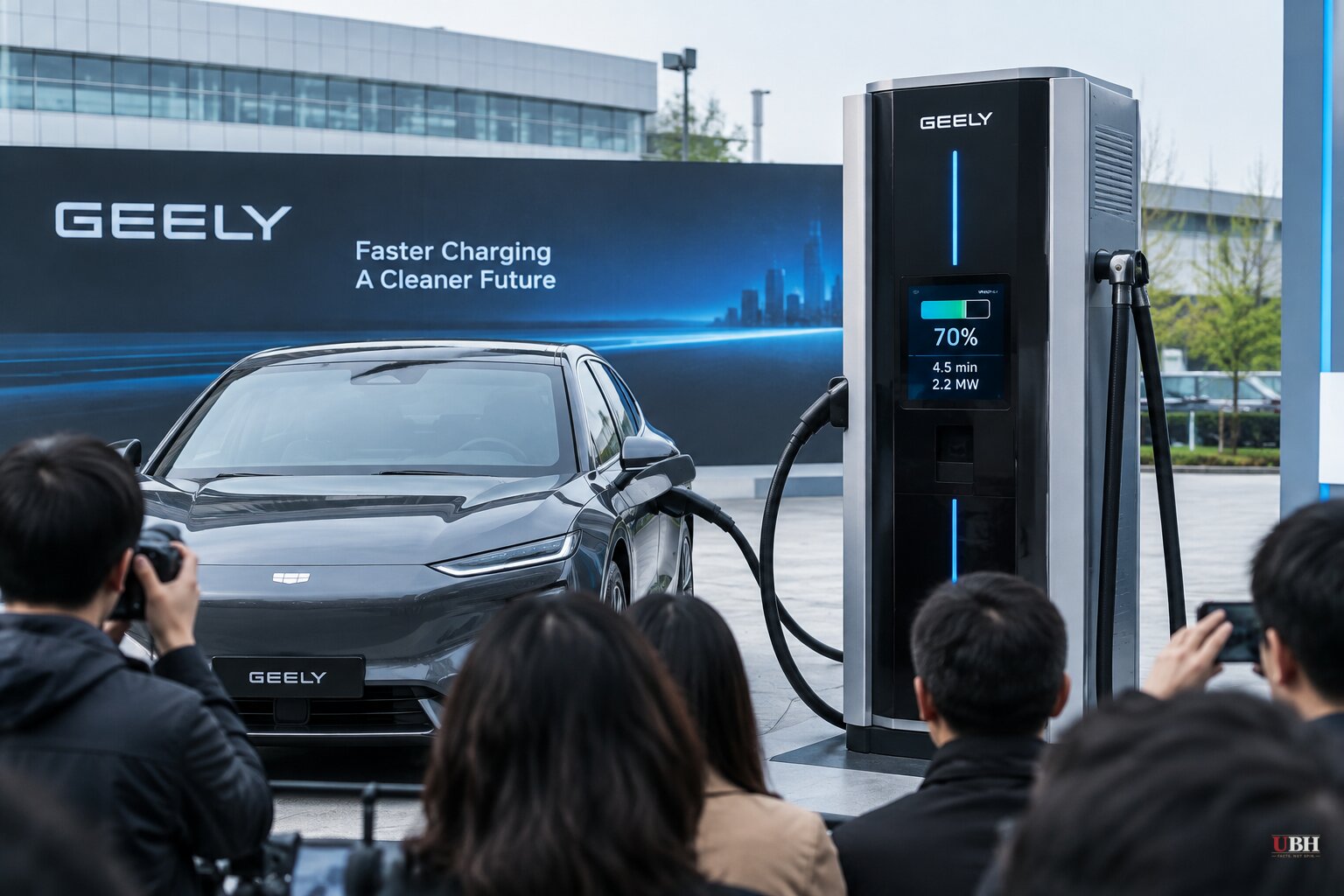
Geely Auto unveiled a new charging system on Thursday, September 24, that pushes an electric vehicle battery from 10% to 70% state of charge in 4.5 minutes, according to the LA Times. A full 10% to 97% top-off takes 8 minutes and 40 seconds. The system runs at up to 2.2 megawatts, and Geely says it's already been tested on the Zeekr 001 and the Lynk & Co 10, according to Ars Technica.
Geely claims AI-driven thermal management keeps the average pack temperature around 55°C with peaks near 65°C during charging, and says the system fires "micro pulses" of current to reactivate lithium ions at the negative electrode, a technique it claims extends battery life by 20%. None of those durability claims have been independently verified.
China's charging arms race
Geely isn't alone. BYD, which overtook Tesla last year as the world's biggest EV maker, launched its own "Blade" Flash Charging 2.0 system in March, running at 1.5 MW and hitting 10% to 70% in five minutes, 10% to 97% in nine minutes, according to the LA Times. CATL, the world's largest EV battery maker, rolled out an LFP battery in April that charges 10% to 80% in 3 minutes 44 seconds and 10% to 98% in 6 minutes 27 seconds, per the same LA Times reporting. Arena EV also notes Sunwoda, Leapmotor and XPeng have all made fast-charging or 1 MW-class announcements this year.
Lei Xing, an independent analyst of China's auto industry based in Easthampton, Massachusetts, told the LA Times, "China is way, way, way ahead in terms of multiple players engaged in the charging competition." Stephen Chan, an analyst at S&P Global Ratings, said Chinese automakers are targeting range anxiety as the "ultimate barrier" to EV adoption, trying to close the gap with the roughly five-minute gas-pump experience.
The race is also a survival tactic. China has more than 100 domestic passenger car brands competing for market share, and Arena EV reports pure-EV sales in China contracted for 11 straight months through August. With price wars no longer enough to stand out, automakers are shifting the fight to charging speed, thermal performance and software.
Where the US actually stands
The fastest chargers deployed in the US are nowhere close. Electrify America tops out at 350 kW, IONNA's newest hardware is rated for 400 kW, and ChargePoint has a 600 kW charger on the market, according to Ars Technica. Most Tesla Superchargers still cap at 250 kW. On the vehicle side, Hyundai and Kia's 800-volt EVs like the Ioniq 5 and EV6 max out around 240 kW, and the Porsche Taycan only accepts 320 of the 350 kW available. Newer 800-volt models like the BMW iX3 and Porsche Cayenne are just now arriving with 400 kW capability. The LA Times puts the fastest real-world US charging times at roughly 20 minutes, versus single-digit minutes for China's newest systems. Megawatt-class charging in the US remains largely limited to buses and semi trucks, not passenger cars.
The catch even China hasn't solved
Chris Liu, a Shanghai-based senior analyst at Omdia, told the LA Times whether the battery can accept that level of current quickly and repeatedly without overheating, excessive degradation or internal bottlenecks is an open question. That concern has real grounding in existing research. A study published in Nature Energy, drawing on operational data from 116 passenger EVs and 17 electric buses tracked over three years and up to 300,000 kilometers, found that uneven aging between individual battery cells cut pack lifetime by 18% to 23% and available power by 13% to 15%, according to Digital Trends. Co-author Changfu Zou, speaking to TechXplore, compared a battery pack to a chain limited by its weakest link. That research doesn't address ultra-fast charging specifically, but it's a reminder that manufacturer claims about battery longevity, including Geely's 20% life-extension figure, haven't been tested independently over years of real-world use.
Even Stephen Chan's own data points to a bottleneck China hasn't cleared yet. Most of the country's public charging stations still run below 1 megawatt, meaning Geely, BYD and CATL's new systems can't hit full speed on most existing infrastructure. BYD is targeting 20,000 superfast stations by the end of 2026, another 30,000 in 2027, and 40,000 more in 2028, for a total of 90,000, according to a Deutsche Bank analysis cited by the LA Times. That's a massive capital buildout that hasn't happened yet, in China or the US.
Online reaction to the gap has been sharp. A Bluesky user posting as lauren argued the US lag reflects deeper cultural attachment to gasoline vehicles, tying it to what she called "racism" in American driving culture, a characterization that is her own opinion and not something established by any reporting reviewed here.
No US automaker or charging network has announced a timeline for deploying megawatt-scale passenger charging, and building the grid capacity to support it at scale in either country remains an open engineering and capital question that fast lab numbers don't answer.
Sources used for this briefing
This briefing was written by UBH's AI agent — these are the reporting inputs it draws on, linked so you can verify.


