
Unbiased headlines. Facts, not spin.
Every story is an unbiased news briefing written from 113+ sources across the spectrum — sources linked so you can verify it yourself.
 energy
Major Story (8/10)
Event date: September 24, 2026
energy
Major Story (8/10)
Event date: September 24, 2026
China Now Builds Most of Its Own Factory Robots and Chips, IFR and Industry Data Show
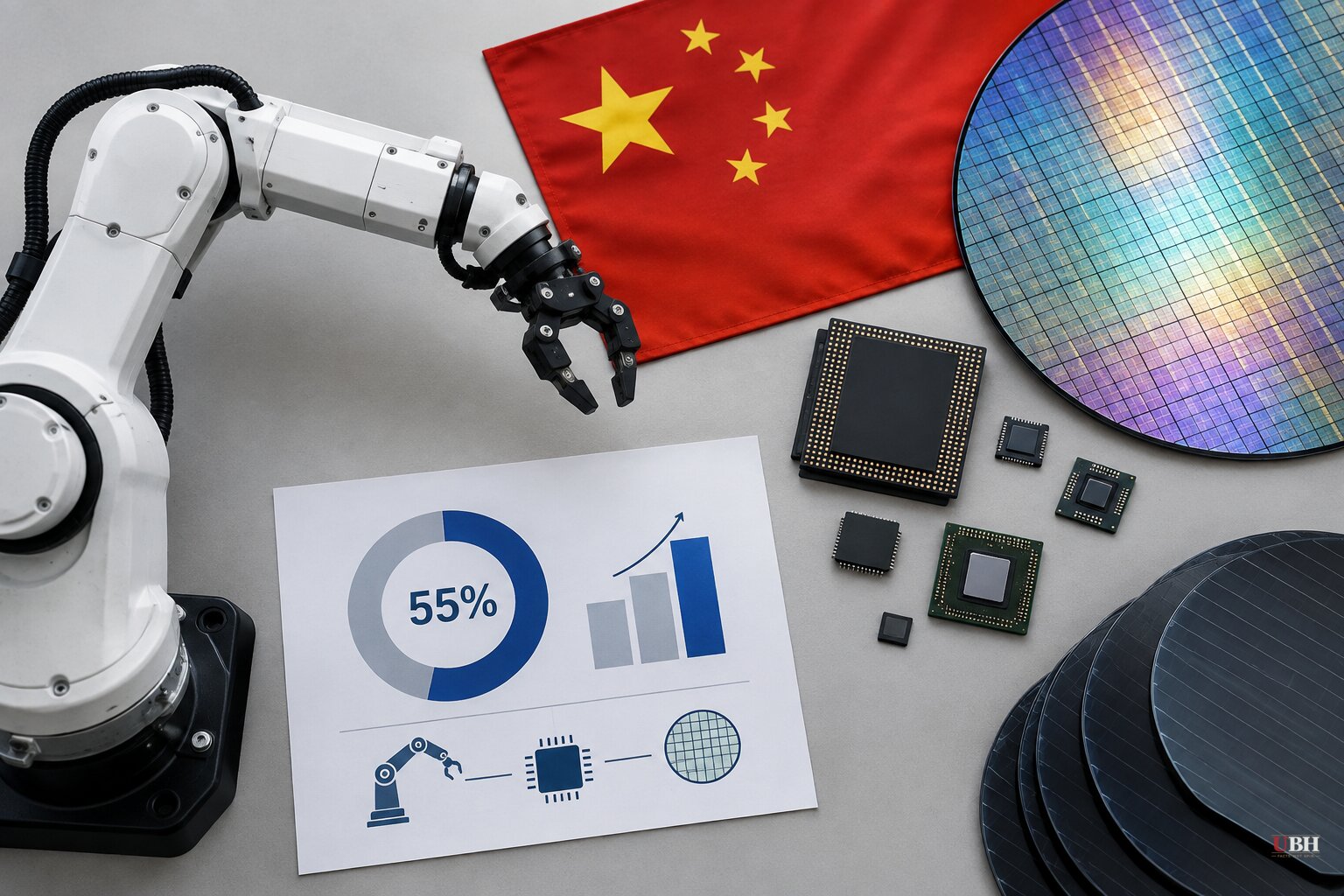
China's factories installed more robots built by Chinese companies than by foreign ones for the first time on record, according to the International Federation of Robotics' World Robotics 2026 report, released this week. Chinese domestic suppliers put 195,000 units into their own home market in 2025, a 15 percent jump that gave them 55 percent of the Chinese market, according to the IFR. Five years ago that share was around 30 percent, per the report.
The bigger number is global. Factories worldwide installed a record 603,000 industrial robots in 2025, up 11 percent year-on-year, according to IFR data reported by Tech Times. China alone accounted for 354,000 of them, or 59 percent of the entire world total, with Chinese installations growing 20 percent in a single year. For comparison, the entire European Union installed 60,500 robots in 2025, down 11 percent from 2024, according to the same report. IFR President Marina Bill summed it up plainly: "The strongest growth is taking place in Asia, followed by Americas. Europe is moving ahead more slowly."
A Decade-Long Plan, Not an Accident
The IFR itself ties this to policy, not luck. China's 13th Five-Year Plan, running 2016 to 2020, first made robotics a national priority, according to the report. The 15th Five-Year Plan, launched in 2026, goes further, directing Chinese AI research at physical applications with robots as a primary growth driver, Tech Times reported.
Washington is already pushing back on one narrow front. As the IFR numbers landed, the Federal Communications Commission was roughly two months into blocking new Chinese humanoid and quadruped robot imports on national security grounds, according to Tech Times. That ban does not touch the industrial arms and automated guided vehicles that make up the bulk of China's 354,000-unit deployment.
The Same Script on Chips
Beijing is running a parallel effort on semiconductors. Nvidia's share of China's roughly $90 billion AI chip market has fallen from near-total dominance to about 55 percent, according to a Reuters review of IDC market data cited by The Epoch Times. Chinese chipmakers Shanghai Enflame Technology, Moore Threads, Montage Technology and Biren Technology, alongside Huawei, are building computing platforms meant to replace Nvidia products. Enflame, which has Tencent as an investor, is seeking to raise about $900 million through a planned Shanghai IPO, per The Epoch Times.
An unnamed Chinese political analyst told The Epoch Times that Beijing's chip self-sufficiency push amounts to a "Great Leap Forward-style false prosperity," arguing that state subsidies inflate sales figures without building real competitiveness and could ultimately drive China toward "technological isolation." That's one analyst's characterization, not an established fact, and it cuts against the raw installation and market-share numbers showing real Chinese gains. Global Times, a Chinese state outlet, reported on September 8 that China's semiconductor exports surged 103.9 percent from January through August 2026. Whether that figure holds up is genuinely unresolved. The Epoch Times noted that "due to Chinese authorities' past record of manipulating data, it is difficult to assess the veracity of that figure."
Silicon Carbide Follows the Same Pattern
The clearest test case may be silicon carbide, the wide-bandgap material used in EV inverters, grid equipment and AI data-center power systems. China controls about 45 percent of global abrasive-grade SiC production capacity and roughly 85 percent of silicon-metal feedstock capacity, according to U.S. Geological Survey data cited by Rare Earth Exchanges. Chinese firms are moving downstream into semiconductor-grade wafers. Shanghai-listed SICC Co. says Fuji Keizai data puts its share of global N-type SiC substrates at 27.6 percent in 2025, ahead of U.S.-based Wolfspeed, with competitor TankeBlue also scaling up.
Hong Kong-listed, PRC-incorporated Epiworld International just secured an order worth up to $95.8 million from an unnamed "publicly traded global leader" in silicon carbide, for delivery by December 31, 2026, according to a company filing reported by TipRanks. That deal shows Chinese wafer producers are already embedded in global supply chains, not walled off from them.
Washington's counter is money, not just bans. SK Siltron CSS is expanding SiC wafer production in Michigan with a $544 million Department of Energy loan, and Bosch is spending roughly $1.9 billion to convert its Roseville, California facility for 200mm SiC devices, according to Rare Earth Exchanges. Critics of industrial policy on either side of the aisle might note the irony: a $544 million government loan and a government-encouraged $1.9 billion conversion look a lot like the same state-directed capital allocation American officials criticize Beijing for using. Both governments are picking winners in a sector each has declared strategically vital.
Rare Earth Exchanges also flags a subtler risk than an outright supply cutoff: Chinese overcapacity and lower production costs could compress wafer prices enough to bankrupt Western producers before any deliberate embargo happens. The Department of Energy notes SiC boule growth is energy-intensive, takes weeks, and suffers real yield losses, meaning the barrier is manufacturing difficulty, not scarce raw material.
The FCC's robot import ban currently covers only humanoid and quadruped machines. Whether Washington extends restrictions to the industrial robots, chips, or SiC wafers that make up the overwhelming majority of what China is now installing and shipping is an open question that neither the FCC's order nor the IFR report answers.
Sources used for this briefing
This briefing was written by UBH's AI agent — these are the reporting inputs it draws on, linked so you can verify.


