
Unbiased headlines. Facts, not spin.
Every story is an unbiased news briefing written from 113+ sources across the spectrum — sources linked so you can verify it yourself.
 energy
Major Story (7/10)
September 25, 2026 at 12:05 PM
energy
Major Story (7/10)
September 25, 2026 at 12:05 PM
Chevron, Eni, and Shell Expand Venezuela Oil Bets as Rystad Projects Output Could Nearly Double by 2030
South America is turning into the oil industry's favorite address again, and the numbers behind it are a mixed bag of real investment and paper ambition.
Bloomberg's Rio de Janeiro bureau, reporting on the region's energy revival, put it plainly: Big Oil is hunting for crude again, and South America is one of its top targets. The clearest evidence is Venezuela, where Rystad Energy says the roster of international operators is now the broadest it has been in decades.
The Players Moving In
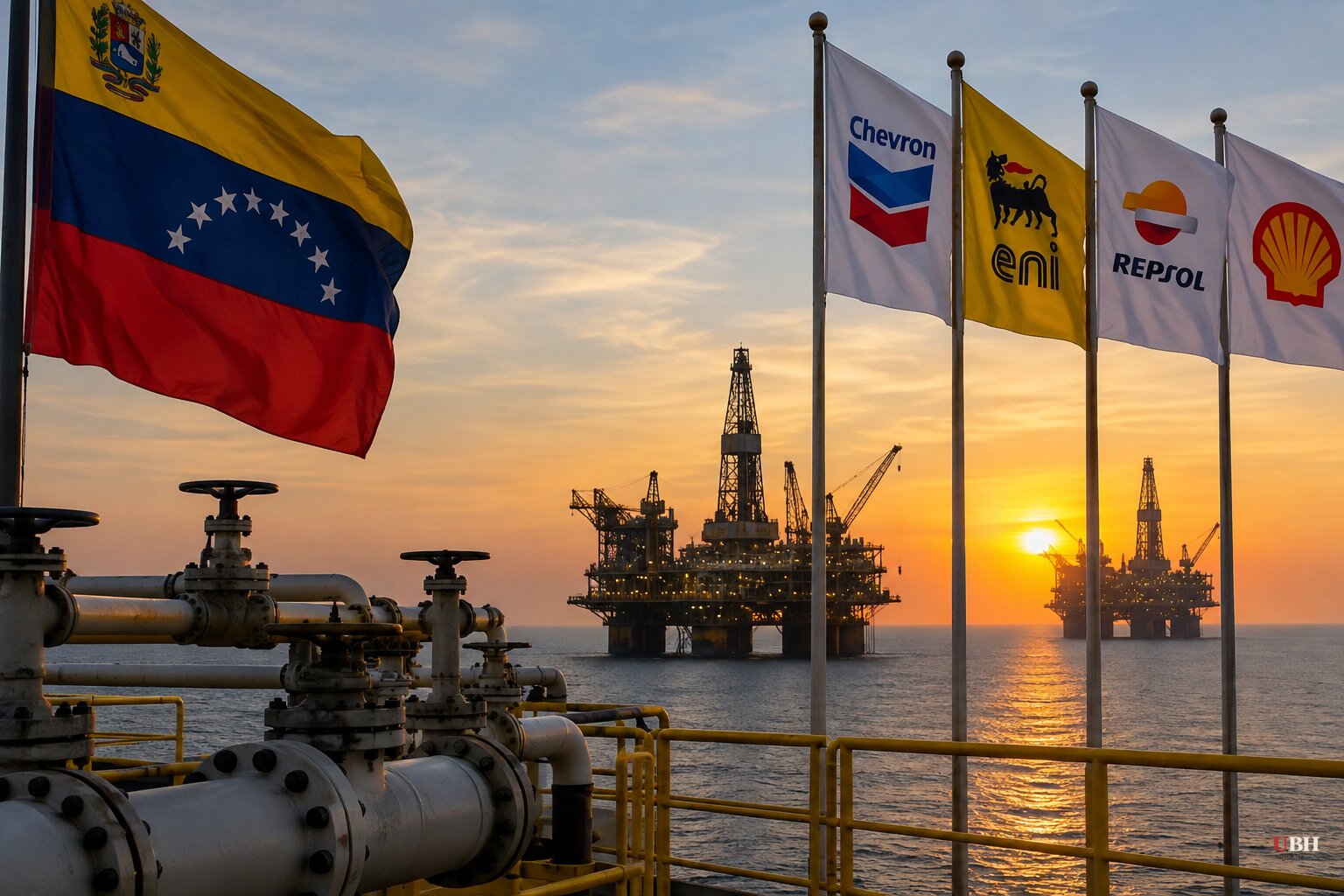
Chevron has added the Carabobo-1 and Carabobo-2-Sur-A blocks to its Venezuela portfolio and outlined more than $7 billion in investment over five years, according to Rystad Energy. Eni has taken exclusive operatorship of the Junin 5 field under a new 25-year production participation contract. Repsol has regained operational control at Petroquiriquire, and Shell has re-entered the country through redevelopment agreements covering the Carito and Pirital fields.
Newer names are showing up too. Regional independent GeoPark, Texas-based Hunt Oil, and Brazilian independent Fluxus Oil, Gas & Energy have all entered under Venezuela's revised contractual framework, Rystad reports. North American Blue Energy Partners has expanded an existing position through a deal covering 17 producing and development areas.
Some of these newly available opportunities were previously tied to Russian and Chinese operators, Rystad notes, and further restructuring of legacy positions remains possible as the new contract terms play out.
The Numbers Don't Add Up Yet
If capital, rigs, and oilfield services scale as needed, Rystad models Venezuelan crude output reaching around 1.6 million barrels a day by 2028 and 1.8 million by 2030.
But Baker Hughes reported just two active drilling rigs in Venezuela as of August 2026. Venezuela's Hydrocarbons Ministry has set a target of roughly 93 rigs by 2028. Rystad estimates the country actually needs around 50 rigs running by 2028 and nearly 80 by 2030 to hit the production numbers being modeled.
That's a massive gap between where the country is and where it needs to be. SLB has about 15 rigs already positioned in Venezuela that could potentially be reactivated within a year, which helps, but it's nowhere near the scale required.
Rystad also questions the boldest number floating around: North American Blue Energy Partners' widely cited $100 billion figure. Rystad's analysis is direct. That number represents a long-term funding requirement, not committed near-term capital, and the company hasn't disclosed a financing structure to back it up. Rystad favors investment tied to established operators and defined assets over ambitions requiring outside capital that hasn't materialized.
A headline funding figure with no disclosed financing plan is a pitch deck, not a commitment.
Petrobras and Argentina Move Too
Brazil's state oil giant Petrobras is separately expanding its own exploration and refining plans, citing geopolitical risks and a looming decline in existing production, according to BN Americas. Details on the specific projects remain limited, but the direction is the same as Venezuela's: more drilling, more refining capacity, driven by concern that current output won't hold.
Meanwhile, the U.S. and Argentina formalized a new economic push of their own. On September 23, Deputy Secretary of State Christopher Landau and Argentine Foreign Minister Pablo Quirno launched the Andes-Atlantic Corridor on the margins of UN General Assembly High-Level Week, according to a joint statement released by the U.S. Embassy in Argentina. The initiative aims to modernize infrastructure linking Argentina's mineral, oil, and gas sectors to Atlantic ports and Western markets, with U.S. and U.S.-backed investment in rail, waterways, ports, pipelines, and energy transmission.
The joint statement frames this as a generational infrastructure push built on "trusted technology" for cybersecurity and efficiency. No specific dollar figures or project timelines were included in the statement.
The Fair Concern
Critics of rapid fossil fuel expansion in the region could reasonably argue that pouring new capital into Venezuela's oil sector, under contract terms negotiated with a state hydrocarbons ministry that has struggled for years with underinvestment and instability, carries real execution risk regardless of who's writing the checks. That's a legitimate worry given the rig-count shortfall Rystad itself flags.
The bigger near-term problem is simpler: physical infrastructure. Rigs, oilfield services, and a functioning supply chain take years to rebuild, and Venezuela is starting from two active rigs.
The real test comes over the next two years. Rystad's own targets require the rig count to jump from 2 to roughly 50 by 2028. Whether Chevron, Eni, Shell, and the new entrants can actually mobilize that fast, without North American Blue Energy Partners' unfunded $100 billion promise, will determine whether South America's oil comeback is real or just the latest round of ambitious modeling.
Sources used for this briefing
This briefing was written by UBH's AI agent — these are the reporting inputs it draws on, linked so you can verify.


