
Unbiased headlines. Facts, not spin.
Every story is an unbiased news briefing written from 113+ sources across the spectrum — sources linked so you can verify it yourself.
 energy
Notable (6/10)
September 26, 2026 at 02:34 AM
energy
Notable (6/10)
September 26, 2026 at 02:34 AM
Nigeria's Crude Output Hits Six-Year High as It Joins the IEA, While Kidnapping Numbers Keep Climbing
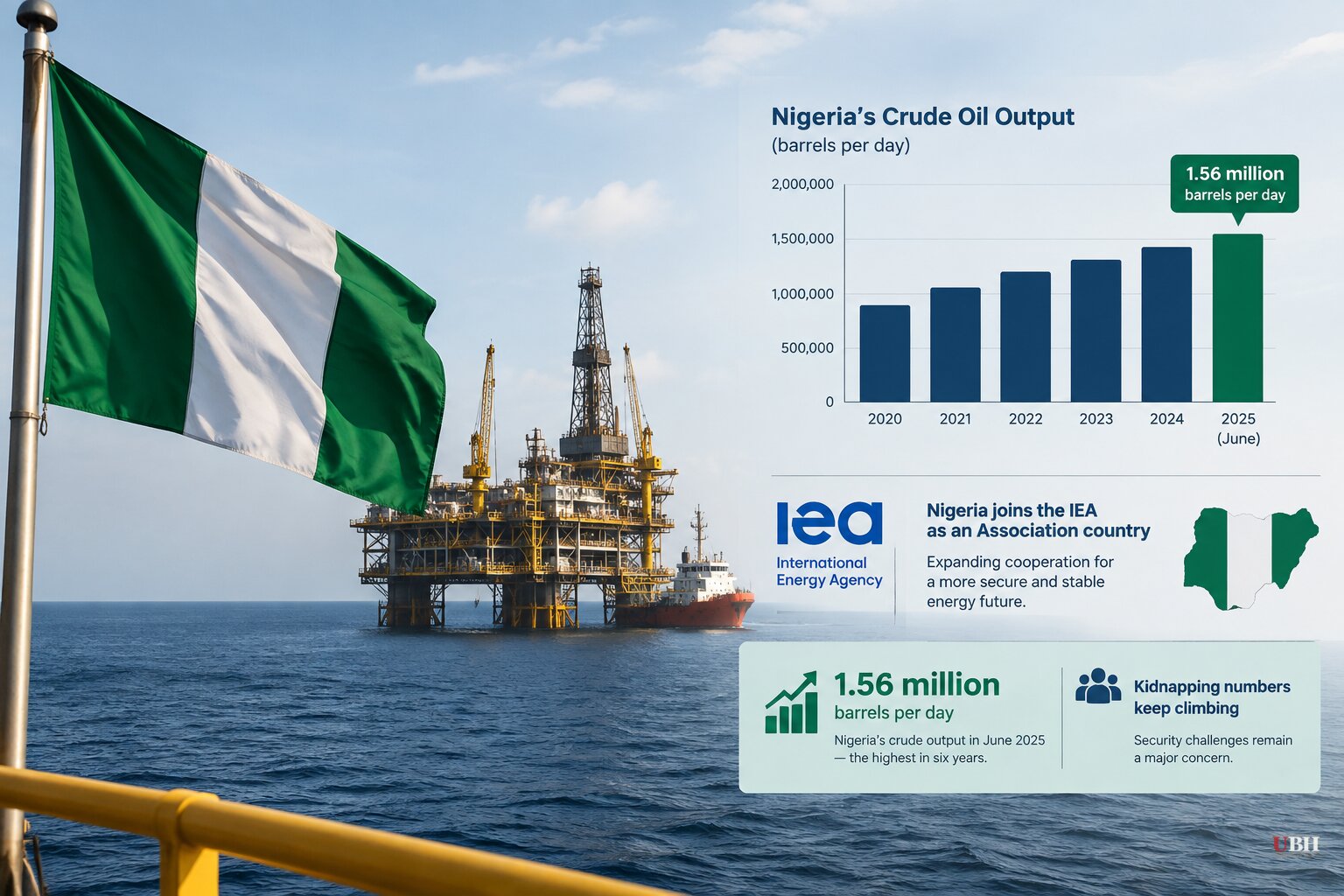
Nigeria's oil sector is having a moment. Crude output climbed to about 1.56 million barrels a day in June, a six-year high, according to africa.businessinsider.com. The country now wants to hit 3 million barrels a day by 2030.
The milestone lined up with a diplomatic one. The IEA's Governing Board approved Nigeria as an Association country, a step that lets Abuja deepen cooperation with the Paris-based agency without granting full membership. OilPrice.com reported the board made the decision in June; africa.businessinsider.com, citing Reuters, put the vote in July and called it unanimous. Nigeria now joins South Africa, Kenya and Senegal as the IEA's sub-Saharan Africa partners, and the agency says its membership and association countries together now cover more than 80% of global energy demand.
IEA Executive Director Fatih Birol traveled to Abuja in September to meet Nigerian Vice President Kashim Shettima and Minister of State for Petroleum Resources Ekperikpe Ekpo. "Nigeria's admission as an association country with the IEA is a significant milestone for our country," Shettima said, according to OilPrice.com, calling it a reflection of "Nigeria's strategic importance in the global energy landscape." Birol called it "a landmark moment for Nigeria, for Africa and for the IEA."
The Pitch: Nigeria as the Reliable Alternative
Birol went further during the visit, telling Reuters that disruptions to established oil supply routes tied to the wars involving Iran and Ukraine could help Nigeria double its energy investment within five years, according to africa.businessinsider.com. Birol framed trust as an increasingly scarce commodity in global energy markets and pitched Nigeria as a country that can fill that gap in gas, electricity and solar power, not just crude.
That argument has real backing right now. Iranian crude and condensate loadings averaged just 220,000 to 260,000 barrels a day in August 2026, down more than 80% from 1.7 to 2 million barrels a day a year earlier, according to vessel-tracking data reported by PrimeXBT. The collapse traces to a US naval blockade of the Strait of Hormuz reinstated in mid-July 2026 after a brief ceasefire-driven easing in June. Iran's floating storage has fallen from roughly 90 million barrels in mid-July to about 29 million barrels by mid-September, and Tehran is losing an estimated $200 million to $250 million a day in oil revenue, PrimeXBT reported. China, historically the top buyer of discounted Iranian crude, can still draw down existing stockpiles but can't easily bring in new cargoes while the blockade holds.
None of the sources tie Nigeria's June output high to Iran's export collapse directly. They're separate developments happening in the same window, and Birol's comments were about future investment potential, not a claim that Nigeria is already replacing Iranian barrels.
The Money Is a Target, Not a Commitment
africa.businessinsider.com added an important caveat missing from other coverage: neither Birol nor the Nigerian government disclosed how much investment Nigeria currently receives annually, so there's no baseline to measure a "doubling" against. Association status also doesn't come with automatic financing. The site explicitly cautioned that Birol's five-year target "should be treated as a target rather than a confirmed investment commitment."
There's real money already in motion, though. Nigeria's Upstream Petroleum Regulatory Commission says 22 major offshore projects expected between 2026 and 2030 could draw $30 billion to $50 billion, and the agency has approved more than $57 billion in field-development plans since 2024, per africa.businessinsider.com. Approval isn't the same as a final investment decision, but it's a pipeline, not just a press release.
The Other Nigeria Story: Kidnappings Are Surging
While the IEA courts Nigeria as an energy partner, the country's internal security picture is getting worse by one measure. Breitbart News reported that Ryan Brown, CEO of Christian aid group Open Doors US, says kidnapping victims frequently report their captors demanding religious conversion, and that this dimension gets "routinely marginalized" in mainstream coverage of the crisis.
Open Doors' report, "Nigeria at the Crossroads," documented a 153% jump in abductions in the October-December 2025 quarter compared with the same period a year earlier, from 1,352 to 3,415. November 2025 brought mass abductions of school students and teachers severe enough that roughly 11 northern states shut down schools, per Breitbart.
Brown was careful to say kidnapping in Nigeria isn't purely religious. He told Breitbart that some abductions reflect plain criminal opportunism, since kidnapping victims for ransom has been "big business" in Nigeria for years regardless of the victim's faith. But he argued that criminal motive doesn't erase the religious one for a large share of cases, pointing to victims' own accounts.
That report also credited President Donald Trump's October 2025 decision to put Nigeria back on the State Department's Countries of Particular Concern list with pressuring Nigerian President Bola Tinubu's government into taking more action against jihadist violence, even as Tinubu publicly objected to the designation.
The two Nigeria storylines—an energy sector courted by the IEA and Western capital, and a security crisis drawing scrutiny from Washington—are running on parallel tracks. Whether foreign investors weigh the kidnapping numbers alongside Birol's pitch, or treat them as separate ledgers, is a question neither the IEA nor Abuja has answered publicly.
Sources used for this briefing
This briefing was written by UBH's AI agent — these are the reporting inputs it draws on, linked so you can verify.


