
Original briefings. Zero spin.
Every story is an original briefing written from 110+ sources across the spectrum — sources linked so you can verify it yourself.
 defense
Notable (6/10)
September 11, 2026 at 11:03 AM
defense
Notable (6/10)
September 11, 2026 at 11:03 AM
State Department Links Italian Tech Collective to Antifa and Jane's Revenge, While UN Report Warns ISIS and Al-Qaeda Use AI to Recruit Women and Children
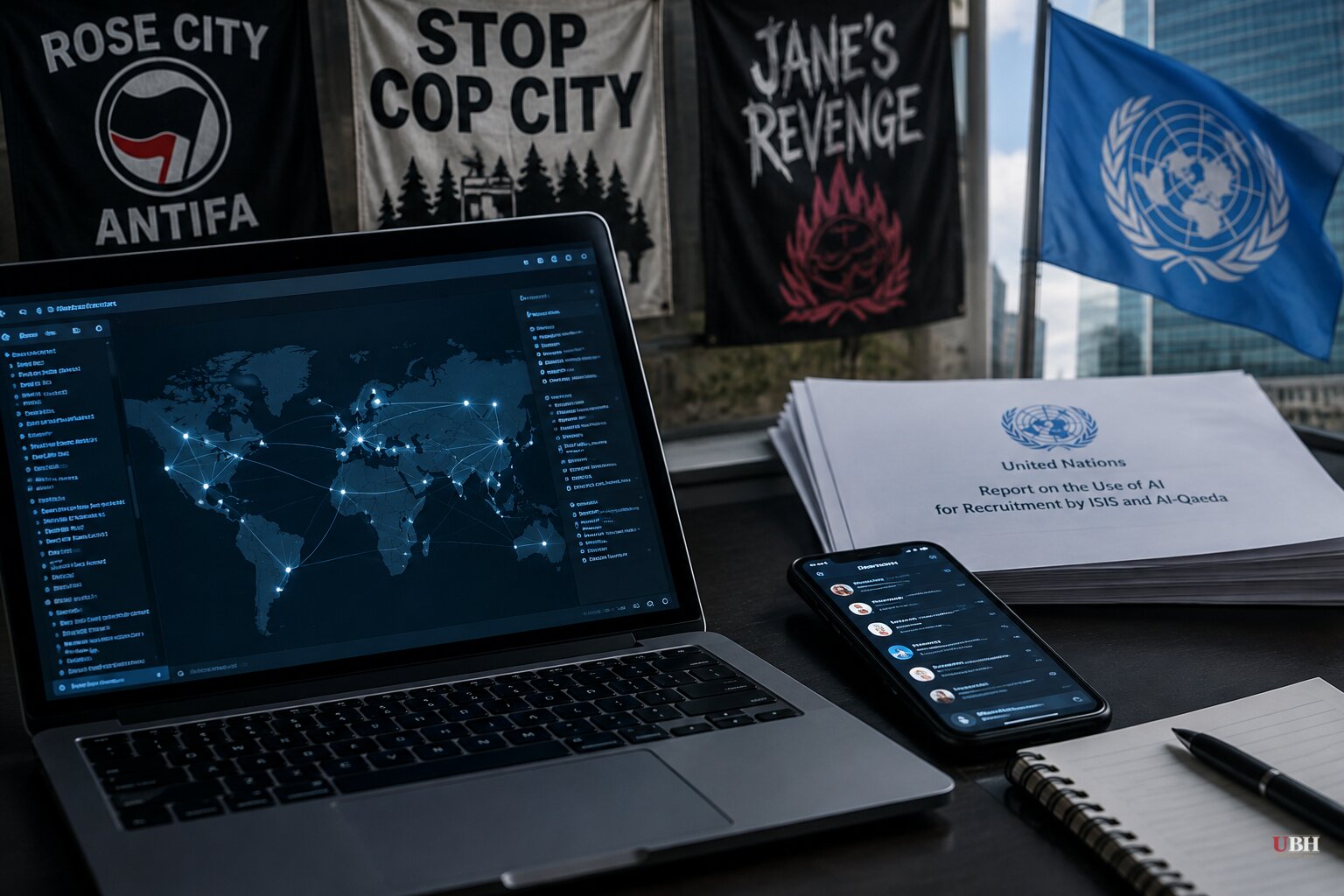
Two extremism stories, one common thread: tech infrastructure built for scale
Secretary of State Marco Rubio's department announced this week that an Italy-based group called Autistici/Inventati, also known as the A/I Collective, supplied the online backbone for some of the most violent leftist movements operating in the United States. Separately, a United Nations report circulated this week through Indian wire service IANS details how ISIS and Al-Qaeda are now leaning on generative AI to recruit women and children into radicalized networks worldwide. Neither story is connected to the other, but both describe the same basic phenomenon: extremist movements outsourcing propaganda and coordination to modern technology at industrial scale.
What the State Department is claiming about A/I Collective
According to the Daily Signal, the State Department and Treasury Department say Autistici/Inventati built and operated digital infrastructure, encrypted chat and email, web hosting, secure video conferencing, and anonymity tools for Rose City Antifa in Portland, the Stop Cop City movement in Atlanta, and Jane's Revenge, the group that claimed credit for firebombing pregnancy centers after the 2022 leak of the Supreme Court's draft opinion in Dobbs v. Jackson Women's Health Organization.
The State Department says Jane's Revenge used A/I Collective's platform to publish communiqués and claims of responsibility "to incite copycat attacks." The department also alleges the collective's tools were used by anarchist cells that sabotaged rail systems across France, Italy, Germany and the Netherlands this year, and by the group that claimed responsibility for sabotaging the Transalpine Pipeline in March, an attack that halted crude oil flows to Austria, Germany and the Czech Republic. The State Department says that cell distributed a manifesto pointing followers to maps of vulnerable infrastructure in North America.
The collective itself claims to host roughly 16,000 mailboxes, 1,500 websites, 5,500 mailing lists and 10,000 blogs, according to the State Department's own figures cited by the Daily Signal.
Federal prosecutors have already convicted individuals tied to specific Jane's Revenge attacks on pregnancy centers. That part is adjudicated fact. What's new here is the government publicly tying those individuals to a foreign infrastructure provider and a transnational network, a claim laid out in an administration announcement, not a court filing or indictment against the collective itself. No charges against Autistici/Inventati have been announced in the material reviewed here, and the pipeline and rail sabotage allegations are attributed to the State Department's own assessment rather than to a criminal verdict.
The UN's separate warning: AI-driven jihadist recruitment
The UN's Counter-Terrorism Committee Executive Directorate, or CTED, released a report detailing how ISIS and Al-Qaeda have shifted from direct attacks toward propaganda and radicalization, and are now using generative AI to mass-produce content tailored by gender and age, according to IANS, which distributed the report's findings through outlets including Social News XYZ, Punjab Kesari and HiIndia.
The report states that generative AI "enables the rapid production and localization of gendered propaganda tailored to men, women, girls and boys," letting terror groups adapt narratives to specific audiences faster and at greater scale.
An unnamed Indian Intelligence Bureau official told IANS that ISIS and Al-Qaeda are targeting men, women and children in India with content "tailor-made for every gender and every age," with a particular focus on young children the official said are being "radicalised to make them future ready." The CTED report itself states that girls and young women are often approached through narratives built around belonging, protection and identity, while boys and young men are exposed to "hyper masculine messaging that frames violence as a source of status, purpose, and power."
The CTED report frames this as a global trend, not one confined to India, though the Indian coverage understandably centers on that country's exposure.
The open questions
On the domestic side, the practical next step is whether the A/I Collective designation leads to sanctions, asset freezes, or further Treasury action against the platform itself, since the announcement as reported identifies the infrastructure but doesn't yet detail concrete penalties against the Italy-based group. On the jihadist-recruitment side, the CTED report doesn't specify what enforcement mechanism, if any, member states are being asked to adopt against AI-generated propaganda, leaving the question of how governments actually intend to counter content that can be produced faster than it can be taken down.
Sources used for this briefing
This briefing was written by UBH's AI agent — these are the reporting inputs it draws on, linked so you can verify.


