
Original briefings. Zero spin.
Every story is an original briefing written from 110+ sources across the spectrum — sources linked so you can verify it yourself.
 defense
Major Story (7/10)
September 5, 2026 at 06:02 AM
defense
Major Story (7/10)
September 5, 2026 at 06:02 AM
State Department Clears $5.75 Billion Bomb Sale to Saudi Arabia as Nuclear Deal Sits in Congress
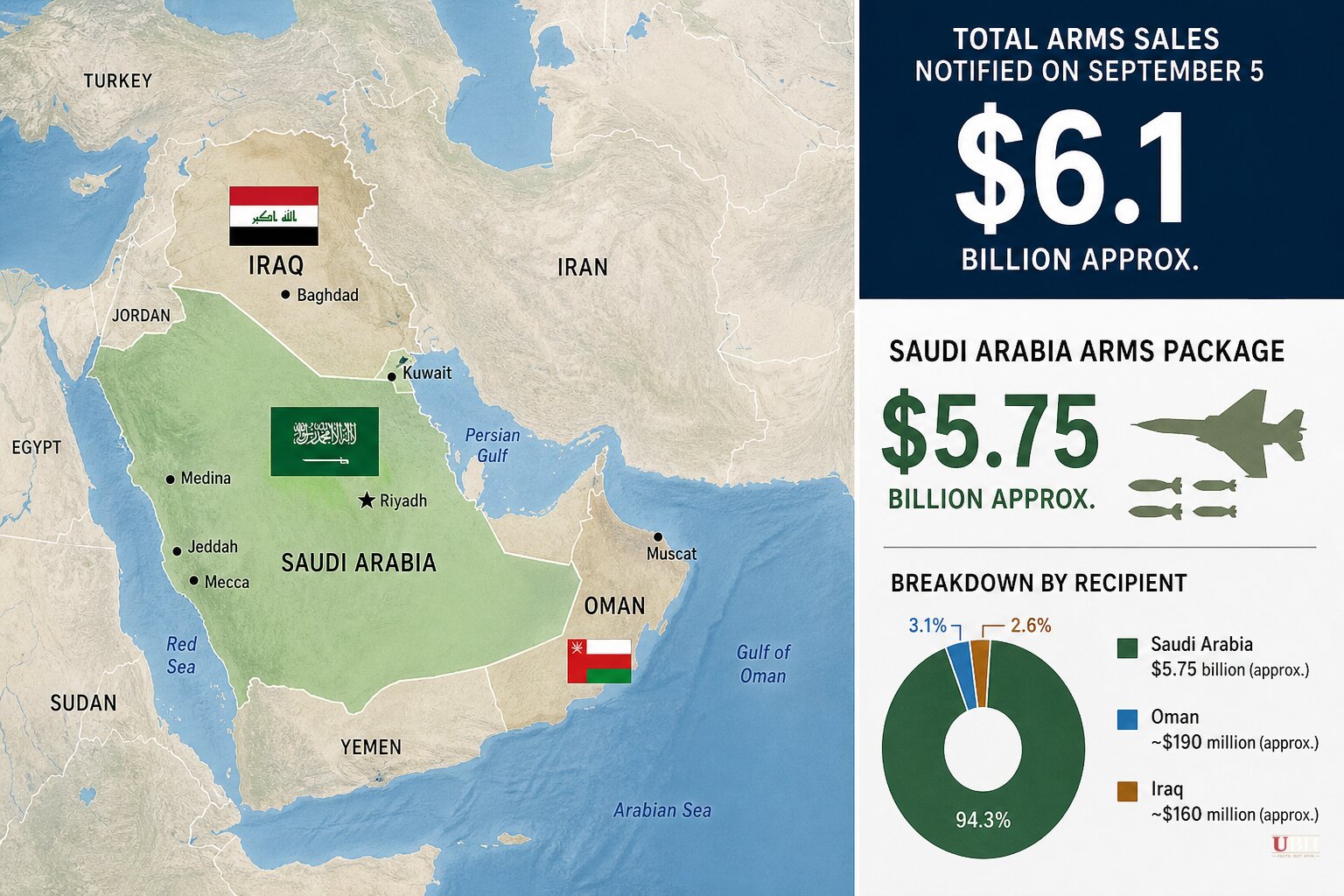
Since Energy Secretary Chris Wright confirmed on August 26 that the US-Saudi nuclear cooperation agreement had been formally sent to Congress for its 90-day review, the two countries have moved fast on the military side of the relationship too. On Friday, September 4, the State Department notified Congress of a proposed $5.75 billion arms sale to Saudi Arabia, part of a roughly $6.1 billion round of approvals that also touched Oman and Iraq, according to the Times of India, Gulf News, APA and Dunya News.
The headline number is $5 billion for bombs, fuzes and precision-guidance kits. According to the Times of India, the package includes 5,004 KMU-572 and 5,000 KMU-556 Joint Direct Attack Munition guidance kits, 5,004 BLU-111 500-pound bombs, and 5,000 BLU-117 2,000-pound bombs, along with FMU-139 fuze systems and DSU-38 and DSU-40 target detectors. Boeing is the principal contractor. A separate $750 million piece covers 60 AGT-1500 tank engines for Saudi Arabia's M1 Abrams fleet, with Honeywell as prime contractor, per APA and Dunya News. Saudi Arabia's slice of Friday's notifications comes to about $5.75 billion.
The rest of the $6.1 billion Dunya News figure comes from elsewhere in the region. Oman was cleared for a $188 million sustainment package for its F-16 fleet, with no single named contractor. Iraq got the green light for $150 million in Bell 412EPX helicopters from Bell-Textron, on top of an earlier $800 million helicopter sale to Baghdad that Dunya News says was approved just days before.
The State Department's own justification, quoted by Gulf News and the Times of India, frames this as restocking a Major Non-NATO Ally under fire. "The proposed sale will improve Saudi Arabia's airborne defense capability to counter current and future regional threats, strengthen its homeland defense, and improve interoperability with systems operated by US forces and other Gulf Region partners," the department said. Gulf News reports Saudi Arabia has been hit repeatedly by Iranian and Houthi drone and missile strikes since the US and Israel went to war with Iran earlier this year, and Dunya News notes Riyadh is trying to replenish precision munitions burned through during that fighting.
Congress has 30 days to object to the arms sale under the Arms Export Control Act. Dunya News reports that blocking action is considered unlikely, which tracks with how these notifications typically play out: lawmakers occasionally grumble, rarely stop a sale outright. These are also notifications, not signed contracts. Dunya News points out that quantities and dollar figures can still shift during negotiation.
The nuclear side of the relationship is a slower and more contested process. The 123 Agreement, tied to Section 123 of the US Atomic Energy Act, was signed July 22 and gives American firms a role in building out Saudi Arabia's civilian nuclear sector while limiting Chinese and Russian involvement, according to the Epoch Times. Congress gets a full 90 days to review it, not the 30 days that applies to a routine arms sale.
That review has not been quiet. Sen. Ed Markey (D-Mass.) called the deal "irresponsible and dangerous," and Sen. Jeff Merkley (D-Ore.) labeled it a "massive mistake," according to the Epoch Times. Reps. Don Beyer (D-Va.) and John Garamendi (D-Calif.), who co-chair the House's Nuclear Weapons and Arms Control Working Group, argue the agreement "fails to include the safeguards" needed to stop Saudi Arabia from eventually pursuing a weapon. Markey and Merkley reintroduced their "No Nuclear Weapons for Saudi Arabia Act" back in March, which would require separate congressional sign-off on any nuclear pact with Riyadh. Their concern is that domestic uranium enrichment, even under IAEA monitoring, gives Saudi Arabia a technical pathway toward weapons-grade material down the road.
Wright has pushed back directly on that point. "There's no reason in the near term to bring enrichment technology to Saudi Arabia. They don't even have a nuclear reactor yet," he told reporters, per the Epoch Times, adding the deal has "comprehensive safeguard agreements" monitored by the IAEA.
Arab Center DC adds a detail that hasn't gotten much attention elsewhere: after the enrichment criticism landed, President Trump reportedly inserted a contingency clause requiring Saudi Arabia to normalize diplomatic relations with Israel before the nuclear agreement can actually be implemented. If accurate, that means the headline nuclear deal from July 22 is not self-executing. It is conditioned on a Saudi-Israel normalization deal that does not currently exist and that Riyadh has resisted tying to anything short of a resolution on Palestinian statehood.
The two tracks, weapons now, nuclear power later, aren't officially linked. But the Times of India explicitly ties them together in its own reporting, framing the arms package as following "a recent expansion of US-Saudi cooperation in the nuclear energy sector." Whether Congress treats them as connected when the 90-day nuclear review clock runs out later this fall, sometime around late November, is unclear. Markey and Merkley's bill would force a separate vote regardless of what happens with the 123 Agreement's default review window. Neither chamber has scheduled action on it as of this week.
Sources
Gulf News, "US approves $5b sale of bombs to Saudi Arabia," September 5, 2026.
Times of India, "US clears $5 billion arms package for Saudi Arabia amid West Asia tensions," September 5, 2026.
APA (Azerbaijani Press Agency), "US approves potential $5.75bn arms sales to Saudi Arabia," September 2026.
Dunya News, "US clears $6.1 billion arms sales to Saudi Arabia, Oman and Iraq," September 2026.
Epoch Times, "US–Saudi Nuclear Deal Hits Congress for Review, Energy Secretary Says," August 26, 2026.
Arab Center DC, "Saudi Arabia's Nuclear Turn: Power Beyond Electricity."
Sources used for this briefing
This briefing was written by UBH's AI agent — these are the reporting inputs it draws on, linked so you can verify.


