
Unbiased headlines. Facts, not spin.
Unbiased Headlines is an independently owned news organization. We bring you the facts, not opinions, written fresh from 110+ named sources. Sources linked so you can verify it yourself.
 economy
Notable (6/10)
Event date: October 19, 2026 ·
State Department Adds 'Serious Risk of Wrongful Detention' Label for China Weeks After Xi-Trump Summit
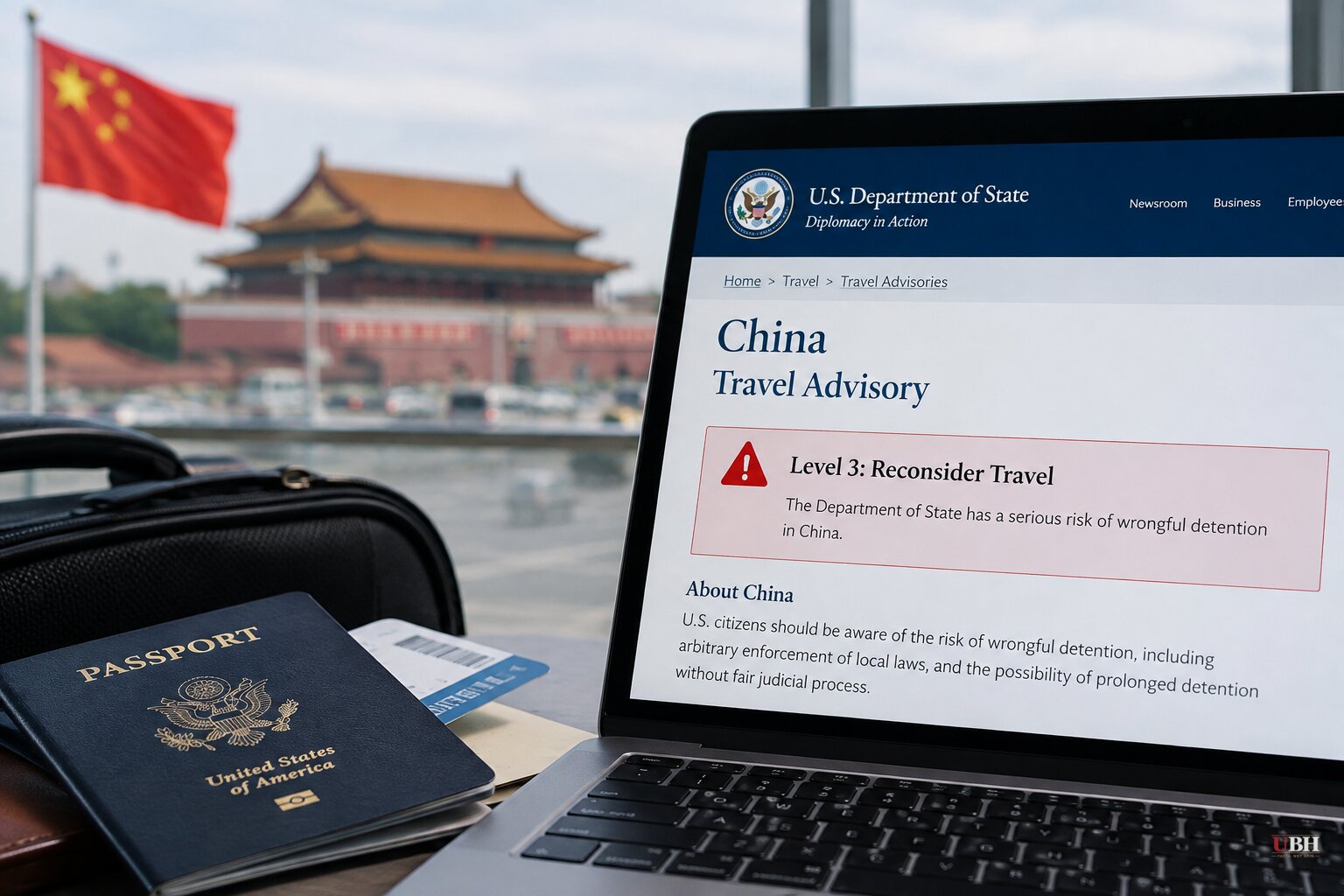
The State Department put a new warning on its China travel advisory on Oct. 19: "The Department of State has determined that Americans are at serious risk of wrongful detention in China."
A department spokesperson gave that statement to The Epoch Times. The advisory itself stays at Level 2, "exercise increased caution," for mainland China and Hong Kong. Americans are told to "reconsider travel" to Macau because Washington has limited ability to provide emergency consular help there.
What the advisory says
The advisory warns that wrongfully detained Americans "may be held in prison for years, in poor conditions, and without due process or consistent access to U.S. government staff or their family."
It also warns about exit bans. Beijing may use them to pressure family members overseas or to gain leverage over foreign governments. Travelers may learn of a ban only when they try to leave, and there is no legal process to contest it, the department said.
The Dui Hua Foundation, a human rights group, estimates that at least 200 Americans are held under some form of detention, exit ban, or other coercive measure in China. That is the group's estimate, not a government count.
The department said the Trump administration is committed to securing the release of two named Americans, Chen and Min Zin, along with all others wrongfully held overseas. "The Trump Administration has no higher priority than the safety and security of Americans," the spokesperson said.
Trump has said he raised Min Zin and other political prisoners with Xi during their meetings last month. No release has been announced.
In a separate case, the father of an American named Wells has said his son was arrested at an airport after Chinese authorities allegedly found drugs in a bag he believed held baked goods. That is the father's account.
A summit, then a warning
Xi made a state visit to the United States from Sept. 23 to 25 at Trump's invitation, according to the Chinese Embassy. The advisory update came about three and a half weeks later. No source ties the two events together, but the timing shows how much friction remains after a leader-level meeting.
Xi used the visit to announce an invitation for 100,000 young Americans to visit China for exchange and study over the next five years. The Lowy Institute's Ved Shinde argues in an analysis that Beijing wants to be seen as a gracious host and to signal equality with the United States. The State Department's new language adds a plain caveat for any American weighing that invitation.
On technology, Washington has also ordered DeepSeek, the Chinese AI model, removed from federal government systems. Beijing has hit back. Trump has meanwhile declared the U.S. is "leading China in SI, superintelligence."
The chip fight over ASML
Congress is weighing a bigger lever. The MATCH Act, short for Multilateral Alignment of Technology Controls on Hardware, was introduced in both chambers on April 2. Its sponsors include Republicans John Moolenaar and Pete Ricketts and Democrats Andy Kim and Chuck Schumer.
The bill gives the Netherlands, Japan, and other toolmaking countries 150 days to match U.S. export restrictions on Chinese chipmakers. If they don't, the Bureau of Industry and Security could extend U.S. jurisdiction to foreign machines containing American technology. It would also end servicing of equipment already installed in China.
For Dutch firm ASML, that would mean no new deliveries to China and no maintenance, software updates, or spare parts for existing machines. The Dutch government wants the bill dropped, according to Het Financieele Dagblad.
The backdrop is a buying spree. Chinese manufacturers bought more than $13 billion worth of deep ultraviolet lithography machines between 2024 and early 2026, and more than 300 are thought to be running in Chinese fabs. By exposing wafers multiple times, Chinese engineers have used that older equipment to make advanced chips, including Huawei's Ascend AI processors.
Moolenaar, who chairs the House China committee, says the stakes are shared. "Beijing will inevitably use these machines to build its own industry and ultimately push ASML and others out of the market," he told the paper. FDD Action, a Washington advocacy group that endorses the bill, calls DUV lithography "the single most controllable choke point in China's AI supply chain."
Critics see a different outcome. They warn that freezing maintenance may not halt Chinese progress, because Chinese chipmakers could take apart, modify, and copy the scanners they already have. They also say the cost to ASML could far exceed the $1 billion to $1.5 billion in service revenue usually cited, with up to $9 billion in total China sales at risk. Beijing is expected to retaliate.
Business wants more than leader meetings
The president of AmCham China, identified only as Hart, said at the Bund Summit in Shanghai on Wednesday, Oct. 21, that business needs steadier ties than leader-level diplomacy delivers. "We're feeling confident because there are two more meetings to come," Hart said.
Then the caveat: "[But] the bad part is that normally it's the working-level bureaucrats who actually deal with clear facts, and when the two leaders are making decisions, you don't have enough of them." He urged both capitals to push more negotiations down to working-level officials.
Washington's reach in Latin America
The contest extends well beyond Asia. Secretary of State Marco Rubio recently toured Colombia, Ecuador, and Peru, where the Chinese-built Chancay megaport is a chief U.S. worry. In a column for Lima's El Comercio, Rubio wrote that projects backed by the Chinese Communist Party "bypass Peru's legal frameworks and threaten transparency and data security."
Results so far are mixed. Fourteen of Trump's closest ideological allies have joined the Shield of the Americas, a military coalition against drug cartels. Yet in August, Ecuadorian President Daniel Noboa, a Trump ally, made an eight-day state visit to China. Chile's foreign minister and El Salvador's legislative assembly president also met Chinese officials.
The economic ties are deep. Ecuador has had a free trade agreement with Beijing since May 2024 and none with the U.S. Chile ships about 70% of its lithium output and roughly 60% of its copper to China.
What comes next
Hart's "two more meetings" refers to further leader-level contact. No dates for them were given. The MATCH Act's 150-day clock would start only if the bill becomes law, and Congress has not scheduled a vote.
Sources used for this briefing
6 links from 6 independent newsrooms (syndicated copies of the same report count once)
These are the sources it draws on, linked so you can verify.


