
Unbiased headlines. Facts, not spin.
Unbiased Headlines is an independently owned news organization. We bring you the facts, not opinions, written fresh from 110+ named sources. Sources linked so you can verify it yourself.
 economy
Major Story (8/10)
Event date: October 20, 2026 ·
French 10-Year Yield Touches 5%, Highest in 24 Years, With the 2027 Budget Still Unpassed
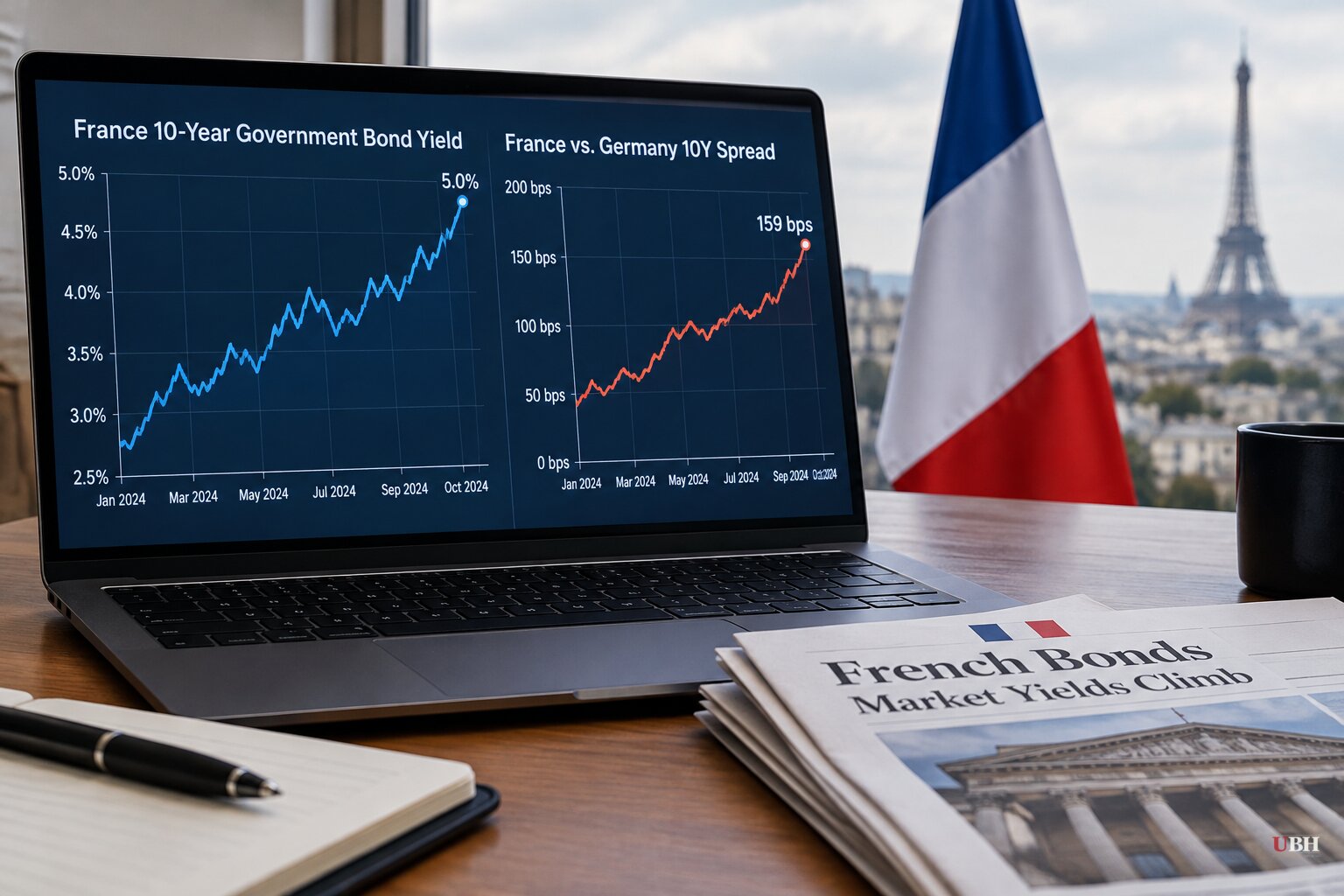
Since students began blocking schools in late September and the protests spread into riots over the cost of living, French borrowing costs have climbed in steps. The latest step is a round number: the yield on the 10-year OAT rose more than 8 basis points to 5% in morning trading, then eased to 4.99%. That is the first time it has hit 5% in 24 years.
On Oct. 21, French OATs paid 5.01% against 3.42% for the German Bund. That is a spread of 159 basis points, according to RSM chief economist Joe Brusuelas, who called it "highly unusual" for the world's seventh-largest economy with GDP of $3.6 trillion.
The bill is coming due
The numbers behind the move are not subtle. France's deficit was 5.1% of GDP in 2025 and its debt stood at 115.6%. Current estimates put debt around 119% of GDP this year, double the EU's target. The annual deficit is running at 5.4%.
Jake Scott, writing in The Epoch Times, put projected debt at 121.7% of GDP in 2027 and debt interest at 65 billion euros (about $73 billion), which he calls the largest single item of state spending. The economy contracted in the first quarter of 2026 and stagnated in the second.
At the Treasury's September auction, the 10-year cleared at 4.23%, against 3.45% in February, before fuel costs skyrocketed and the European Central Bank retreated from expected rate cuts and looked instead to rate rises.
The International Monetary Fund said last week that the average 10-year yield across G7 economies has risen more than 1 percentage point since February, to its highest in nearly 20 years. The IMF expects the group's combined public debt to exceed its combined economic output by the end of the decade, the first time since World War II. CNN ties the Iran war to the pressure on those yields.
So France is not alone. It is, however, where the pressure is showing up first and worst.
No rescue coming from Frankfurt
On Sept. 25, Bank of France Governor Emmanuel Moulin told the French Senate that France must do "everything possible to avoid a sovereign debt crisis" ahead of the 2027 presidential election. He added that it "would be misguided to expect the European Central Bank to ride to the rescue."
His reasoning was that ECB crisis mechanisms assume the government in trouble has acted first. The tools to close a deficit sit with governments and parliaments. Moulin described the squeeze as a "gradual stranglehold."
The Guardian reports that international lenders have become increasingly reticent about lending to Paris, with some, notably Japanese fund managers, withdrawing from lending to France. Those that remain have demanded a higher price for their loans, especially longer-period loans.
A budget that may not fix anything
No single party has had overall control of parliament since Macron called a snap election in 2024. That gridlock has blocked his plan to raise the pension age from 62 to 64, along with a series of measures designed to reduce or redirect state spending. The government has yet to pass its budget for next year.
Matthew Ryan, head of market strategy at Ebury, said it "remains unclear whether the 2027 budget will clear parliament, and even if it does, it seems set to be so riddled with concessions to both the left and the right that the deficit problem is left insufficiently addressed." He said the political risk premium in France is also dragging down the euro.
The government's room to respond to the street is just as thin. Eurasia Group head Mujtaba Rahman said on X that it is "difficult for the government to respond to the legitimate demands of students and others because it has no money." He added that it is "impossible to respond to demands of the violent minority because they have none except screw the system."
The unrest has been real. Protesters set fire to the town hall in Limoges, and stores such as Louis Vuitton have been hit by looting.
Is America next?
Brusuelas argues France is "likely a preview of coming attractions across the G-7 and potentially the United States." He says the cause is rising government debt "without the means or intention to pay it off," and expects higher inflation and interest rates, most likely followed by fiscal consolidation.
CNN's analysis argues the opposite on timing. It says similarities with the U.S. "can be superficial," that France's safety net is a much larger share of government spending, and that the United States "faces no imminent danger of becoming the next France." CNN also puts the U.S. public debt at $32 trillion, roughly equal to annual GDP, with a $2 trillion budget deficit for the year just closed.
Both agree on one point: the spending path is the problem, and voters resist every fix. Raising taxes and cutting spending are, in CNN's words, politically unpopular decisions that could risk further angering an already livid public.
Economists such as University of Kent professor Peter Taylor-Gooby warn that in Europe, people are "increasingly scared of the bond market." France's next test is whether a divided parliament can pass a 2027 budget that cuts the deficit enough to pull the 10-year yield back from 5%. Ebury's Ryan says it remains unclear whether the budget will clear parliament at all.
Sources used for this briefing
6 links from 6 independent newsrooms (syndicated copies of the same report count once)
These are the sources it draws on, linked so you can verify.


